dYdX Review 2026: Fees, Trading Features, and Security
On this page
On this page
Our verdict
dYdX provides a dedicated perpetual trading chain, a mobile app, staking and liquidity vaults. Margin, validator and vault risks remain relevant alongside trading costs.
| Stats | dYdX |
|---|---|
| Assets | |
| Futures contracts (crypto) | 72 |
| Commodities | 1 |
| Fees | |
| Spot fees (maker/taker) | 0.1% / 0.1% |
| Futures fees (maker/taker) | 0.01% / 0.05% |
| Trading | |
| 24h spot volume | $0 |
| 24h futures volume | $7,828,862 |
| Max leverage | 50× |
| CryptoWinRate score | 6.9/10 |
- dYdX is a decentralized perpetual exchange operating on its own Cosmos-based blockchain.
- Futures fees start at 0.01% maker and 0.05% taker, with volume-based discounts.
- dYdX supports 72 perpetual futures contracts with leverage and advanced order types.
- The mobile app supports trading, position management, and essential account functions.
- The dYdX token offers fee discounts, governance rights, and staking rewards paid in USDC.
Many traders view perpetual trading as a recent development, often associating its rise with platforms like Hyperliquid, where the niche gained mainstream attention. In reality, dYdX entered this space much earlier. Launched in 2017, dYdX was among the first decentralized platforms to offer margin trading and perpetual derivatives at scale. Over time, it built a reputation for advanced tools and a trader focused design. In this dYdX review, we sift through its services, features, fees, and limitations to help you assess the exchange better.
dYdX Overview
Perpetual trading is built around transparency, self-custody, and scalability, and dYdX was designed with those principles from the start. Founded in 2017 by former Coinbase engineer Antonio Juliano, dYdX set out to provide decentralized access to advanced trading tools that were traditionally limited to centralized exchanges. Instead of custodial accounts, the platform allows users to connect self-custody wallets such as MetaMask or Phantom, with no mandatory KYC requirements, although regional restrictions still apply. dYdX operates on its own independent blockchain, the dYdX Chain, which is built using the Cosmos SDK and runs on a Tendermint Proof-of-Stake consensus mechanism to support high-throughput perpetual trading.
Today, dYdX operates as an independent decentralized chain and supports multiple networks through bridging, allowing users to transfer assets like USDC and ETH from Ethereum and other EVM-compatible ecosystems. Deposits still depend on the selected bridge and its security model.
The platform reports more than 46K active traders and records daily trading volume exceeding $15.64 million. dYdX is also a major player in decentralized derivatives, with cumulative trading volume surpassing $1.55 trillion. The platform focuses entirely on perpetual trading and is available in more than 6 languages.
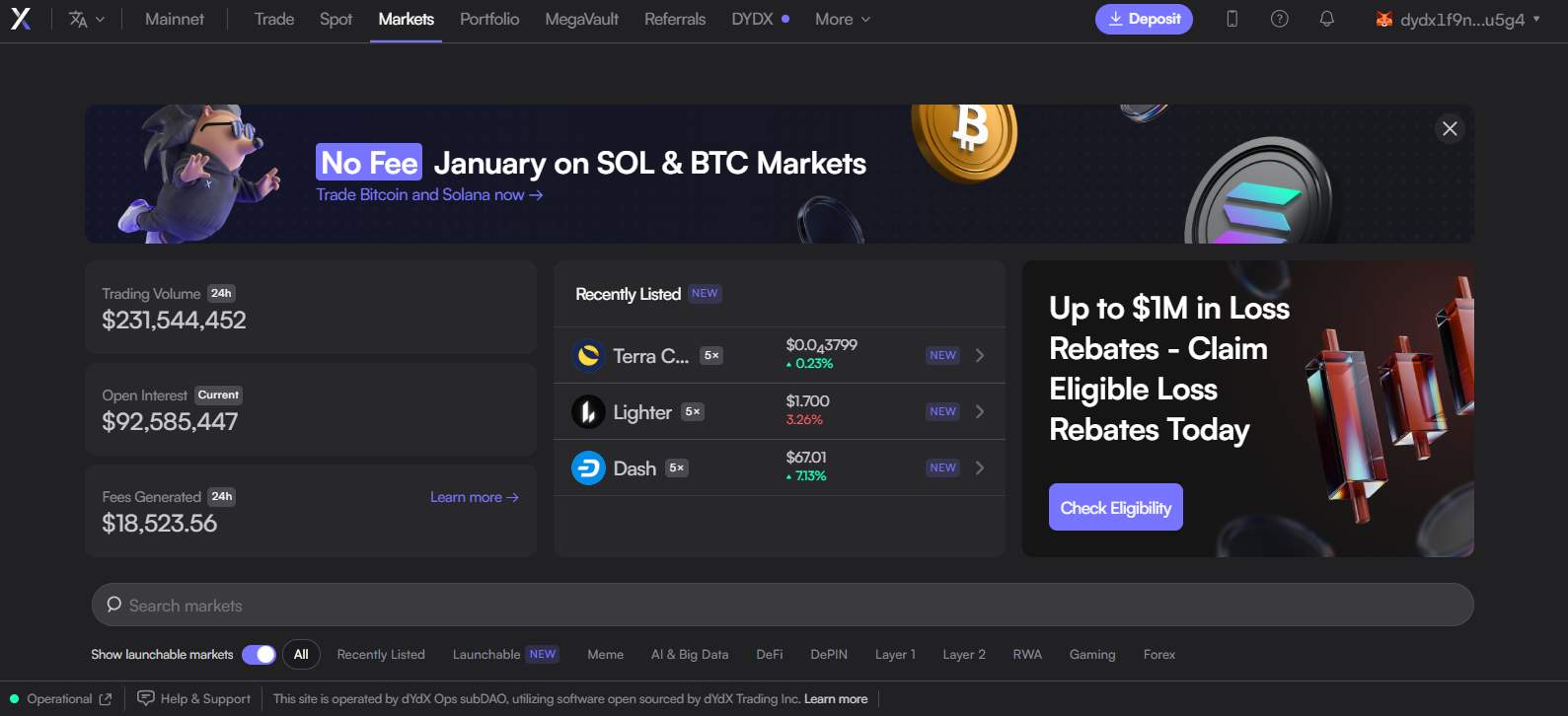
Traders can access 72 crypto perpetual markets with leverage of up to 50x. Futures trading fees are set at 0.01% for makers and 0.05% for takers. Beyond trading, dYdX provides additional features such as USDC liquidity deposits through MegaVault, with returns that depend on strategy performance and can be negative.
From a security standpoint, dYdX follows a rigorous audit process and has been reviewed by firms including OpenZeppelin, PeckShield, CertiK, and Certora. In 2023, the dYdX V3 protocol experienced a targeted price manipulation attack that resulted in approximately $9 million in losses at the protocol level. The incident was linked to a flaw in protocol logic rather than a wallet breach, and the team confirmed that user funds were not directly impacted. Since then, further safeguards and monitoring mechanisms have been implemented to reduce similar risks.
With the overview in place, the following sections examine dYdX’s features, risks, and usability in more detail.
dYdX Pros and Cons
What we like
- Fully decentralized, non-custodial trading platform
- No mandatory KYC for trading
- dYdX token offers trading fee discounts
- Beginner friendly interface for onchain trading
- MegaVault enables passive USDC participation
- Mobile trading supported with key trading functions
- Deep liquidity on major derivative markets
- Gasless on-chain execution on own blockchain
What holds it back
- Leverage lower than some competitors
- Unavailable in key markets like US, Canada
- Small selection of traditional-market contracts
dYdX Sign-up & KYC
dYdX operates as a decentralized trading platform, meaning users can access its services by connecting a Web3 wallet without completing traditional KYC procedures. There are no account forms, identity checks, or withdrawal limits tied to verification levels. Getting started takes only a few steps.
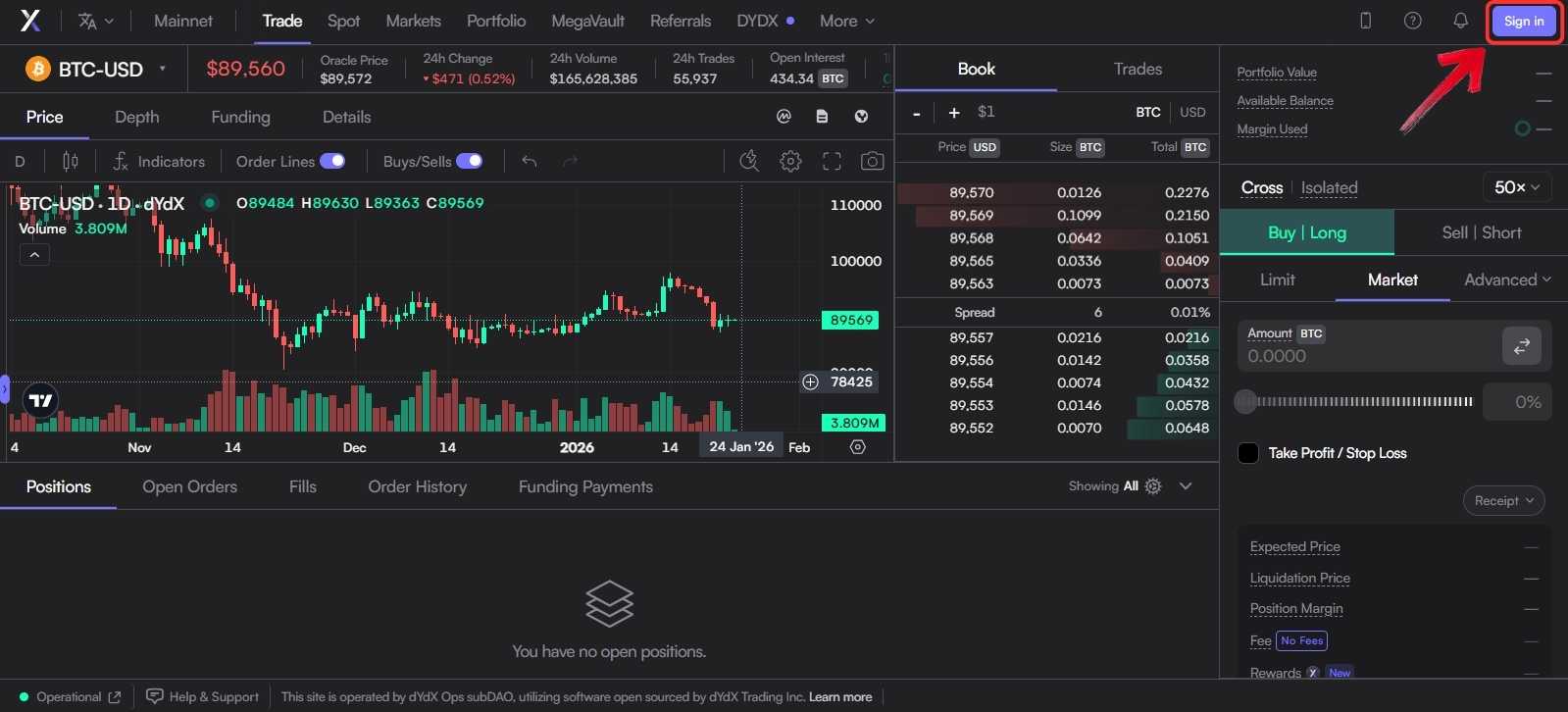
Step 1: Visit the official dYdX website and click on the “Sign In” option.
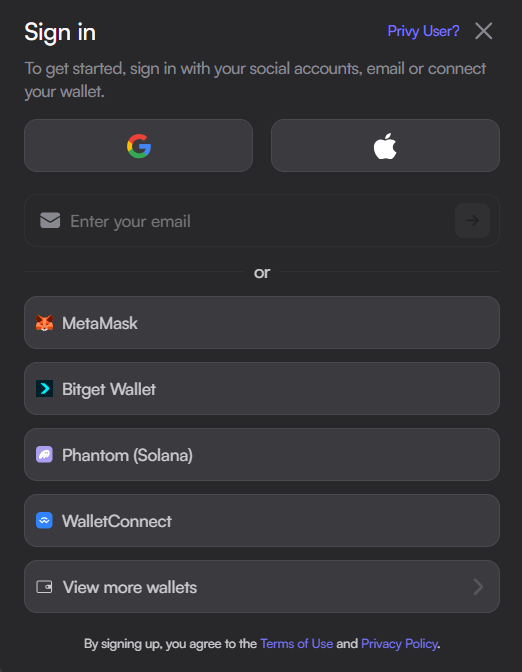
Step 2: Select a supported wallet such as MetaMask or Phantom. Approve the connection request from the wallet popup.
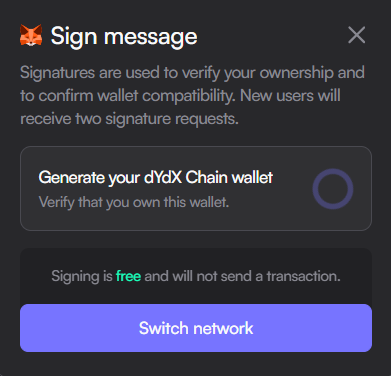
Step 3: After connecting, dYdX will prompt you to sign a message. This step confirms wallet ownership and does not involve any transaction or gas fee. Approve the request in your wallet.
Step 4: Deposit funds to begin trading. dYdX supports deposits in ETH and USDC.
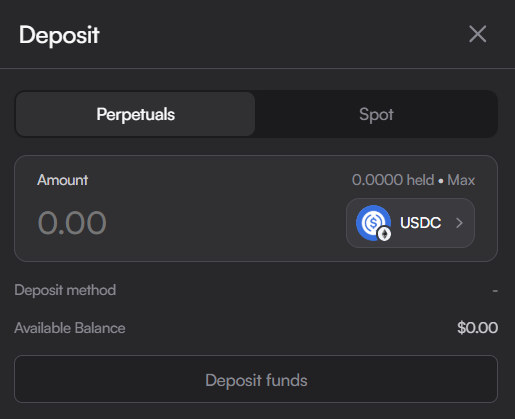
Once completed, your dYdX account is ready for trading, with full access to platform features and no custodial withdrawal restrictions commonly found on centralized exchanges. That said, while the platform remains technically accessible, certain regions may be restricted due to regulatory requirements. Users can check availability in their country using our dYdX country checker before trading.
Networks Supported
Currently, dYdX supports deposits through 6 networks: Ethereum, Polygon, Arbitrum, Base, Avalanche, and Optimism. Users can transfer only USDC or ETH through these supported networks to fund their dYdX account.
dYdX Supported Cryptocurrencies
dYdX lists 72 futures markets. Its native token is DYDX.
 ETH
ETH BTC
BTC SOL
SOL XRP
XRP SUI
SUI NEAR
NEAR HYPE
HYPE BNB
BNB ONDO
ONDO ALGO
ALGO ATOM
ATOM LINK
LINK ADA
ADA WLFI
WLFI DOT
DOT RENDER
 AAVE
AAVE FIL
FIL INJ
INJ PYTH
PYTH SEI
SEI APT
APT ASTER
ASTER POL
POL ICP
ICP PUMP
PUMP UNIWTI
 WLD
WLD DYDX
DYDX TIA
TIA ARB
ARB STRK
STRK DOGE
DOGE PEPE
PEPE PENGU
PENGU PAXG
PAXG TRUMP
TRUMP PENDLE
 XLM
XLM LTC
LTC CRV
CRV ZEC
ZEC ENA
ENA TAO
TAO HBAR
HBAR AVAX
AVAX OP
OP IMX
IMX XMR
XMR JUP
JUP BONK
BONK COMP
COMP ETC
ETC ATH
ATH LDO
LDO TRX
TRX CHZ
CHZ MON
MON BCH
BCH JTO
JTO RUNE
RUNE 1INCH
1INCH APE
APE BLUR
BLUR DYM
DYM EIGEN
EIGEN LIT
LIT ORDI
ORDI WIF
WIF ZEN
ZEN ZORA
ZORANo cryptos match your search.
No TradFi assets match your search.
dYdX Trading Platform
dYdX has narrowed its trading focus to perpetual contracts, with the platform currently listing 72 crypto perpetual markets and offering leverage of up to 50x, depending on the asset. The selection includes major cryptocurrencies alongside newer and less actively traded tokens, giving traders plenty of markets to choose from without moving between separate trading sections.
The platform also offers Launchable Markets, which allows users to introduce new perpetual markets and provide liquidity through MegaVault. This effectively lets traders participate as market makers, while making it possible to trade contracts linked to tokenized real-world assets. However, this part of the platform is still limited, with gold, silver, and only a small number of other RWA-related contracts launched so far.
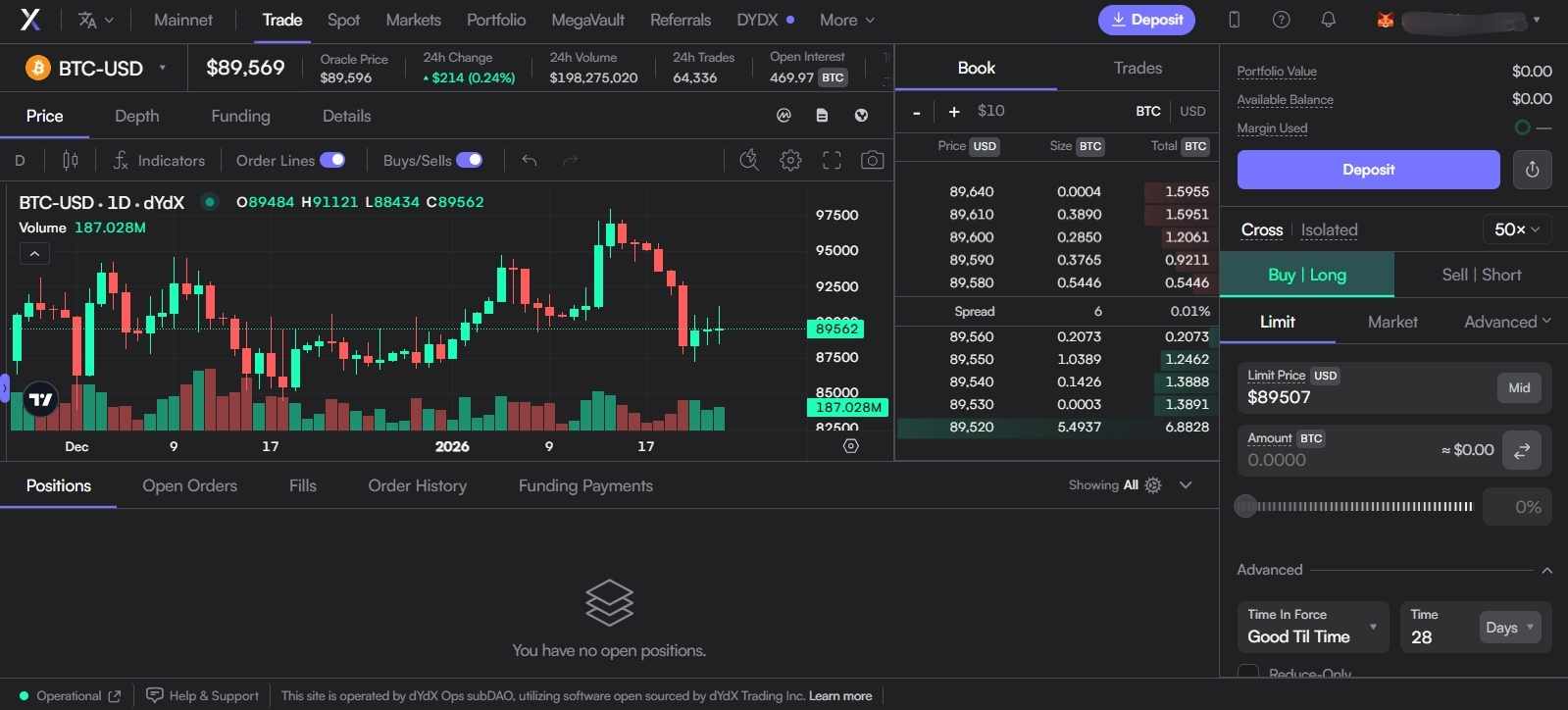
The trading interface is clean and relatively easy to understand, with the TradingView chart, order book, order form, open positions, and market details arranged across clearly defined sections. Navigation feels intuitive, while TradingView provides the indicators and drawing tools needed for technical analysis.
Order functionality, however, is somewhat limited compared with competing perpetual exchanges. Alongside market and limit orders, dYdX supports stop market, stop limit, and scale orders for more advanced trade setups. It does not provide many specialized order types or the option to create subaccounts, which may feel restrictive for traders managing several strategies.
Liquidity is generally strong on major contracts such as BTC-USD, where spreads remain tight and orders are executed smoothly. Newer or less active markets can have thinner order books and wider spreads, increasing the possibility of slippage during volatile periods or when placing larger orders.
Maximum leverage is 50×.
dYdX Deposit and Withdrawal Methods
Deposits and withdrawals on dYdX are handled entirely through crypto networks, which is standard for decentralized exchanges. The platform does not directly support fiat deposits or bank transfers. Users can deposit USDC or ETH through six networks: Ethereum, Polygon, Arbitrum, Base, Avalanche, and Optimism.
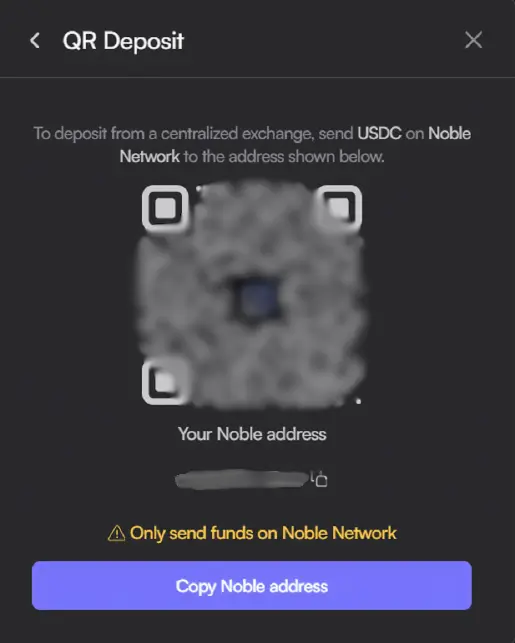
dYdX also supports direct deposits from centralized exchanges such as Coinbase. Each user receives a unique Noble network wallet address where USDC can be transferred directly from a supported exchange. This method accepts USDC only, so any other crypto asset must first be converted into USDC before it can be deposited through Noble.
For withdrawals, dYdX supports a larger selection of networks, including Ethereum, Base, Avalanche, Optimism, Arbitrum, Polygon, Osmosis, and Solana. Users can select their preferred destination network and enter the receiving wallet address directly. Available assets and transaction fees depend on the selected network.




dYdX Trading Fees
Every exchange structures its fees differently, and understanding how dYdX applies trading and network costs helps set clear expectations before placing any orders.
Trading Fees
dYdX applies a tiered fee structure to perpetual trading, with base fees starting at 0.01% for makers and 0.05% for takers. These rates decrease based on a trader’s 30-day trading volume, with further discounts available to DYDX token holders. Trading fees are waived on major markets such as BTC-USD and SOL-USD.
Deposits and Withdrawals Fees
Deposit and withdrawal fees on dYdX vary by method and network rather than a flat platform charge. Skip Go Fast deposits cost 0.10% of the transfer amount plus gas, around $2.5 on Ethereum and $0.01 to $0.10 on L2 networks, with no fees for fast deposits above $100 on Ethereum and $20 on L2s. Skip Go (regular) deposits cost around $0.02, while withdrawals range from $0.10 to $7 plus gas fees. Coinbase via Noble charges standard Coinbase withdrawal fees plus $0.10 to $0.20 in IBC fees, and direct IBC transfers typically cost $0.10 to $0.50.
| Trading type | Maker fee | Taker fee | DEX median (22 tracked) | Verdict |
|---|---|---|---|---|
| Spot | 0.1% | 0.1% | 0% / 0.05% | Pricier |
| Futures | 0.01% | 0.05% | 0.011% / 0.045% | Average |
The median across the 22 decentralized exchanges (DEX) we track, per fee type. dYdX is only ever compared with its own kind. "Average" means within half a basis point of that median.
dYdX Products and Services
dYdX offers a range of tools designed to support active trading, governance participation, and capital efficiency.
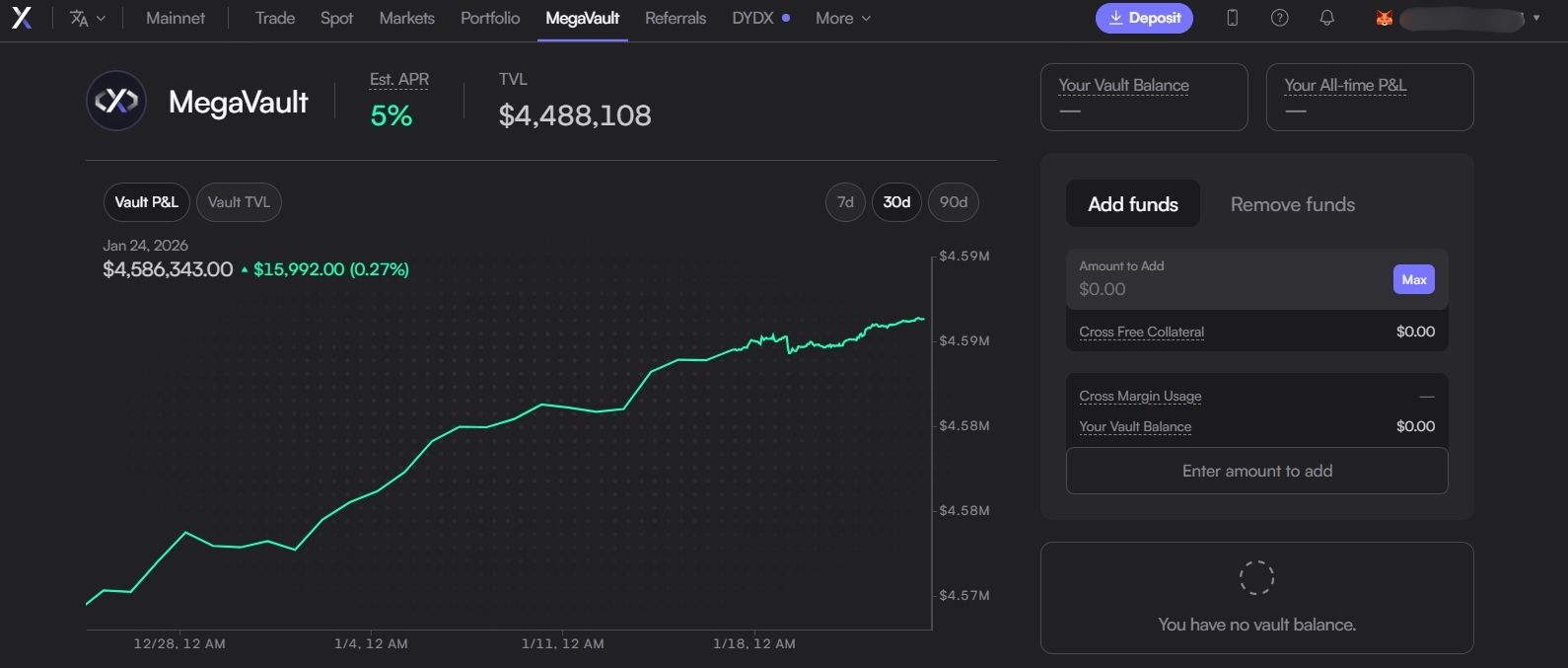
MegaVault
MegaVault allows users to deposit USDC into a shared liquidity pool that provides automated liquidity across dYdX perpetual markets. Depositors gain proportional exposure to trading fees and strategy performance, without managing positions manually. Returns are variable and depend on market conditions, vault allocation, and overall trading activity, with no guaranteed yield.
dYdX Staking
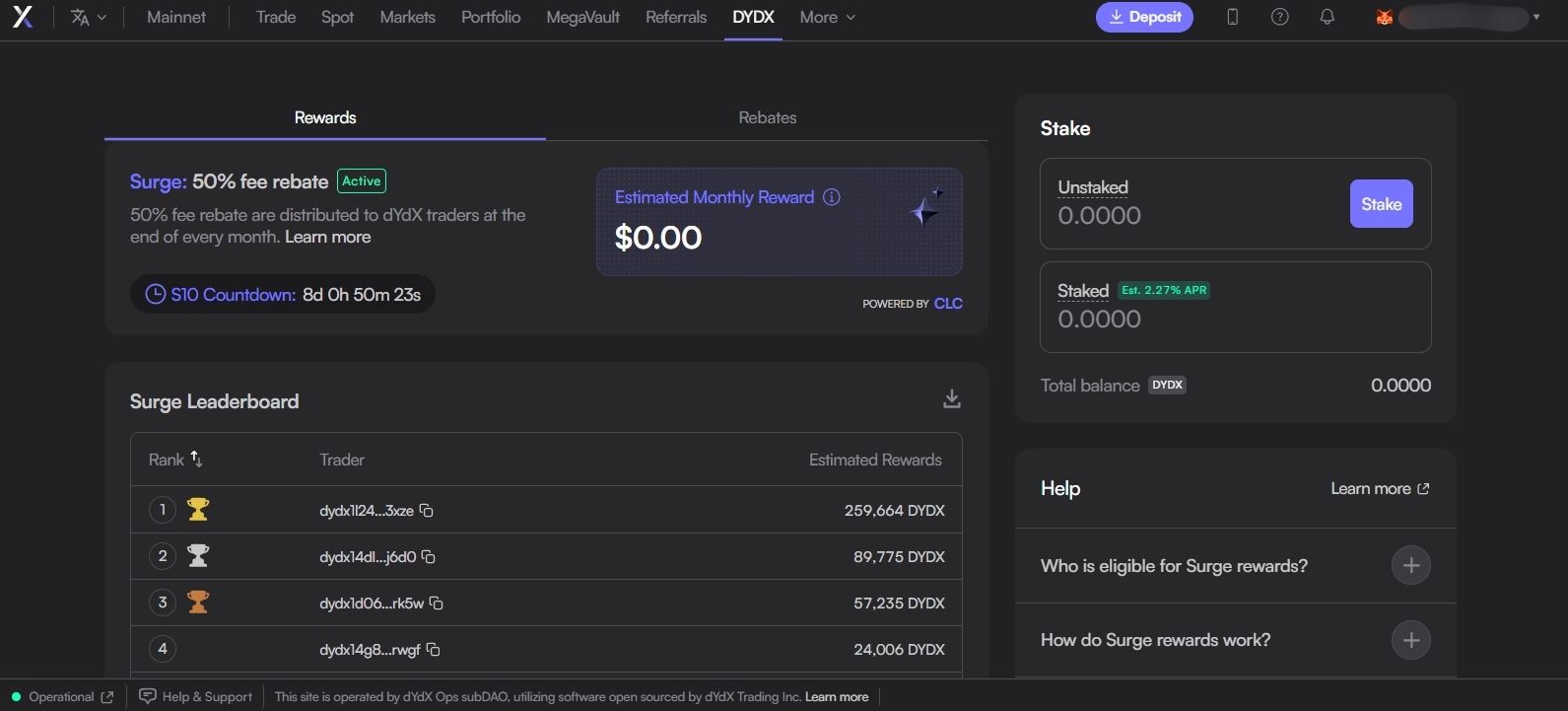
dYdX staking lets users delegate DYDX tokens to validators on the dYdX Chain to help secure the network. In return, stakers earn a share of real protocol revenue, paid in USDC, rather than inflationary token rewards. Rewards fluctuate with trading volume, and unstaking requires a fixed unbonding period.
dYdX Token (DYDX)
DYDX is the native token used to secure and govern the dYdX Chain. Holders can delegate it to validators and participate in decisions about the protocol. This utility belongs to Cosmos-native DYDX; the older Ethereum token does not provide the same chain staking functions. The dYdX Foundation staking guide explains validator selection, rewards and the unbonding process.
Staking can also lower trading costs. The staking-based fee programme applies tiered discounts according to the amount of bonded DYDX and the trader’s fee tier. Unstaked coins and tokens already unbonding do not qualify. Discounts reduce eligible positive fees; they do not increase negative maker fees or rebates.
Delegation is a network commitment, rather than a fee-payment toggle that spends tokens on each trade. The documented unbonding period is 30 days, and delegated funds can be penalised if their validator is slashed. Validator commission and network activity also affect rewards. These conditions matter when weighing a potential trading-fee saving against the amount and duration of DYDX committed.
dYdX
Connecting- Market cap
- $117.87M Rank #264
- 24h trading volume
- $2.51M Across tracked markets
- Circulating supply
- 846.09M DYDX 88.3% of total supply
dYdX Security & Regulation
Security on dYdX is built around a non-custodial model, where users retain full control of their funds through self-custody wallets. The platform operates in a fully decentralized manner on the dYdX Chain, meaning core trading activity, protocol parameters, and network performance are recorded on-chain and remain publicly verifiable. Users can view network statistics, validator data, and protocol activity at any time through on-chain explorers.
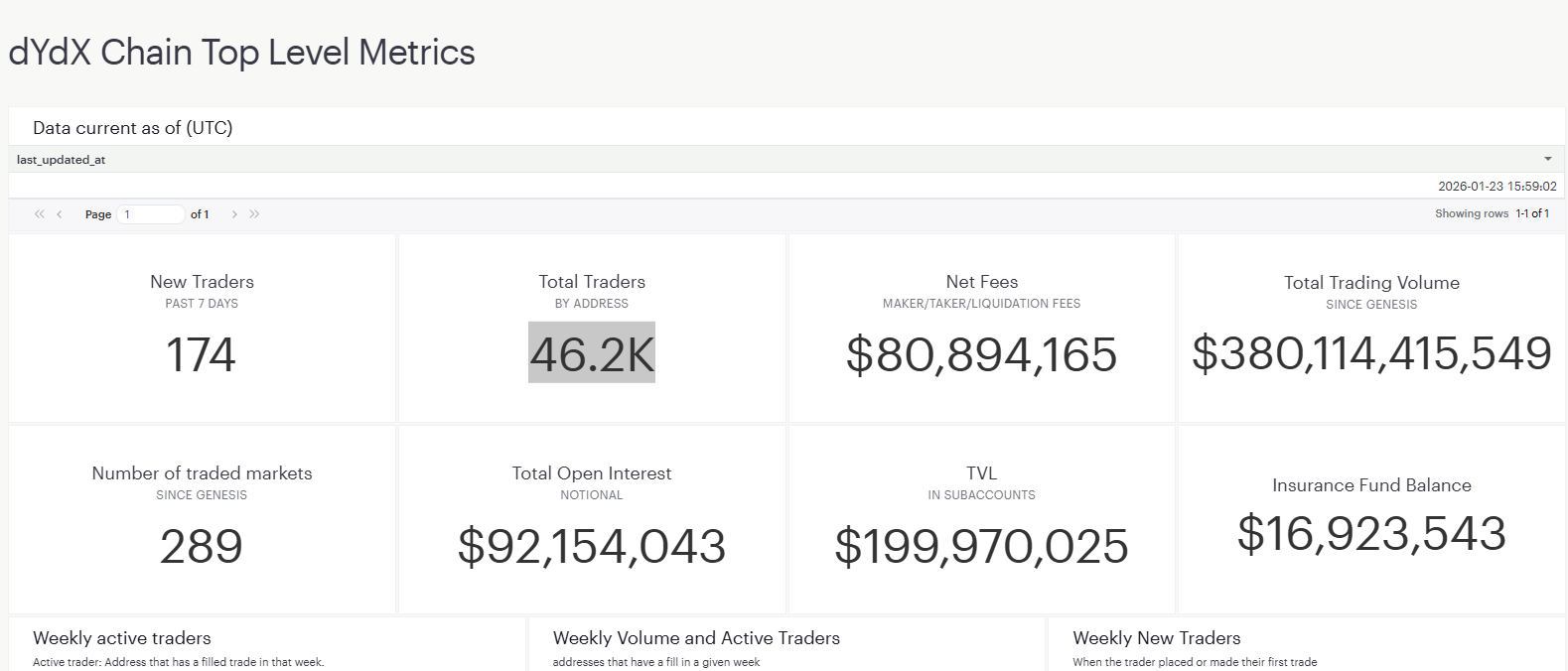
The protocol has undergone multiple third-party security audits by firms such as OpenZeppelin, PeckShield, CertiK, and Certora, covering smart contracts, protocol logic, and risk parameters. On the mobile app, dYdX also supports biometric authentication, adding an extra layer of access control for users.
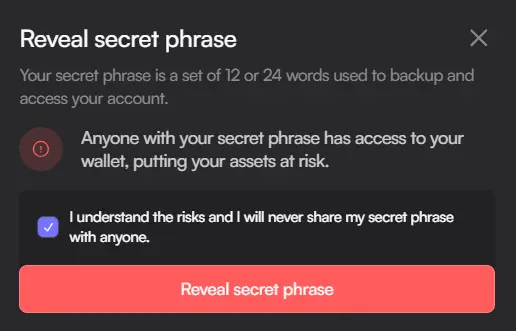
Each trader also receives a unique 24-word Secret Phrase that controls their dYdX Chain address. For users connecting through an Ethereum-compatible wallet, this phrase is created when they sign the wallet connection request and is separate from the recovery phrase of their connected wallet. Users can view their dYdX Wallet Secret Phrase by opening Settings and selecting “Export Secret Phrase”. It can also be imported into Cosmos wallets such as Keplr or Leap to access the same dYdX Chain address. Since anyone with these 24 words can control the associated funds, the phrase must be stored privately and never shared.
In 2023, dYdX V3 experienced a targeted price manipulation attack that resulted in approximately $9 million in protocol-level losses. The incident did not involve wallet breaches, and the team confirmed that user funds were not directly affected. Since then, additional safeguards and monitoring measures have been implemented to strengthen risk controls.
dYdX Customer Support
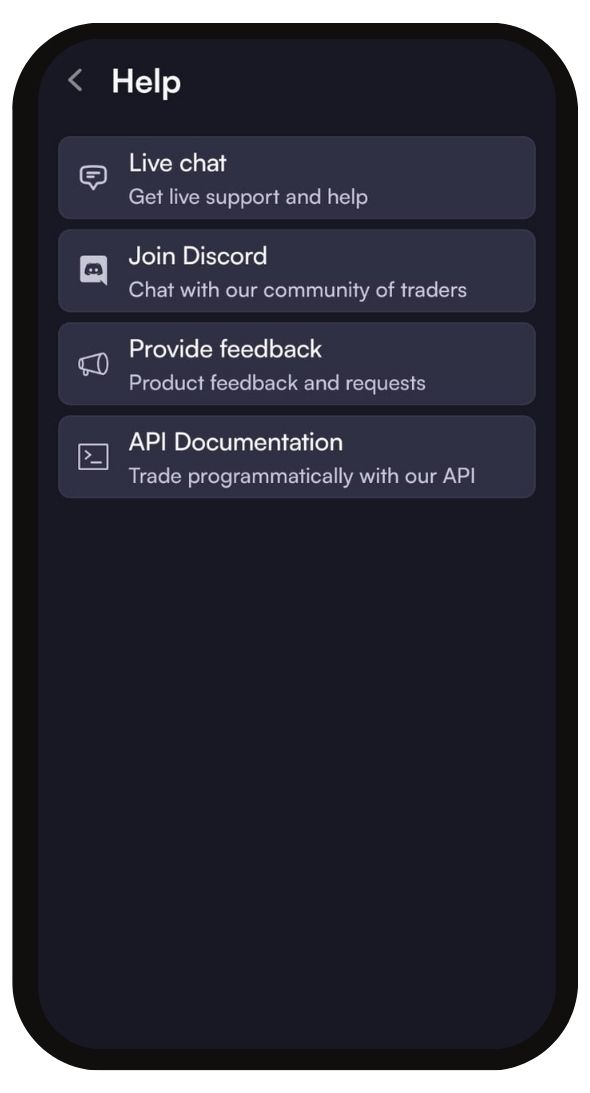
dYdX primarily relies on its Help Center for user support, which covers everything from basic setup to advanced trading features. The articles and guides are detailed and regularly updated. For direct assistance, users are guided to the platform’s Discord through in-app support, where tickets can be raised and real-time help is available, including for issues like outages or account related concerns.
dYdX Alternatives
| Feature | dYdX | Hyperliquid | Lighter | edgeX |
|---|---|---|---|---|
| Founded | 2017 | 2021 | 2022 | 2024 |
| CryptoWinRate score | 6.9/10 | 8.8/10 | 7.5/10 | 7.2/10 |
| Spot maker fee | 0.1% | 0.04% | 0% | — |
| Spot taker fee | 0.1% | 0.07% | 0% | — |
| Futures maker fee | 0.01% | 0.015% | 0% | 0.012% |
| Futures taker fee | 0.05% | 0.045% | 0% | 0.038% |
| Spot assets (crypto) | — | 316 | 2 | — |
| Futures contracts (crypto) | 72 | 183 | 205 | 168 |
| Max leverage | 50× | 40× | 50× | 100× |
| KYC | No KYC | No KYC | No KYC | No KYC |
| Available in your country | — | — | — | — |
| Links |
See every dYdX alternative compared
Bottom Line
One thing dYdX has in its favor is experience. It has been in the market long enough to build a track record, while continuing to improve as traders’ needs have changed. Throughout these upgrades, security and liquidity have remained central priorities.
However, its trading setup is not as flexible as some newer perpetual DEXs. The order selection is limited, hedge mode and subaccounts are unavailable, and only a small number of tokenized RWA contracts have been introduced. dYdX handles its core perpetual offering well, but traders seeking different tools or market selections can find more options in our top perpetual DEXs guide.
FAQs
dYdX is a decentralized exchange that operates on its own blockchain. Users trade directly from self-custody wallets without relying on custodial accounts.
Yes. dYdX offers a mobile app on Android and iOS that supports trading, position management, and account monitoring.
dYdX follows a non-custodial model and has undergone multiple third-party audits. While a protocol-level incident occurred in 2023, user funds were not directly affected.
MegaVault allows users to deposit USDC to provide automated liquidity across dYdX markets and earn variable returns based on trading activity.
Leverage on perpetual futures can go up to 50x, depending on the asset and market conditions.