Velocity Review 2026: Drift’s Successor, Fees and Risks
On this page
On this page
- Verdict & score
- Velocity Overview
- Velocity Pros and Cons
- Velocity Sign-up & KYC
- Velocity Supported Cryptocurrencies
- Velocity Trading Platform
- Velocity Deposit and Withdrawal Methods
- Velocity Trading Fees
- Velocity Products and Services
- Velocity Security & Regulation
- Velocity Customer Support
- Velocity Alternatives
- Bottom Line
- FAQs
Our verdict
Velocity is a separate Solana deployment built from Drift’s codebase. Its narrower product set, new audit and USDT settlement do not transfer old Drift balances or resolve losses from the earlier incident.
| KYC | No KYC |
|---|
| Stats | Velocity |
|---|---|
| Fees | |
| Futures fees (maker/taker) | -0.0025% / 0.06% |
| Trading | |
| Max leverage | 20× |
| CryptoWinRate score | n/a |
- Velocity is Drift’s rebuilt successor, deployed under a new Solana program ID.
- No KYC is required; users connect a Solana-compatible Web3 wallet.
- Supports BTC, ETH, SOL and HYPE perpetual contracts with leverage of up to 20x.
- Hybrid liquidity combines JIT auctions, DLOB orders, and a virtual AMM.
- Perpetual maker fees are -0.0025% and base taker fees are 0.06%, with tier and market adjustments.
- No spot order book; token swaps are routed through Jupiter.
- Earn supports USDT and SOL, alongside two delegated strategy vaults.
- Affected Drift users have not yet recovered their losses in full.
Velocity is Drift Protocol’s rebuilt successor following the April 2026 attack. It runs under a new Solana program rather than upgrading the old deployment. Drift accounts and balances do not carry over: users must create a new Velocity account, and recovery of earlier Drift losses remains a separate process. Velocity returns with a narrower focus on perpetual trading and a revised security structure. This Velocity review looks at what has changed and whether the rebuilt platform deserves another chance.
Velocity Overview
Velocity is the rebranded version of Drift Protocol, a Solana-based decentralized exchange launched in 2021 by Cindy Leow. Before the April 2026 incident, Drift had grown into one of Solana’s larger DeFi platforms, having previously recorded more than $700 million in TVL and processed over $148.55 billion in cumulative perpetual trading volume. These figures describe the predecessor, Drift, rather than activity on Velocity’s new deployment.
That history also includes the sophisticated attack that drained approximately $285 million in user assets. According to Chainalysis, the operation involved months of social engineering and the misuse of Solana’s durable-nonce mechanism, which led Security Council members to unknowingly pre-sign transactions that transferred administrative control. The attack removed more than half of the protocol’s TVL and forced Drift to suspend its services.
Following the incident, the team rebranded Drift Protocol as Velocity and relaunched it through a newly deployed program rather than upgrading the compromised version. The new platform uses a separate program ID, rotated keys, a smaller codebase, and fewer products. The transition is also tied to a recovery framework, under which Tether proposed contributing up to $127.5 million, with another $20 million proposed by additional partners. Velocity has also replaced USDC with USDT as its primary settlement asset.
Velocity now focuses on perpetual futures alongside lending and borrowing. It currently supports BTC, ETH, SOL and HYPE perpetual contracts with leverage of up to 20x, while token swaps remain available with up to 5x leverage. Its cross-margin system allows deposited assets to earn lending yield while also serving as collateral for perpetual positions.
The platform also retains the hybrid liquidity structure previously developed by the team, combining JIT auctions, a decentralized limit order book, and an AMM that provides backstop liquidity. However, these components now operate within a smaller platform built mainly around perpetual trading, collateral management, and lending.
Velocity Pros and Cons
What we like
- No KYC required
- Simple trading interface
- Hybrid liquidity model
- Maker rebates across all tiers
- New security architecture
- Earn and managed vaults
What holds it back
- Unresolved user recoveries
- No native spot orderbook
- No hedge mode
- Limited customer support
Velocity Sign-up & KYC
Velocity does not require KYC or a conventional account registration. You only need a Solana-compatible Web3 wallet to connect with the exchange. Phantom is one option, while MetaMask can also be used through its native Solana support. Here is how to get started on Velocity:
Step 1: Open the official Velocity app.
Step 2: In the Velocity app, click the “Connect” button in the top-right corner to connect your Web3 wallet.
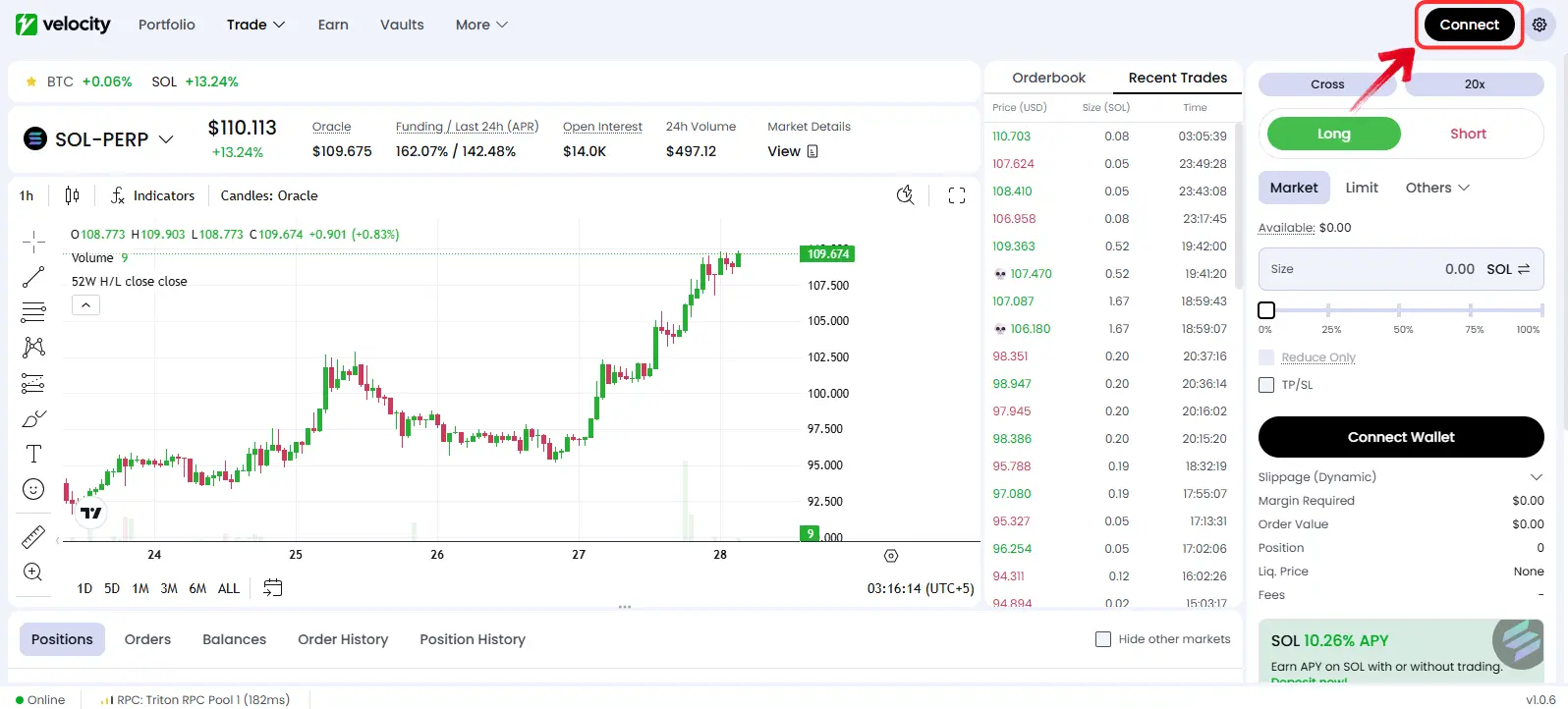
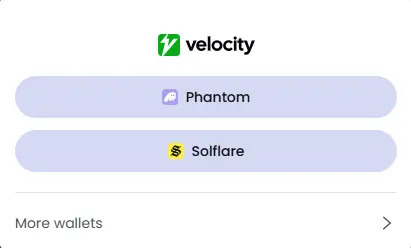
Step 3: Select your preferred Solana-compatible wallet from the available options. If your wallet is not immediately visible, click “More Wallets” to view the complete list.
Step 4: Velocity will send a wallet connection request followed by a signature request. Approve both requests through your wallet to continue.
Step 5: Accept Velocity’s terms when prompted. You can then deposit supported assets through your Solana wallet and start using the exchange.
Supported Networks
Velocity currently operates only on the Solana network, so deposits and withdrawals must be completed through a Solana-compatible Web3 wallet. Although USDT is available across several blockchains, funds deposited to Velocity must use the Solana network. If your assets are held elsewhere, you will need to bridge them to Solana before funding your account. Always confirm the selected network and asset compatibility before transferring funds.
Velocity Supported Cryptocurrencies
The current market list includes BTC, ETH, SOL and HYPE perpetual contracts. BTC, ETH and SOL allow up to 20x leverage; HYPE has a lower limit. Check the order panel for the limit that applies to your position.
Velocity Trading Platform
Velocity uses a simple trading layout that feels familiar and is easy to navigate. Its perpetual interface includes an integrated TradingView chart, an order book, recent trades, and an order panel. Charting is somewhat limited because traders can display only one chart at a time, with no multi-chart view available.
Although Velocity runs through a newly deployed program, its trading engine builds on several years of activity under Drift Protocol. Before the rebranding, the platform had processed more than $50 billion in cumulative trading volume across over 10 million historical trades.
Velocity now uses a smaller codebase, with native spot order-book trading and other side products removed. Its perpetual engine runs on Solana’s parallelized runtime, allowing transactions to be processed without every operation competing for the same computing resources. On-chain order updates operate around Solana’s baseline slot time of approximately 400 milliseconds, although actual fills can take longer depending on the auction duration, available liquidity, and network conditions.
Velocity Swaps
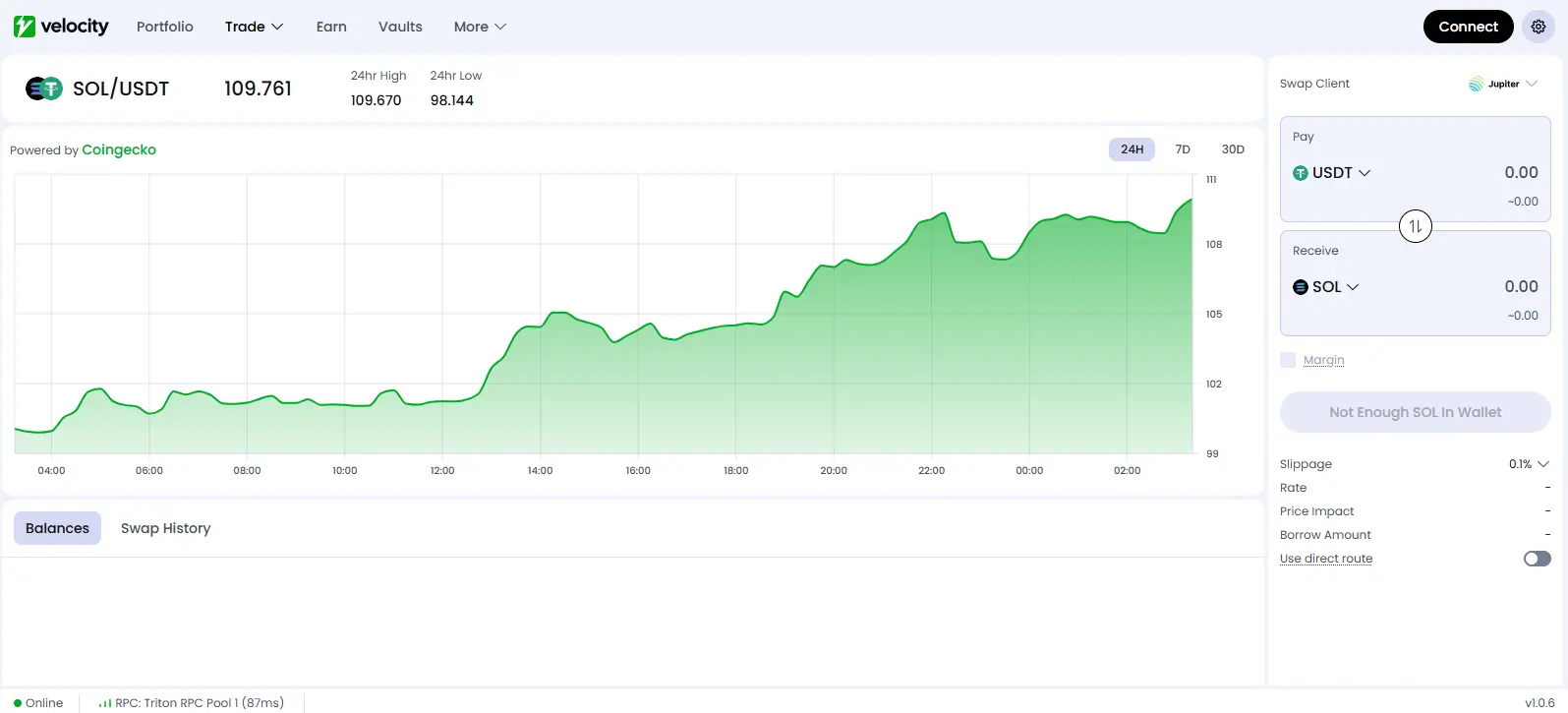
Velocity has removed its native spot order book, so there is no fixed list of spot trading pairs or native Spot Market and Limit orders. Instead, users can exchange supported Solana tokens through integrated swap clients such as Jupiter and Titan. The official documentation describes this as the ability to swap any supported pair, with margin of up to 5x.
Velocity Perpetuals
Velocity currently provides perpetual contracts for BTC, ETH, SOL, and HYPE, with leverage reaching up to 20x. The selection is limited entirely to cryptocurrencies, with no contracts for stocks, commodities, forex, or indices.
Supported order types include Market, Limit, Stop Market, Stop Limit, Take Profit Market, Take Profit Limit, Oracle Limit, and Scale orders. Traders can also apply Reduce-Only, Post-Only, and Immediate-or-Cancel settings where supported.
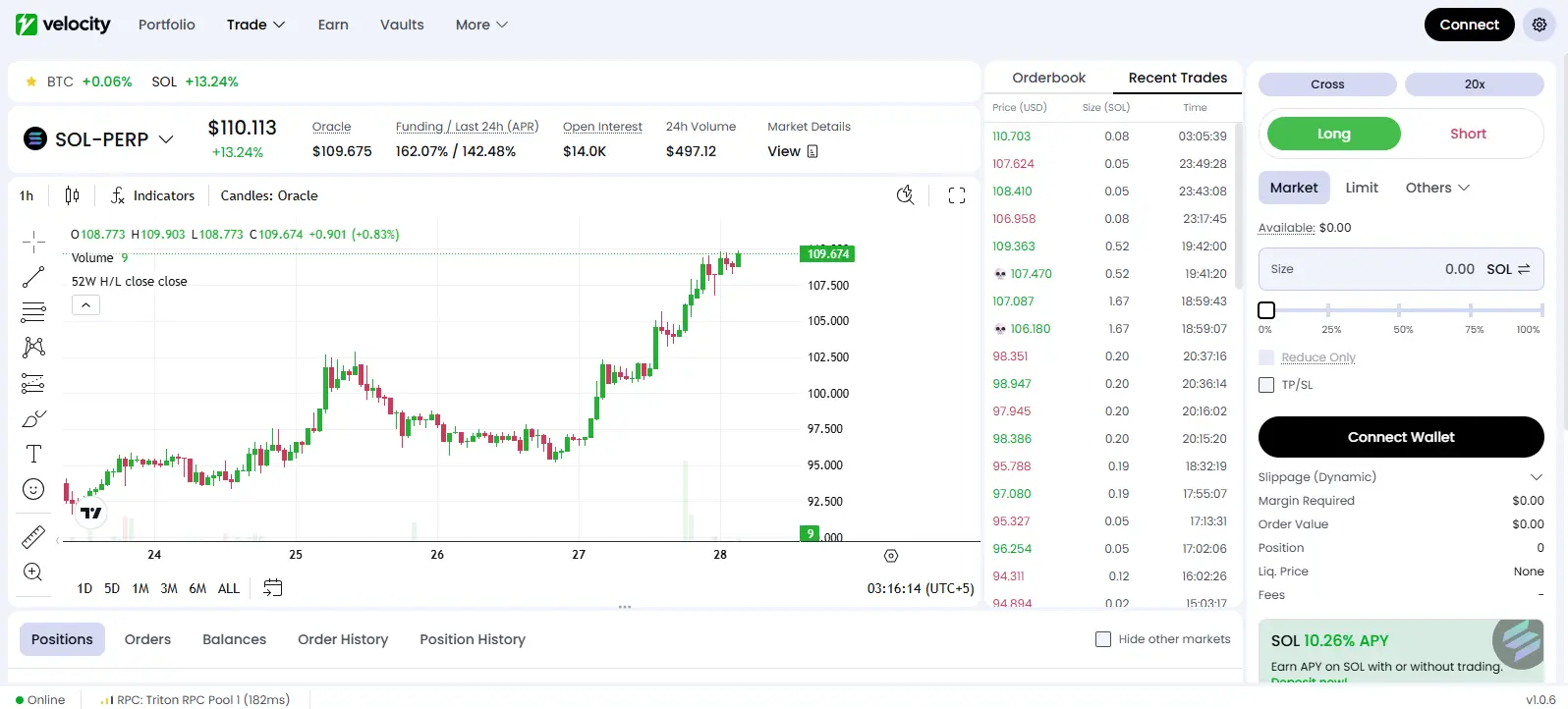
Maximum leverage is 20×.
Velocity Deposit and Withdrawal Methods
Velocity supports crypto deposits and withdrawals through the Solana network. USDT serves as the platform’s main quote and settlement asset, while other supported Solana assets can also be deposited as collateral.
To fund your account, first hold the asset in the Solana-compatible wallet connected to Velocity. You may transfer it there from a centralized exchange, but the final deposit into Velocity must be approved through your connected wallet.
Velocity does not provide direct fiat deposits or native cross-chain transfers. Assets held on another blockchain must first be bridged to Solana using an external service. Withdrawals are returned to the connected Solana wallet, and users should keep a small amount of SOL available for network fees and account-related transactions.
Read more: How to Get Started With Phantom Wallet
Velocity Trading Fees
Fees remain an important consideration when using a DEX, as traders may need to account for both platform charges and onchain transaction costs. Here is what you can expect when using Velocity.
Trading Fees
Velocity follows a dynamic fee structure based on a trader’s 30-day perpetual volume, with a baseline schedule for BTC, ETH and SOL and configurable rates on other markets. The structure has also changed from Drift’s earlier model, as holding DRIFT no longer provides taker fee discounts or additional maker rebates.
The published regular tier charges 0.06% for takers and pays makers a rebate, represented by the negative -0.0025% maker rate. Rates vary with trailing 30-day volume, market settings and any promotional tier. On September 21, 2026, the beta app advertised a temporary 0.02% taker rate, also reflected in its market API. This promotion differs from the regular schedule above. Check the live market rate before placing an order; post-only is required for an order to qualify as a maker order.
Swaps do not follow Velocity’s perpetual fee schedule. Their final cost depends on current onchain conditions, including available liquidity, the selected route, price impact, and Solana network charges. Costs may also vary according to the swap client used, depending on which routes are available when you trade.
Deposits and Withdrawals Fees
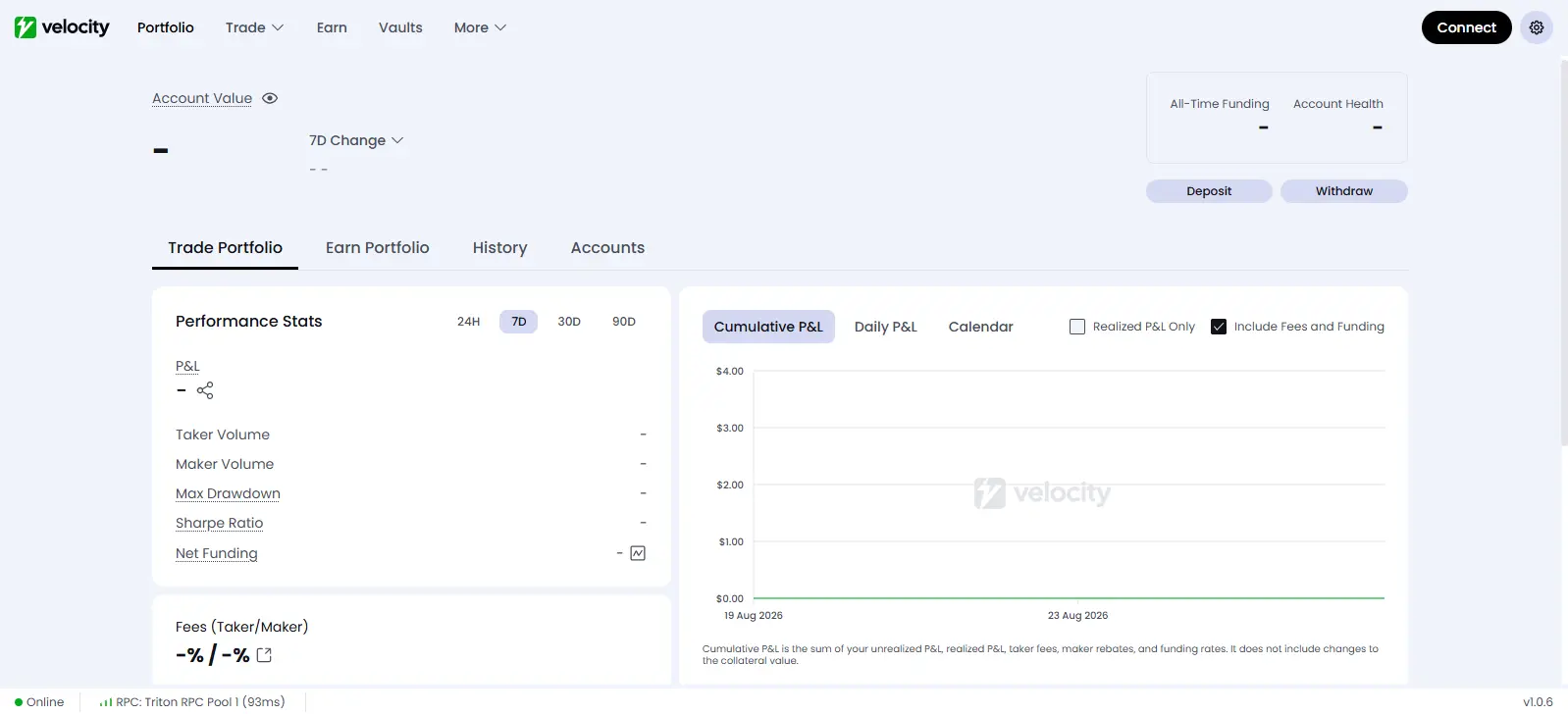
Velocity does not list a separate protocol-level fee for deposits or withdrawals. However, both transactions take place on Solana, so the applicable network fee is paid in SOL from the connected wallet. Initial account setup may also require a small amount of SOL for account initialization costs.
Users should therefore keep some SOL available before depositing or withdrawing. Withdrawals may also be restricted if the funds support open positions or removing them would place the account below its margin requirement.
If you are new to the network, you can read our guide on how to buy Solana and fund your wallet properly before using Velocity.
| Trading type | Maker fee | Taker fee | DEX median (22 tracked) | Verdict |
|---|---|---|---|---|
| Futures | -0.0025% | 0.06% | 0.011% / 0.045% | Average |
The median across the 22 decentralized exchanges (DEX) we track, per fee type. Velocity is only ever compared with its own kind. "Average" means within half a basis point of that median.
Velocity Products and Services
Following its relaunch, Velocity adopted a narrower product focus built around perpetual trading, swaps, lending, managed vaults, and protocol analytics.
Velocity Trading Engine
Velocity’s trading engine uses an auction-based hybrid liquidity model combining JIT makers, the DLOB, and its virtual AMM. Market orders enter a short Dutch auction where liquidity providers compete to offer a better execution price. Resting limit orders remain onchain inside user accounts, while Keeper bots organise and match them when conditions are met.
The AMM quotes alongside these sources and can complete any remaining portion, allowing a single order to receive liquidity from multiple sources based on price priority.
Velocity Earn
Velocity Earn allows users to deposit USDT or SOL, receive lending interest, and borrow against the same collateral. Lending APY changes with market utilization, increasing as borrowing demand rises, while interest accrues continuously and compounds into the user’s spot balance.
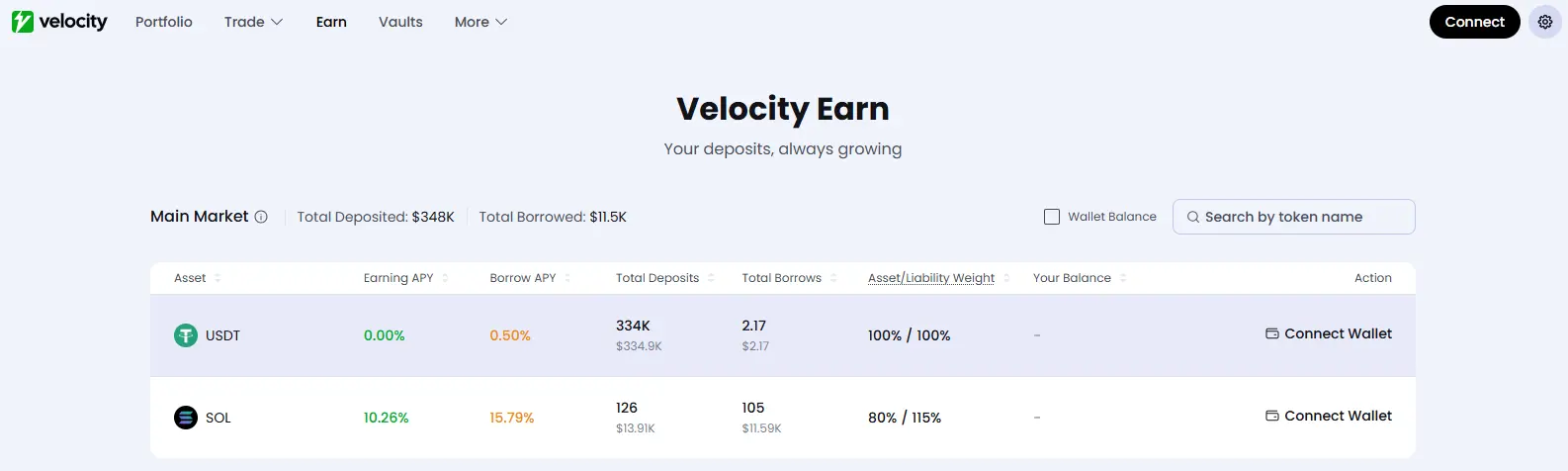
Deposited assets can also support perpetual positions through Velocity’s cross-margin system, so they remain productive while being used as trading collateral. Borrowers pay a variable APY, while Insurance Fund staking provides another yield source with additional loss exposure for users.
Velocity Vaults
Velocity Vaults provide delegated trading strategies for users who prefer not to manage positions themselves. Depositors add USDT or SOL to one of the two currently available vaults and receive shares representing their portion of the pooled capital. A designated manager trades through a dedicated Velocity account, with profits and losses distributed proportionally among shareholders.
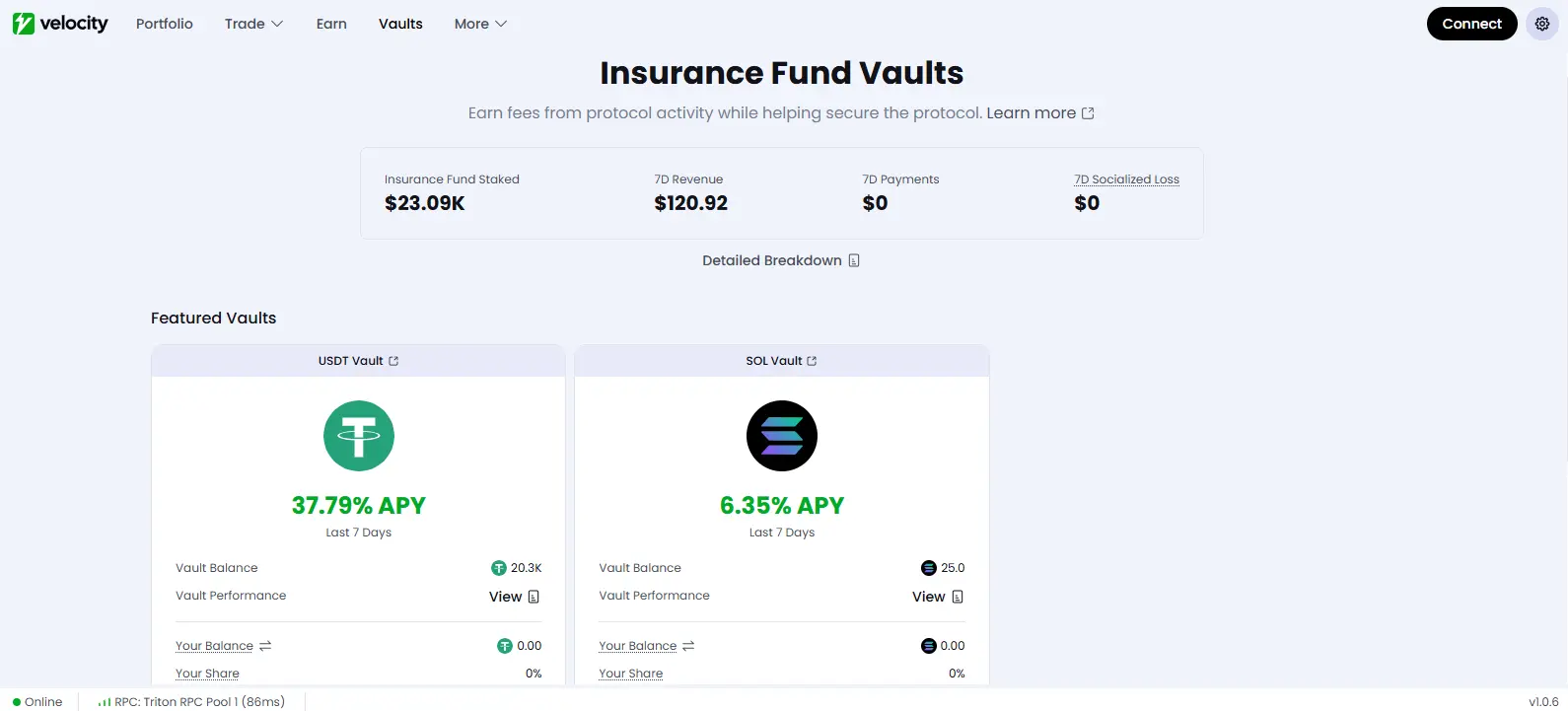
Withdrawals require an advance request and remain subject to the vault’s redeem period. Managers may also charge management or performance fees based on vault terms.
Velocity Stats
Velocity Stats brings the protocol’s trading and account data into a single analytics area. Users can view 24-hour and 30-day volume, open interest, funding rates, deposited capital, oracle prices, liquidations, and bankruptcies. The underlying Data API also provides historical trades and funding records, while market accounts maintain ongoing volume and TWAP information.
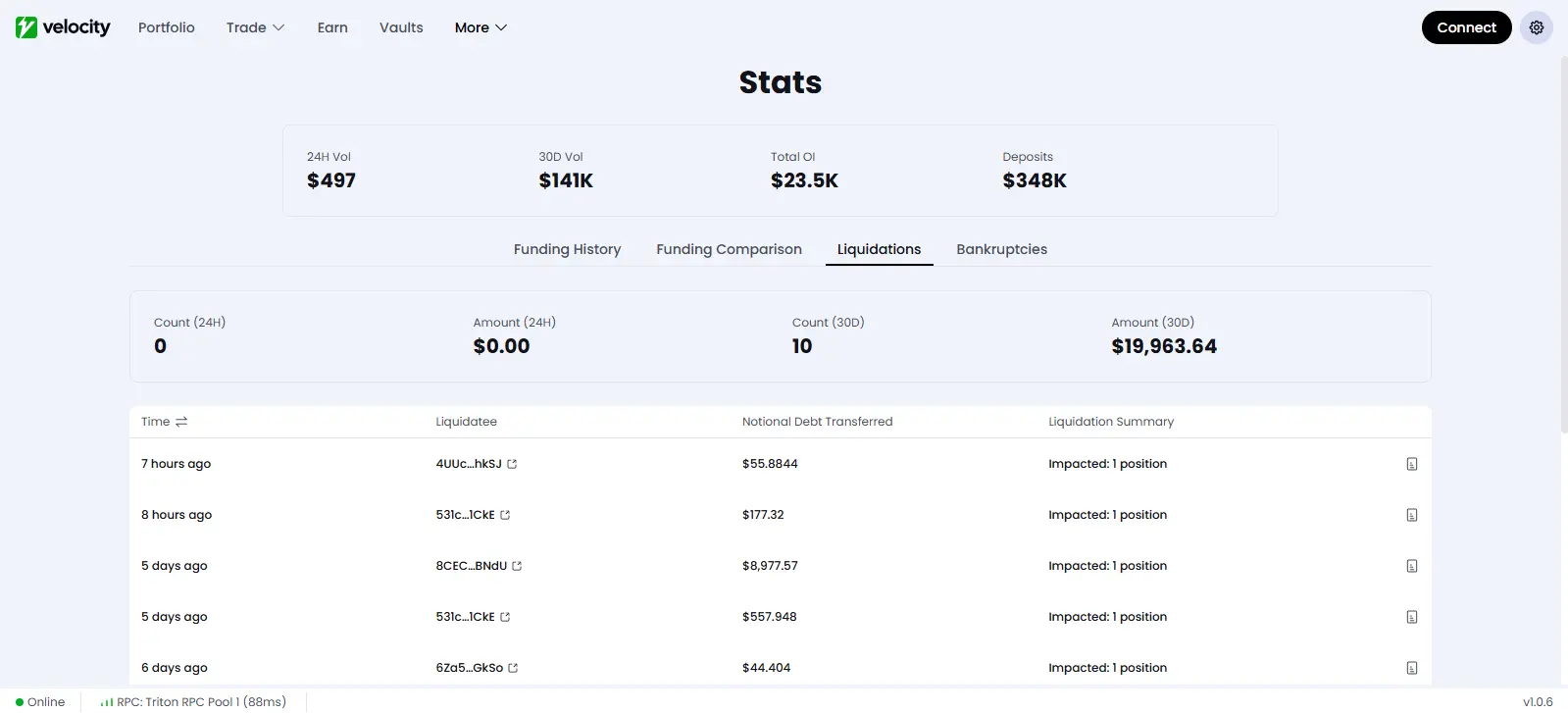
For developers, the DLOB server and SDKs supply real-time order-book and trade data that can be used in third-party dashboards, trading bots, and other Velocity integrations and applications.
Velocity Security & Regulation
Drift Protocol suffered a $285 million security breach that placed its future under serious pressure and eventually led to its relaunch as Velocity. While project rebranding has become common across crypto, this was not simply a name change. Velocity was presented as a security-focused rebuild, with changes intended to address the weaknesses exposed by the breach.
Velocity was deployed as a separate onchain program with a new program ID, reduced codebase, and no spot order-book trading. Trail of Bits and Neodyme audited the pre-fork Drift code, while OtterSec reviewed Velocity’s post-fork changes; the final report was published on September 3, 2026.
Safety controls include oracle-divergence bands that can halt fills, funding updates, and PnL settlement, alongside collateral haircuts, execution limits, progressive liquidations, and Insurance Fund backstops. However, this architecture does not reverse Drift’s losses. A recovery framework funded through future protocol revenue and the Tether-backed arrangement remains active, but affected users have not yet been fully repaid.
Velocity Customer Support
Velocity’s online chat was unavailable at the time of writing. Its support guidance directs users to Discord. Users can post questions there, but assistance may come from community members rather than a dedicated customer support representative.
Velocity Alternatives
| Feature | Velocity | Hyperliquid | Lighter | edgeX |
|---|---|---|---|---|
| Founded | — | 2021 | 2022 | 2024 |
| CryptoWinRate score | n/a | 8.8/10 | 7.5/10 | 7.2/10 |
| Spot maker fee | — | 0.04% | 0% | — |
| Spot taker fee | — | 0.07% | 0% | — |
| Futures maker fee | -0.0025% | 0.015% | 0% | 0.012% |
| Futures taker fee | 0.06% | 0.045% | 0% | 0.038% |
| Spot assets (crypto) | — | 316 | 2 | — |
| Futures contracts (crypto) | — | 183 | 205 | 168 |
| Max leverage | 20× | 40× | 50× | 100× |
| KYC | No KYC | No KYC | No KYC | No KYC |
| Available in your country | — | — | — | — |
| Links |
See every Velocity alternative compared
Bottom Line
Velocity is not simply Drift with a new name. The relaunch brings a smaller, more focused platform with BTC, ETH, SOL and HYPE perpetual markets, up to 20x leverage, a hybrid liquidity engine, and separate Earn and Vault products. Its interface remains simple, but trading activity and market selection are currently far below what Drift offered before the hack.
Velocity is also beginning this new phase while recovery for affected Drift users remains incomplete, which will continue to influence how traders view the platform despite its technical changes. For those looking for greater market activity or a larger selection of contracts, our top perpetual DEX list includes several other platforms worth considering.
FAQs
Velocity is Drift Protocol’s successor, but it runs under a separate program ID with a smaller product lineup.
Drift rebranded after the April 2026 exploit, rebuilding the protocol with a smaller codebase and updated security controls.
Velocity has a reduced codebase, a new program ID, oracle-based risk controls, collateral limits, progressive liquidations, and Insurance Fund backstops. However, smart contract and trading risks remain, and OtterSec’s report was published on September 3, 2026. Audits do not eliminate risks from the running deployment, administrative keys or market conditions.