12 Best Crypto Savings Accounts in 2026: Earn on Stablecoins

このページの内容
このページの内容
- How Does a Cryptocurrency Savings Account Work?
- Top Crypto Savings Accounts Compared
- 1. Binance Simple Earn
- Binance Simple Earn Pros and Cons
- 2. Ledn Growth Accounts
- Ledn Growth Accounts Pros and Cons
- 3. Coinbase USDC Rewards
- Coinbase USDC Rewards Pros and Cons
- 4. Kraken Stablecoin Rewards
- Kraken Stablecoin Rewards Pros and Cons
- 5. Nexo Savings
- Nexo Savings Pros and Cons
- 6. Bitget Simple Earn
- Bitget Simple Earn Pros and Cons
- 7. KuCoin Savings
- KuCoin Savings Pros and Cons
- 8. Bybit Easy Earn
- Bybit Easy Earn Pros and Cons
- 9. Crypto.com Earn
- Crypto.com Earn Pros and Cons
- 10. Bitunix Easy Earn
- Bitunix Easy Earn Pros and Cons
- 11. Sky sUSDS
- Sky sUSDS Pros and Cons
- 12. GRVT Earn on Equity
- GRVT Earn on Equity Pros and Cons
- Risks of Using Crypto-Saving Accounts
- Tips to Choose a Cryptocurrency Savings Account
- Is There Any Tax on Interest Earned From Crypto Savings?
- Bottom Line
- FAQs
- Crypto savings accounts generate returns on stablecoins and other idle crypto assets.
- Flexible accounts keep funds accessible, while fixed terms generally offer higher APYs.
- The best crypto savings account depends on rates, KYC, custody, and withdrawal terms.
- Proof of Reserves provides transparency but does not guarantee that funds are fully protected.
- Rates are variable, quota-based, and often depend on balance or membership tiers.
Keeping crypto idle in a wallet can feel wasteful, especially when exchanges and lending platforms advertise interest on the same assets. Crypto savings accounts offer a simple alternative: deposit Bitcoin, stablecoins, or other supported assets and earn a variable or fixed return. However, the highest advertised APY rarely tells the full story. Rates may apply only to small balances, require locked terms, depend on loyalty tiers, or change by country. This article compares 12 crypto savings products, including custodial, no-KYC, and self-custodial options, based on rates, withdrawal flexibility, supported assets, eligibility requirements, and how each platform generates your returns.
How Does a Cryptocurrency Savings Account Work?
Crypto savings accounts let you earn returns on crypto you already hold, making them a passive way to grow otherwise idle assets. They can work in several ways. You may lend Bitcoin, Ethereum, or stablecoins through flexible or fixed-term products. Other platforms automatically pay yield on eligible account balances without requiring a separate subscription, so the assets remain available for trading or withdrawal.
Behind the scenes, the provider may lend assets to borrowers, use institutional strategies, or share revenue generated from reserves. Flexible accounts usually offer easier access but variable rates, while fixed terms may pay more in exchange for locking funds. Rewards can be credited daily, weekly, or monthly, depending on the platform, product terms, and selected asset.
Top Crypto Savings Accounts Compared
While preparing this list, we found many platforms presenting mining, staking, liquidity provision, and other yield-generating products as crypto savings accounts. However, we limited our selection to services that provide a savings-like experience, where you hold eligible assets and accrue returns over time through flexible accounts, fixed terms, or automatic rewards on idle balances.
We also excluded platforms focused solely on staking. Although staking lets you earn rewards by becoming a validator, it does not fully fit our definition of a crypto savings account. With this in mind, here is our list of the top crypto savings accounts for earning yield on stablecoins and other crypto assets.
| Platform | Supported Stablecoins | Savings Type | Advertised annual rate | KYC | Reserve / audit evidence |
|---|---|---|---|---|---|
| Binance | 6+ | Flexible and Fixed | 7.35% | required | yes |
| Ledn | 2+ | Flexible | 8.50% | Required | Yes |
| Coinbase | 1+ | Flexible | Account / region dependent | required | Public financial reporting; not product insurance |
| Kraken | 7 flexible; availability varies | Flexible and Fixed | Up to 6% APY fixed | required | yes |
| Nexo | 2+ | Flexible and Fixed | Up to 11.5% annually | Required | No public live PoR |
| Bybit | 7+ | Flexible and Fixed | 6.24% | required | yes |
| KuCoin | 6+ | Flexible and Fixed | Up to 6% APR on USDG | required | yes |
| Bitget | 6 dollar-pegged assets; USTC separate | Flexible and Fixed | Up to 6.92% APR | required | yes |
| Crypto.com | 4+ | Flexible and Fixed | 2.00% | required | yes |
| Bitunix | 2+ | Flexible and Fixed | Check Easy Earn offer; tiers vary | optional | yes |
| Sky | 1+ | Flexible and Fixed | 4.85% | No KYC | Onchain collateral |
| GRVT | 2 | Flexible | 3.5% base APY | optional | Onchain; underlying-protocol risk |
This comparison uses product terms reviewed in September 2026. Annual rates and supported savings assets are product-specific. APR excludes compounding; APY includes it. Offers can change and may depend on your balance, region, membership or lock-up term. Reserve disclosures do not guarantee repayment or insure an Earn balance. Check the linked product terms before subscribing.
1. Binance Simple Earn
- Best for: Stablecoin selection
- Savings type: Flexible and fixed
- KYC: required
Binance has one of the most established Earn platforms, supporting more than 300 assets through flexible and fixed-term products. Its stablecoin selection includes USDT, USDC, EURI, U, USDS, and USDP, with advertised rates reaching 7.35% APY. Returns on other assets can reach 46.75%, although these products generally carry greater price and investment risk than stablecoin savings.
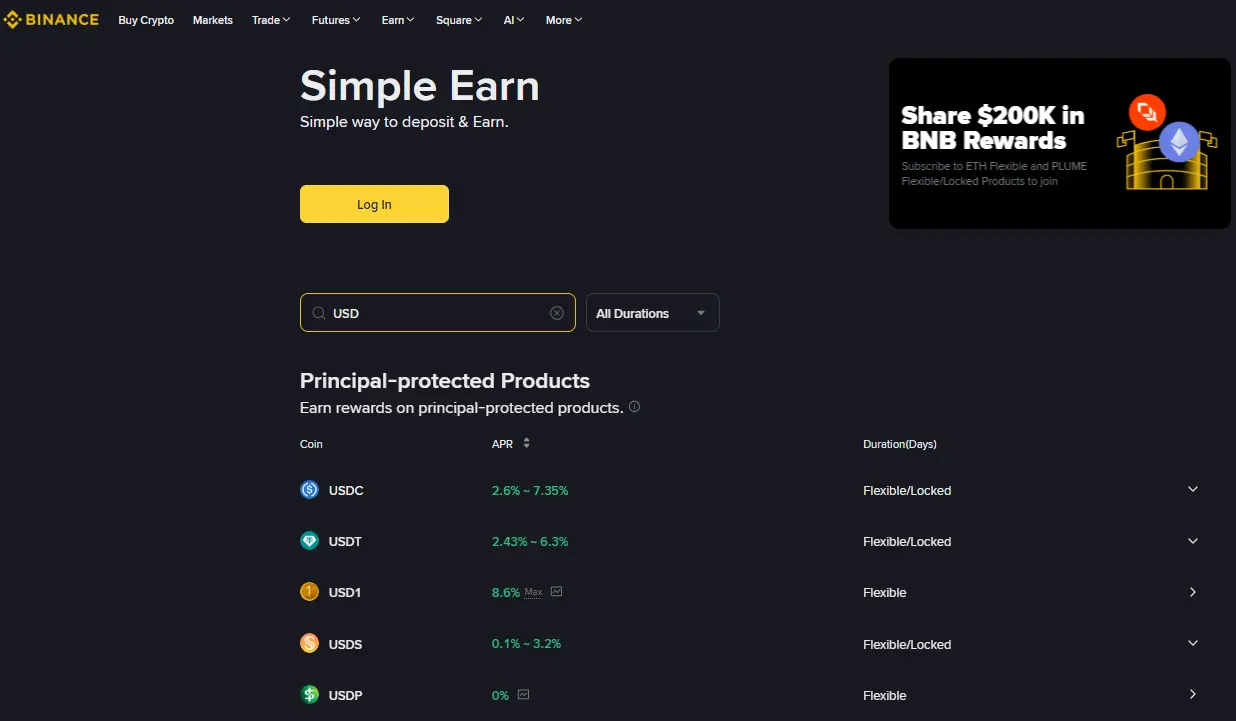
Binance also offers Soft Staking for USDS. Eligible balances automatically accrue rewards while remaining available for trading, providing a more accessible alternative to locking funds. Its USD Yield Hub includes RWUSD and BFUSD products. Users can subscribe to RWUSD with USDC and redeem it back into USDC at a 1:1 ratio, while returns are supported by real-world asset strategies involving US Treasury bills. Binance also provides liquid staking for users seeking returns on other assets, although this sits outside the conventional savings-account model.
Binance Simple Earn Pros and Cons
おすすめポイント
- Several stablecoins supported
- Flexible and fixed terms
- Automatic USDS rewards
- Public Proof of Reserves
注意点
- KYC is mandatory
- Higher rates have quotas
- Product selection feels complex
2. Ledn Growth Accounts
- Best for: Transparent stablecoin lending
- Savings type: Flexible
- KYC: Required
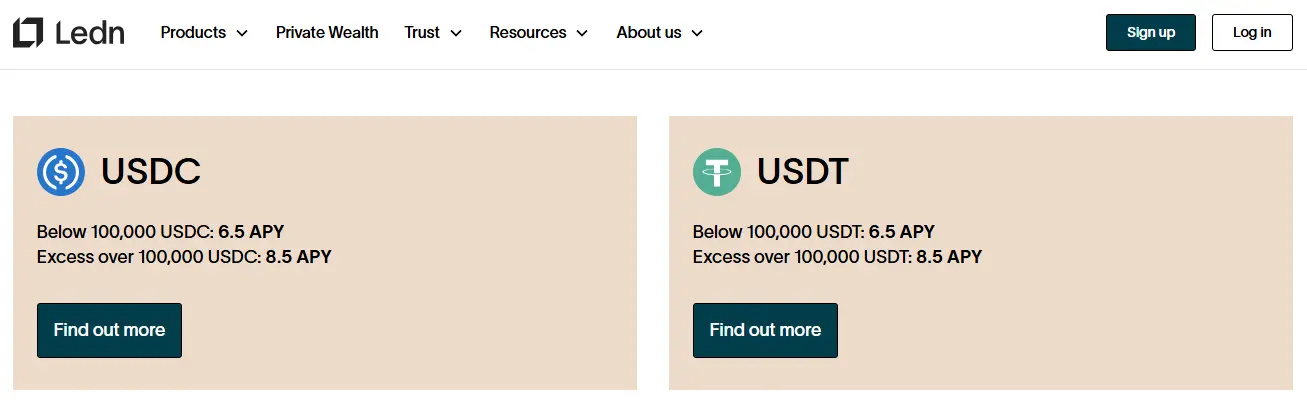
Ledn Growth Accounts are designed specifically for earning interest on USDC and USDT. Both stablecoins earn 6.5% APY on balances below 100,000 units, while only the portion exceeding 100,000 earns 8.5% APY. There is no minimum balance or fixed term, and interest is credited monthly in the same stablecoin.
Ledn generates this yield primarily by lending stablecoins through its Bitcoin-backed retail loan book. These loans are secured at a 2:1 collateral ratio, while Growth Account assets are ring-fenced from Ledn’s other business activities. Funds must be transferred from the Growth Account to the separate Transaction Account before they can be withdrawn or used for another service.
Ledn publishes monthly Open Book Reports and conducts Proof-of-Reserves attestations at least twice yearly. The attestation includes client liabilities, lending operations, and custodial balances, while allowing clients to verify that their balances were included.
Ledn Growth Accounts Pros and Cons
おすすめポイント
- USDC and USDT supported
- No fixed term
- Ring-fenced account structure
- Independent reserve attestations
注意点
- Only 2 supported assets
- Interest paid monthly
3. Coinbase USDC Rewards
- Best for: Earning on idle USDC
- Savings type: Flexible balance rewards
- KYC: required
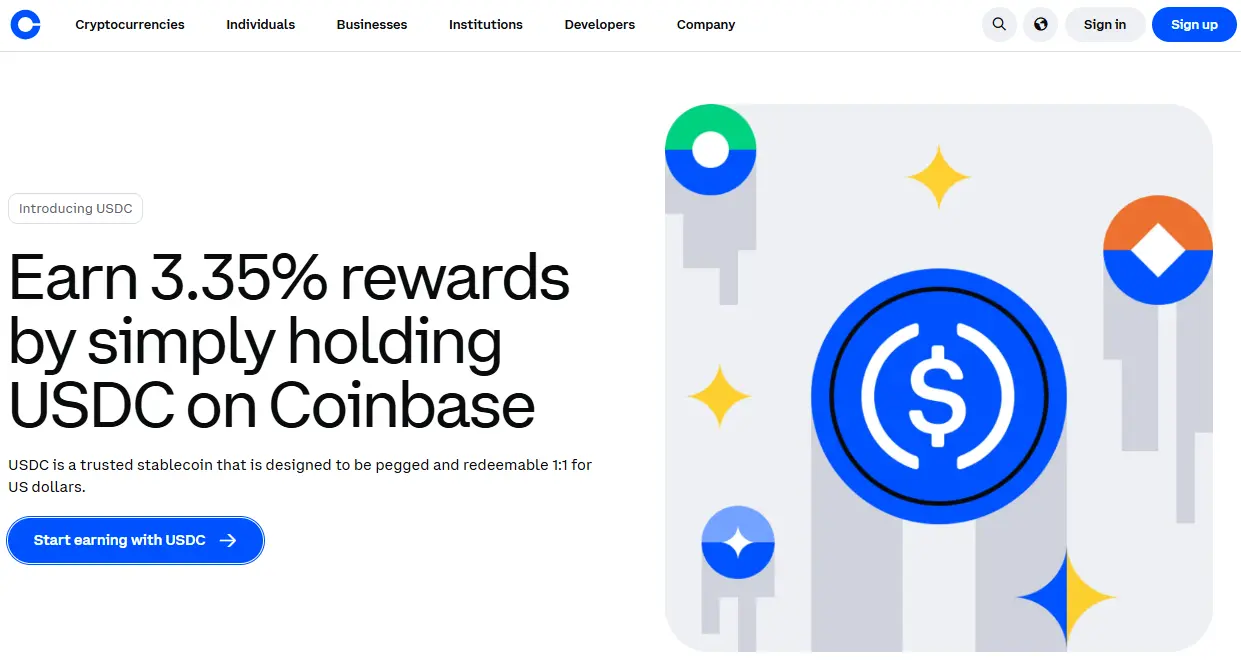
Coinbase offers USDC rewards for eligible accounts holding at least 1 USDC. The rate depends on your country, account type and any promotional offer, so check the rate displayed in your account. There is no separate Earn subscription or fixed term, and your USDC remains available to sell, send, or convert whenever needed. Rewards accrue daily and are distributed weekly. Eligible users may be able to choose rewards in USDC or Bitcoin; see the USDC Rewards terms.
Coinbase does not lend or use your USDC to generate this return. Circle keeps the reserves backing USDC in cash and short-term US Treasury assets, which generate income. Coinbase receives a share of that reserve income through its agreement with Circle and uses part of it to fund USDC Rewards. This is why Coinbase presents the payment as a loyalty reward rather than interest paid directly by Circle.
Eligibility depends on location. Users in the United States, United Kingdom, Australia, and Singapore need a Coinbase One membership, while eligible users in other supported regions can earn by holding at least 1 USDC.
Eligible UK customers can also access Coinbase’s Instant Access Savings Account. This is a separate GBP savings product, with eligible deposits of up to £120,000 protected by the FSCS.
Coinbase USDC Rewards Pros and Cons
おすすめポイント
- No lock-up period
- Weekly reward payments
- Minimum eligible balance of 1 USDC
- Assets held one-to-one
注意点
- Only USDC earns rewards
- Coinbase One membership required in some regions
4. Kraken Stablecoin Rewards
- Best for: Flexible and fixed returns
- Savings type: Flexible and fixed
- KYC: required
Kraken Stablecoin Rewards lets eligible users earn simply by holding supported stablecoins in a Kraken or Krak account. Once Stablecoin Rewards or Auto Earn is enabled, returns begin accruing automatically in the background. There is no minimum balance, holding period, or program fee, and the assets remain available for trading, withdrawal, or transfer.
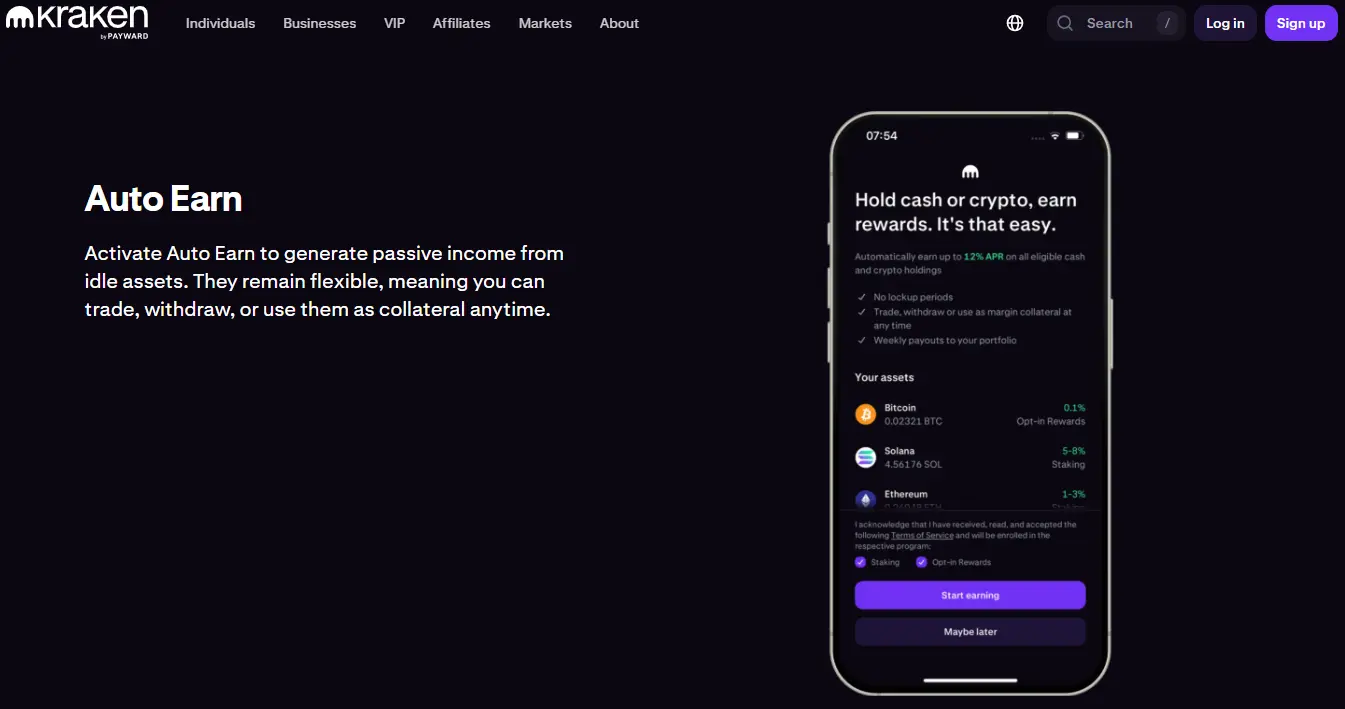
Flexible rewards are available on USDG, USDC, apxUSD, USDe, RLUSD, tokenized GBP, and QCAD, although the selection varies by region. Standard users receive lower base rates. Kraken’s September 17 rate schedule lists Kraken+ rates of up to 4.50% APY on USDG, 4.00% on USDC, 3.75% on RLUSD and 2% on QCAD, subject to regional eligibility. Rates are variable.
Kraken also introduced Fixed Rate Rewards in September 2026. Users can lock USD, EUR, USDT, USDC, or USDG for 3, 6, 12, or 18 months to secure a fixed return of up to 6% APY, according to its launch terms. Unlike flexible rewards, these funds remain committed for the selected term.
Kraken Stablecoin Rewards Pros and Cons
おすすめポイント
- Several stablecoins supported
- No flexible-account minimum
- Assets remain accessible
- Fixed rates available
注意点
- Higher rates require Kraken+
- Fixed funds remain locked
- Availability varies by region
5. Nexo Savings
- Best for: Higher stablecoin rates
- Savings type: Flexible and fixed
- KYC: Required
Nexo provides a crypto savings account for USDT and USDC through flexible and fixed-term plans. Flexible Savings credits interest daily and keeps funds available for redemption. Nexo’s current USDT page advertises annual rates of up to 11.5%, with higher rates available through fixed terms. The applicable rate and term are shown in your account.
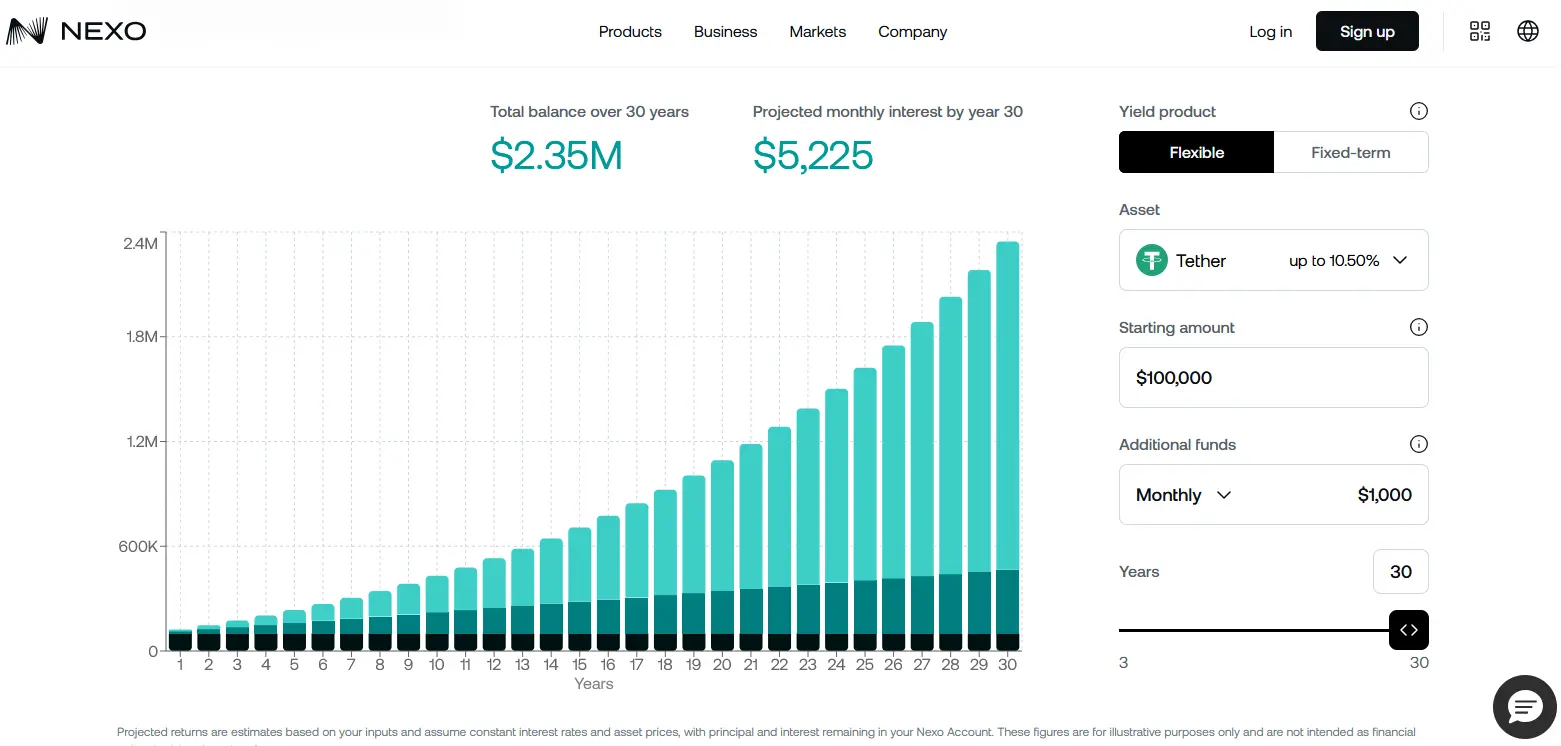
The final rate depends on the user’s Nexo Loyalty Tier, selected term, and payout currency. Choosing to receive interest in NEXO tokens can add up to 2% to the standard rate. Users can also schedule recurring purchases daily, weekly, bi-weekly, monthly, or yearly and fund them through supported methods such as ACH or wire transfers.
Nexo funds these returns through interest spreads on collateralized credit lines, transaction fees from exchange and payment services, and market-neutral treasury strategies. Clients holding at least $100,000 in digital assets can access Nexo Private, which includes personalized onboarding and a dedicated relationship manager. Nexo also provides downloadable transaction histories and tax-reporting tools.
Nexo Savings Pros and Cons
おすすめポイント
- High stablecoin rates
- Daily interest payments
- Flexible and fixed plans
- Automated recurring purchases
注意点
- Loyalty tiers affect returns
- No public live PoR
6. Bitget Simple Earn
- Best for: RWA-backed savings products
- Savings type: Flexible and Fixed
- KYC: required
Bitget Simple Earn supports USDT, USDC, USDGO, U, USDe, USDS, and USTC through flexible and fixed-term products. Current rates reach approximately 6.92% APR on USDT and 6.66% on USDC, although higher-rate offers are subject to subscription quotas.
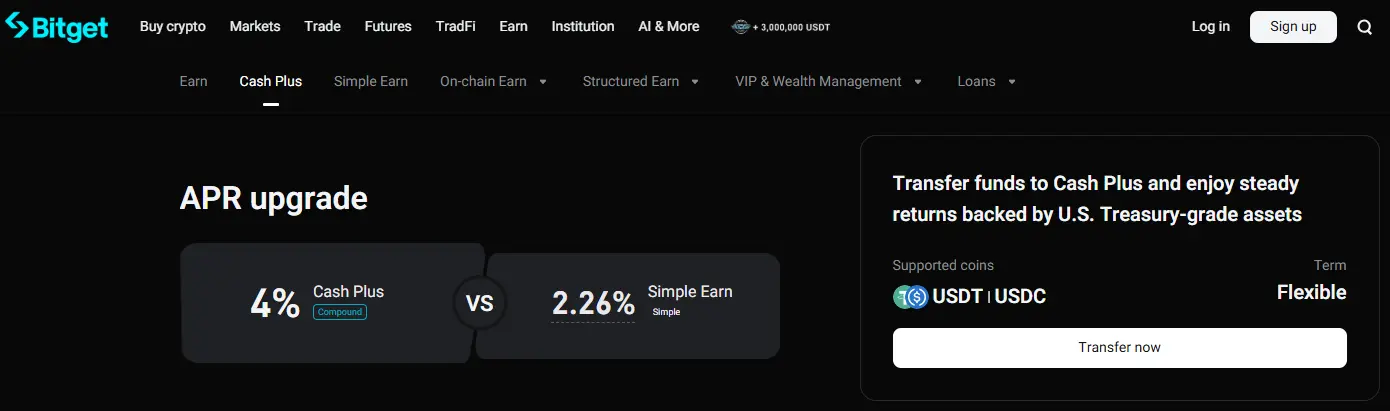
Its Cash Plus product accepts USDT and USDC, pays up to 4% APR with daily compounding, and supports real-time withdrawals. Behind the scenes, deposited funds are converted into USDGO, whose reserves include short-term US Treasuries, Federal Reserve overnight reverse repurchase agreements, money market funds, and cash-management instruments held with federally chartered US banks.
Bitget also offers BGUSD, which it describes as a principal-protected product paying around 3%. That product label does not remove issuer or platform risk. It is backed by a basket of real-world assets, including US Treasuries. Bitget currently reports a 124.01% reserve ratio for BGUSD. USTC is also listed, but it no longer maintains a reliable one-dollar peg and should not be treated like the other supported stablecoins.
Bitget Simple Earn Pros and Cons
おすすめポイント
- Competitive USDT returns
- Daily-compounding Cash Plus
- RWA-backed BGUSD available
- Public reserve disclosures
注意点
- Higher rates have quotas
- Only USD-based stablecoins
7. KuCoin Savings
- Best for: USDG holders
- Savings type: Flexible and Fixed
- KYC: required
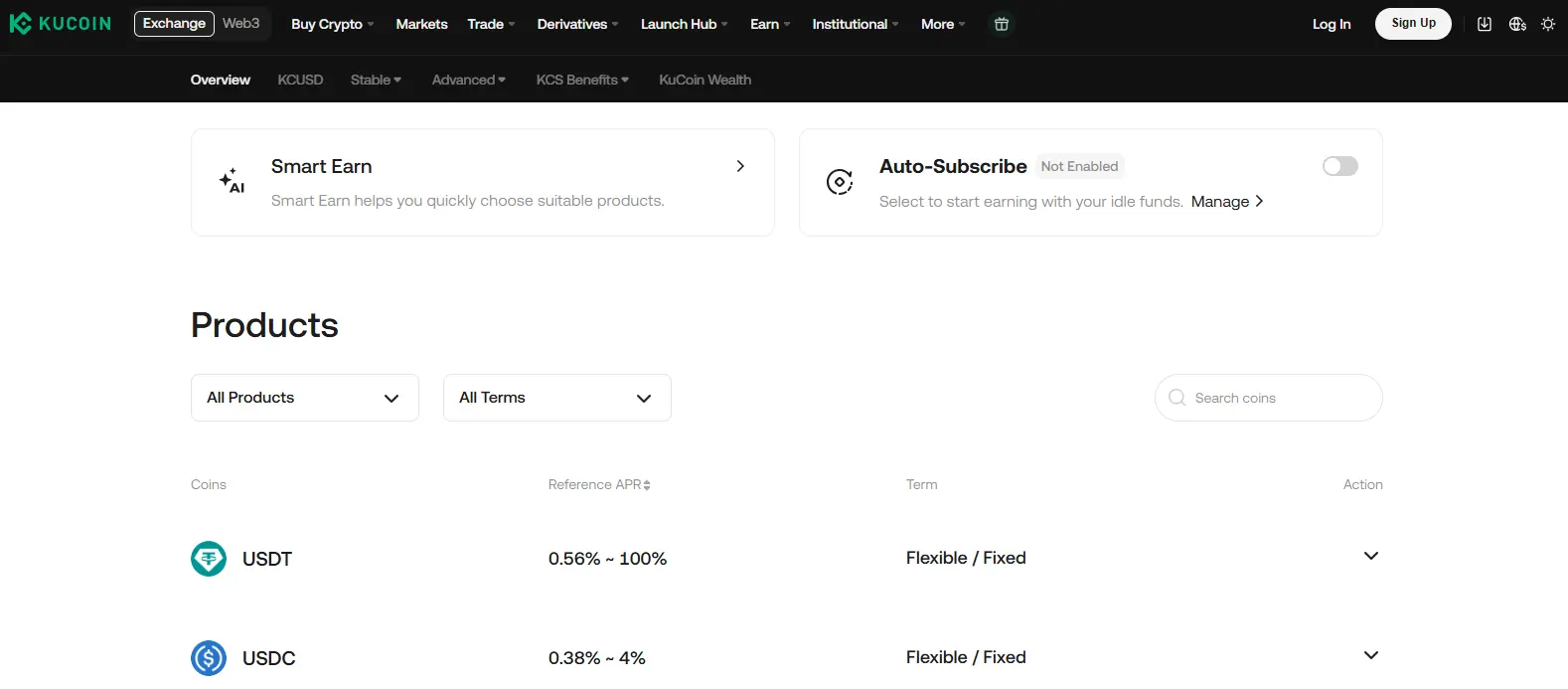
KuCoin Earn supports USDT, USDC, USDG, USDD, USDe, and U through flexible and fixed-term products. The comparison above uses the advertised USDG reference rate of up to 6% APR. Other assets have different rates, and some promotions apply only to a small qualifying balance. The KuCoin Earn page lists reference APRs, with different offers for each asset and term; promotional tiers can apply only to limited balances.
Users who do not want to subscribe to a separate Earn product can use Hold-to-Earn. After it is enabled, this feature pays rewards for maintaining an eligible USDG balance while keeping it accessible. Check the current rate and eligibility in your account.
KuCoin also offers KCUSD, which it describes as a principal-protected Earn product with returns linked to tokenized US Treasury securities. The label does not provide bank deposit insurance or remove platform risk. Earnings accrue daily and are paid according to the product terms. While KCUSD provides another dollar-based earning option, it follows a different structure from regular flexible stablecoin savings.
KuCoin Savings Pros and Cons
おすすめポイント
- USDG Hold-to-Earn available
- Public Proof of Reserves
- Treasury-backed KCUSD available
注意点
- Low USDT and USDC returns
8. Bybit Easy Earn
- Best for: USD-based stablecoin selection
- Savings type: Flexible and fixed
- KYC: required
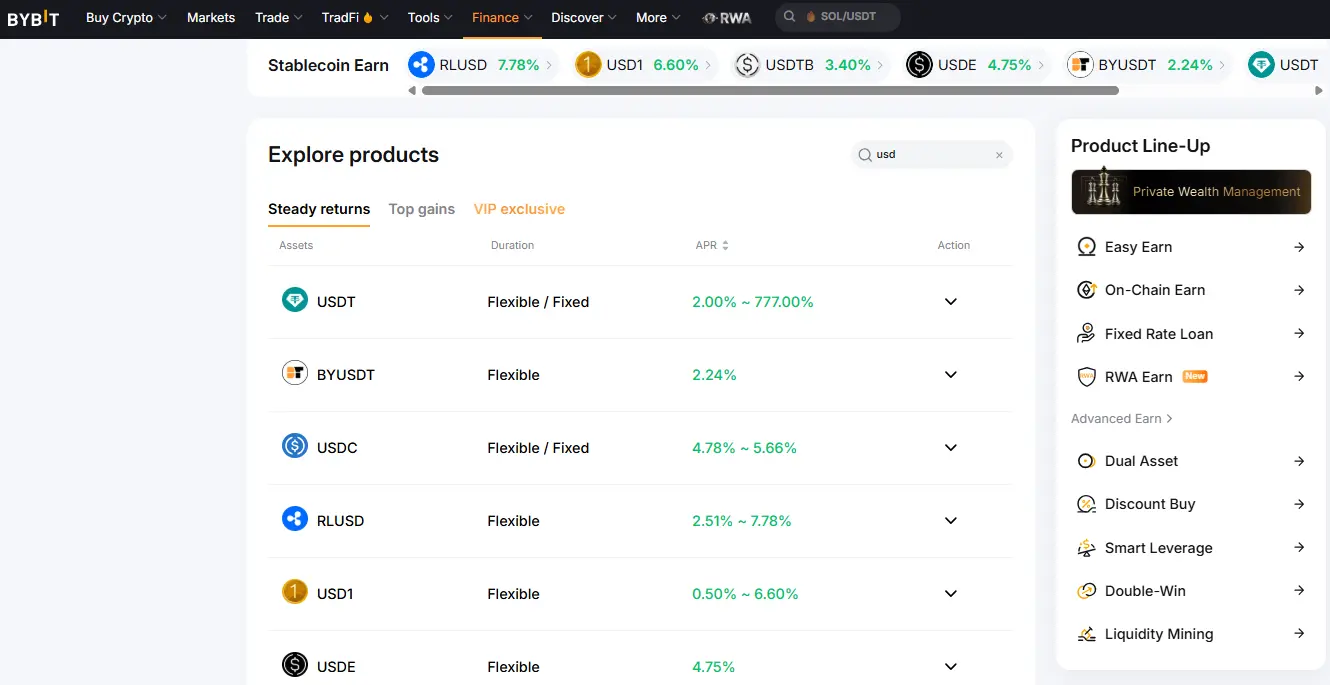
Bybit Easy Earn supports seven dollar-based stablecoins: USDT, BYUSDT, USDC, RLUSD, USD1, USDe, and USDTB. Users can place these assets in Flexible Savings to retain access to their funds or select fixed-term products for a stated period. Advertised returns reach up to 6.24% APY, although the available rate depends on the stablecoin, term, account eligibility, and subscription quota.
Rewards begin accruing after a successful subscription and are credited according to the conditions of the selected product. The stablecoin selection is entirely linked to the US dollar, so there are no euro-backed or pound-backed options. Bybit also has an RWA-backed Earn section, but those products follow different structures and carry additional issuer, liquidity, and underlying-asset risks compared with regular stablecoin savings.
Bybit Easy Earn Pros and Cons
おすすめポイント
- 7 stablecoins supported
- Flexible and fixed products
- Public Proof of Reserves
注意点
- Only USD-based stablecoins
- Higher rates have quotas
9. Crypto.com Earn
- Best for: Existing Crypto.com subscribers
- Savings type: Flexible and fixed
- KYC: required
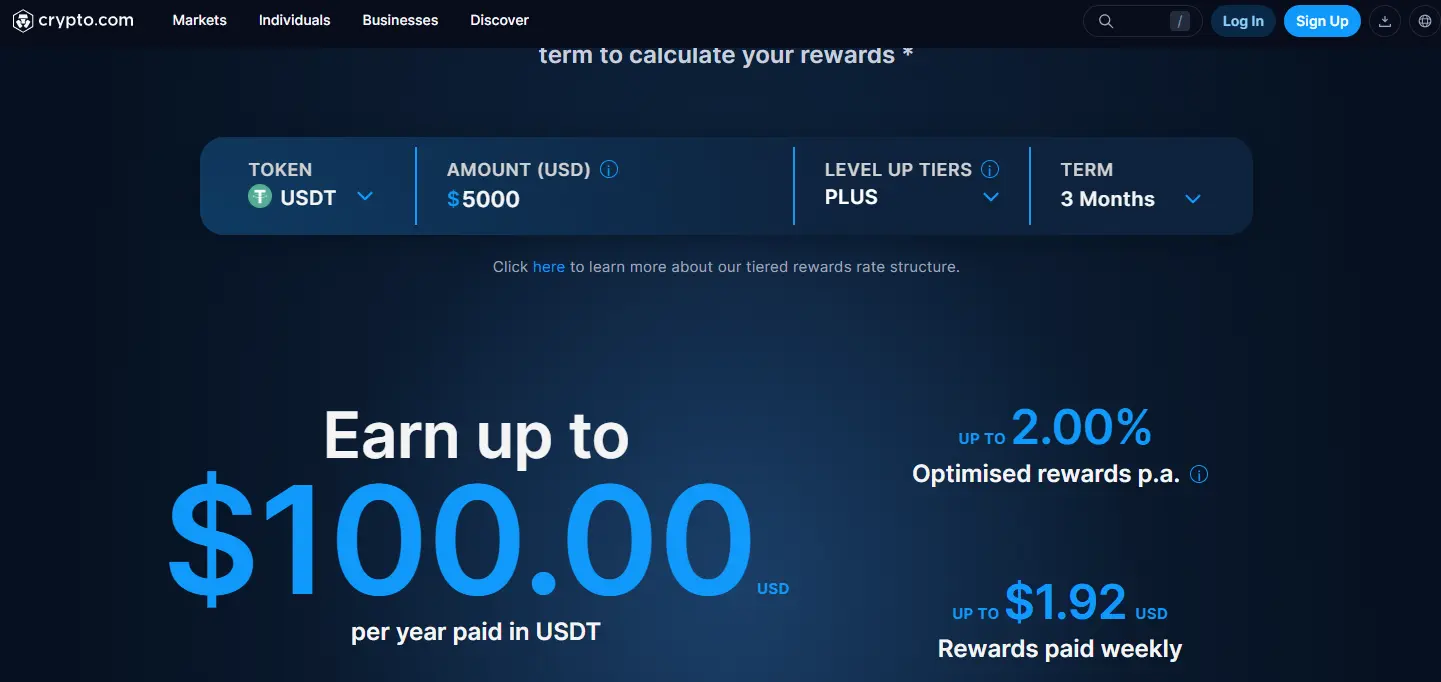
Crypto.com Earn supports USDT and USDC through flexible plans paying up to 0.50% annually. Users willing to commit funds for up to 3 months can earn as much as 2% annually. USDP and DAI are also supported, but only through fixed-term allocations. Access to these products is limited to users subscribed to an eligible Crypto.com membership plan.
Crypto.com has also announced an upcoming cash rewards product offering up to 4.5% annually for Plus members, with higher rates planned for Pro and Private members. Unlike Crypto Earn, this product will generate returns on fiat cash rather than stablecoins. It is expected to have no minimum balance or lock-up period. However, Crypto.com has not yet disclosed its launch date, supported regions, or how the cash yield will be generated, so it is not part of the rate comparison on this page.
Crypto.com Earn Pros and Cons
おすすめポイント
- Flexible USDT and USDC
- Short fixed terms
- Daily reward accrual
注意点
- Paid membership required
- Flexible rates are low
10. Bitunix Easy Earn
- Best for: Earning without mandatory KYC
- Savings type: Flexible and fixed
- KYC: optional
Bitunix is an optional KYC crypto savings account supporting USDT and USDC alongside other assets. Easy Earn includes flexible products that can be redeemed at any time and fixed terms of 7, 14, or 30 days. Flexible earnings are calculated hourly and automatically added to the subscribed balance.
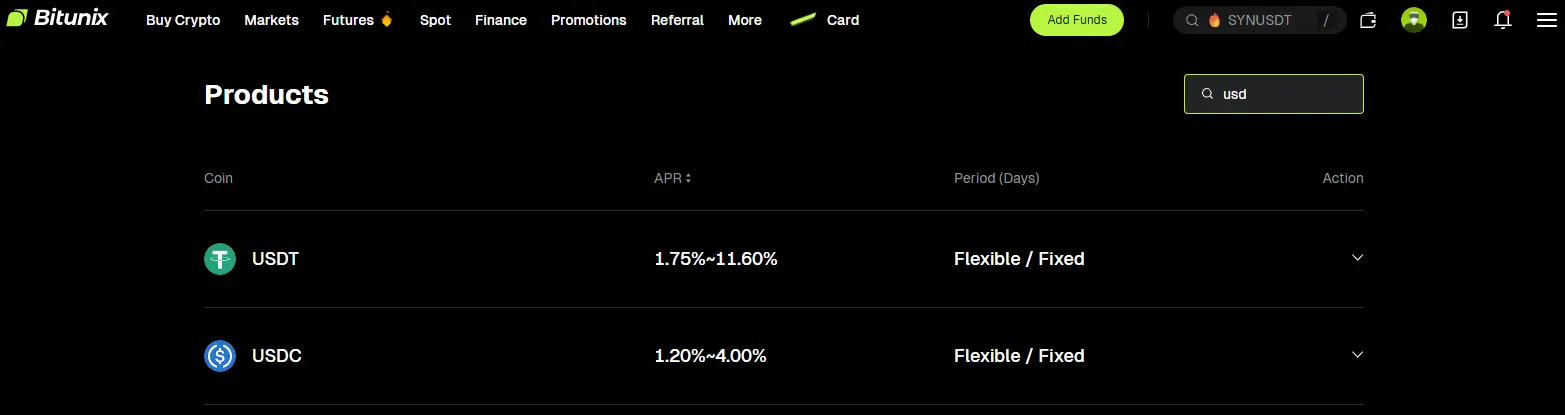
Rates and quotas are shown in the selected Easy Earn offer and can differ by asset, term and account tier. Check how much of your balance qualifies for a promotional rate and what the remainder earns. Bitunix Card Auto Earn is a separate product; its advertised 11.6% APR tier should not be treated as the standard Easy Earn rate.
Bitunix allows unverified users to access Easy Earn, although withdrawal limits apply and identity verification may still be requested during account or compliance reviews. Product access can also vary by jurisdiction.
Bitunix Easy Earn Pros and Cons
おすすめポイント
- Optional KYC
- Hourly interest calculation
注意点
- High APY has quotas
- VIP level affects rates
11. Sky sUSDS
- Best for: Self-custodial savings without KYC
- Savings type: Flexible and fixed
- KYC: No-KYC
Sky offers non-custodial stablecoin savings through sUSDS, currently the world’s largest yield-bearing stablecoin. Users supply USDS and receive sUSDS, which automatically accrues the 3.60% Sky Savings Rate while remaining liquid. The rate comes from Sky Protocol’s aggregate surplus, generated through protocol revenue rather than one borrower, pool, or investment strategy.
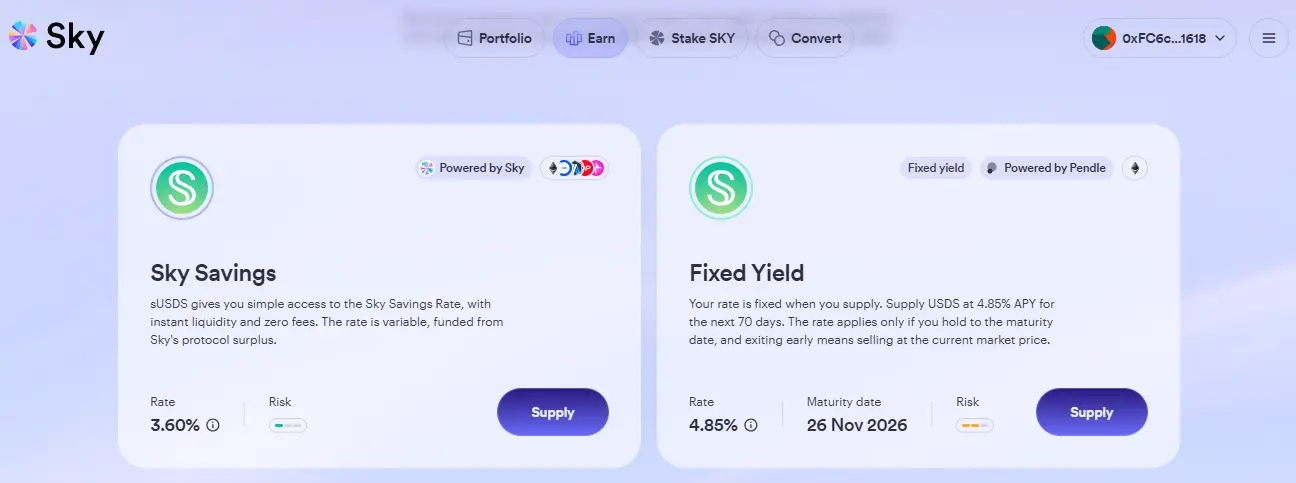
The rate is set through public onchain governance and can be increased or reduced by SKY token holders. Sky also offers fixed yield through a Pendle integration, currently paying 4.85% APY when held until maturity. Exiting early means selling at the prevailing market price, which may be higher or lower than the original value.
Sky.money charges no entry, exit, or performance fee, although blockchain gas fees may apply. USDS backing, collateral levels, and governance changes can be verified onchain. The protocol also uses overcollateralization and formal risk controls, but smart-contract and stablecoin risks remain.
Sky sUSDS Pros and Cons
おすすめポイント
- No KYC required
- Assets remain self-custodied
- Backing is publicly verifiable
- No platform yield fees
- Fixed yield available
注意点
- Only USDS supported
- Governance controls flexible rate
- Early fixed exits fluctuate
12. GRVT Earn on Equity
- Best for: Earning while actively trading
- Savings type: Automatic and flexible
- KYC: optional
GRVT Earn on Equity turns eligible USDT and USDC held across Funding and Trading balances into an automatic crypto savings account. Eligible users earn a variable base rate of 3.50% APY without subscribing, locking funds, or transferring assets into a separate Earn wallet. The balance remains available for trading, transfers, and withdrawals, and there is no maximum earning amount.
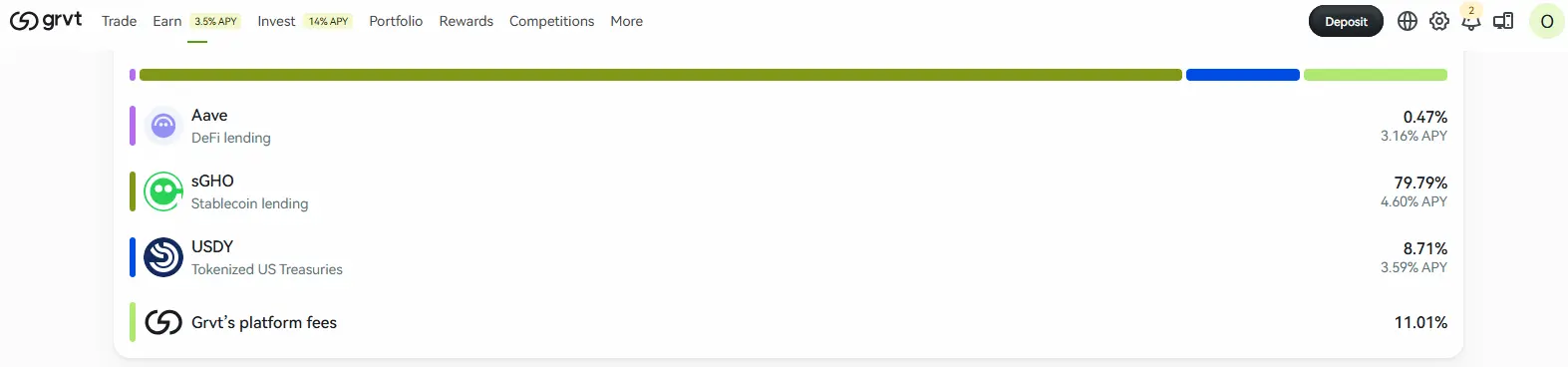
GRVT generates yield through third-party DeFi and real-world asset sources. Its current Earn on Equity terms cover USDT and USDC in funding and trading accounts, with daily payouts in USDT. Funds in Strategies vaults are excluded. The underlying protocols can suffer exploits, depegs or insolvency, so the quoted APY does not guarantee your principal.
Wallet-based access does not require KYC, although GRVT may conduct compliance reviews or request identity information where necessary.
GRVT Earn on Equity Pros and Cons
おすすめポイント
- Earn while trading
- No balance limit
- No lock-up period
- Transparent yield sources
- Wallet-based access
注意点
- Yield paid only in USDT
- Underlying-protocol risk
Risks of Using Crypto-Saving Accounts
Crypto savings accounts can generate returns on idle stablecoins, but the balance is exposed to risks that do not exist in a conventional insured savings account.
- Platform insolvency: A provider may become unable to repay customer balances.
- Counterparty risk: Borrowers or investment partners may fail to meet their obligations.
- Stablecoin depegging: A stablecoin may lose its intended value against the dollar.
- Withdrawal restrictions: Platforms may delay or suspend redemptions during periods of financial stress.
- Smart-contract failures: Onchain savings products can lose funds through coding errors or exploits.
- Variable returns: Flexible APYs can be reduced without advance notice.
- Fixed-term limitations: Locked balances may be unavailable or penalized for early redemption.
- Regulatory restrictions: A product may become unavailable in a particular country.
- No deposit insurance: Most crypto balances are not protected like bank deposits.
- Misleading headline rates: The highest APY may apply only to a small balance or limited quota.
Tips to Choose a Cryptocurrency Savings Account
The highest advertised rate should not be the only deciding factor. A useful comparison considers how the return is generated, when funds can be accessed, and what protection exists if the provider experiences financial trouble.
- Check the effective rate: Calculate the APY that applies to your actual balance, not just the advertised maximum.
- Understand the yield source: Identify whether returns come from lending, reserve income, Treasuries, or DeFi strategies.
- Review reserve evidence: Look for Proof of Reserves, liability reporting, financial audits, or onchain collateral data.
- Check withdrawal terms: Confirm lock periods, redemption times, early-exit conditions, and withdrawal limits.
- Assess the stablecoin: Review its issuer, reserves, redemption process, and previous peg stability.
- Consider account access: Check KYC requirements, supported countries, memberships, and loyalty tiers.
- Review the provider’s history: Look for security incidents, withdrawal suspensions, and previous customer losses.
- Check all costs: Include platform fees, performance fees, spreads, network fees, and subscription charges.
- Separate product risks: Flexible savings, fixed terms, tokenized Treasuries, and DeFi vaults carry different risks.
Is There Any Tax on Interest Earned From Crypto Savings?
Interest earned through crypto savings accounts may be taxable even if it is paid in stablecoins rather than fiat. In many jurisdictions, rewards are treated as income when they are credited to your account or become available for withdrawal. The taxable amount is generally based on the market value of the reward when received. That value may also become the cost basis for a later sale, conversion, or payment.
If the asset is subsequently sold above or below that value, a separate capital gain or loss may arise. Fixed-term rewards, automatic balance rewards, and DeFi savings can receive different treatment depending on local law. Keep records of reward dates, amounts, market values, and disposals, and check the rules applicable locally. For US readers, the IRS digital-assets guidance explains income reporting and disposals.
Bottom Line
If you came here looking for a crypto version of a traditional savings account, stablecoin products are the closest match. They let you earn a relatively steady return on assets designed to track fiat currencies, while flexible accounts may keep the balance available for trading or withdrawal. Other assets are sometimes supported, but their price can move far more than the interest earned, making them less suitable for the usual savings concept.
Crypto savings accounts are only one method of generating returns. Our article on earning passive income with crypto covers staking, lending, liquidity farming, copy trading, and other methods. These options can provide higher returns, but they also introduce greater market, platform, and strategy risks.
FAQs
A crypto savings account lets you earn returns on stablecoins or other assets held with a platform. Depending on the product, rewards may accrue automatically or require placing funds into flexible or fixed-term savings.
Crypto savings accounts carry platform, counterparty, stablecoin, liquidity, and smart-contract risks. Proof of Reserves, independent attestations, audits, and onchain collateral data improve transparency, but they do not guarantee repayment or prevent losses.
Most crypto savings accounts are not protected by bank deposit insurance. Some platforms may have insurance covering specific custody or security incidents, but this generally does not protect users against insolvency, lending losses, or stablecoin depegging.
Yes. Losses can result from depegging, platform failure, lending defaults, withdrawal restrictions, or smart-contract exploits.
Yes. Flexible savings accounts generally let you redeem stablecoins whenever needed. Coinbase, GRVT, and some Hold-to-Earn products also generate rewards on eligible account balances without requiring a separate fixed-term subscription.
Returns may come from lending, stablecoin reserves, US Treasuries, DeFi markets, transaction fees, or treasury strategies.
Usually, but some platforms apply processing periods, redemption limits, or temporary withdrawal restrictions.
Higher returns usually reflect stronger borrowing demand and greater platform, liquidity, counterparty, or stablecoin risk.