GMX Review 2026: Perps, Fees, and Platform
이 페이지에서
종합 평가
GMX earns a solid place among decentralized perpetuals exchanges, offering genuinely high leverage, no KYC friction, and a clean interface that borrows the familiar feel of centralized platforms while keeping funds self-custodied. We appreciate the multi-network support and the layered security work, including multiple auditing firms and a substantial bug bounty program.
| 통계 | GMX |
|---|---|
| 자산 | |
| 선물 계약(암호화폐) | 120 |
| 수수료 | |
| 선물 수수료 (메이커/테이커) | 0.04% / 0.06% |
| 거래 | |
| 현물 24시간 거래량 | $0 |
| 선물 24시간 거래량 | $23,593,204 |
| 최대 레버리지 | 100× |
| CryptoWinRate 점수 | 6.8/10 |
- GMX is a decentralized perp DEX offering up to 100x leverage without KYC requirements.
- Trades execute against liquidity pools instead of order books, keeping execution fully on-chain.
- Supports 103+ perpetual contracts and spot swaps across multiple supported networks.
- Fees are dynamic, with derivatives around 0.04% to 0.06% and swaps varying by pool impact.
- GMX Account enables shared liquidity trading, while wallet-only mode keeps funds self-custodied.
- Smart contracts are audited, though GMX previously faced a GLP pricing exploit incident.
- GMTrade extends the model to Solana with higher leverage but operates independently.
GMX Overview
Decentralized trading has been evolving as more traders look to keep their activity private and reduce reliance on centralized exchanges. Each new platform brings a different approach. In the case of GMX, it introduces a multi-asset liquidity pool model designed to bring a more familiar trading experience while staying aligned with DeFi principles. In this GMX review, we will go through the exchange, its features, leverage, security, and overall experience to help you assess whether it fits your trading needs.
GMX is a decentralized perpetuals exchange that started in 2021, initially launching on Arbitrum before expanding to Avalanche. Built from the merger of earlier projects, it focuses on offering leveraged trading in a fully on-chain environment without relying on custodial control or KYC requirements.
At its core, GMX runs on a multi-asset liquidity pool model, where traders interact with pooled liquidity instead of traditional order books. This allows the platform to support both spot and derivatives trading while keeping execution fully on-chain.
The platform supports up to 8 networks, with Arbitrum acting as the primary hub through GMX accounts, while wallet-only trading extends access to other supported chains. Users can swap spot assets, mostly in wrapped form, and access 103+ perpetual contracts using collateral such as WETH, USDC, or GMX, with leverage of up to 100x. In terms of activity, GMX records around $51.89 million in daily perpetual trading volume, with TVL exceeding $261.65 million, reflecting steady liquidity and consistent usage across its markets.
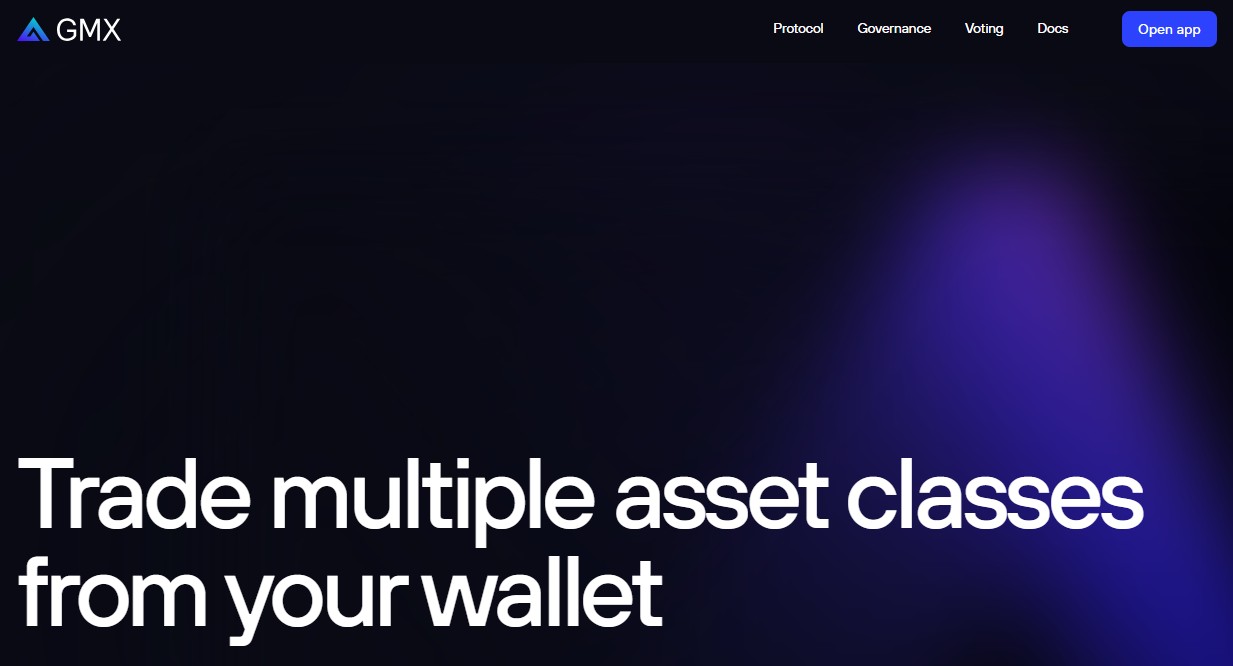
Fees on GMX are dynamic and depend on how your trade impacts the balance of the liquidity pool. For derivatives trading, fees start at around 0.04% for both makers and takers. For spot trading, GMX uses atomic swaps, which come with higher costs, with swap fees reaching up to around 3.75% due to direct pool execution.
GMX places strong emphasis on smart contract security, which is critical for a protocol handling leveraged trading and pooled liquidity. Its contracts have been audited by firms such as Guardian Audits, Dedaub, Zellic, and Sec3. The protocol also runs a bug bounty program on Immunefi, with rewards going up to $5 million.
GMX has faced a security incident in its earlier V1 design. The exploit involved a re-entrancy attack where the attacker manipulated the GLP token pricing mechanism to drain funds from the liquidity pool. The initial loss was around $42 million, though approximately $40 million was later returned after a 10% white-hat bounty agreement.
GMX Pros & Cons
장점
- Up to 100x leverage on perps
- Liquidity pool model reduces slippage
- Earn through staking and pools
- Built on Arbitrum with lower gas
- Transparent, on-chain execution
- Low Slippage
- Multi-Chain Accessibility
아쉬운 점
- Fees can be high and dynamic
- Relies heavily on wrapped tokens
- No order book for advanced traders
- Smart contract risks still exist
- Interface and setup can confuse beginners
GMX Sign-up & KYC
GMX is a decentralized, non-custodial platform, which means users can start trading using a compatible wallet without going through KYC or email sign-ups. Access is entirely wallet-based, and users retain full control over their funds at all times. Here is how you can connect your wallet to GMX and start trading:
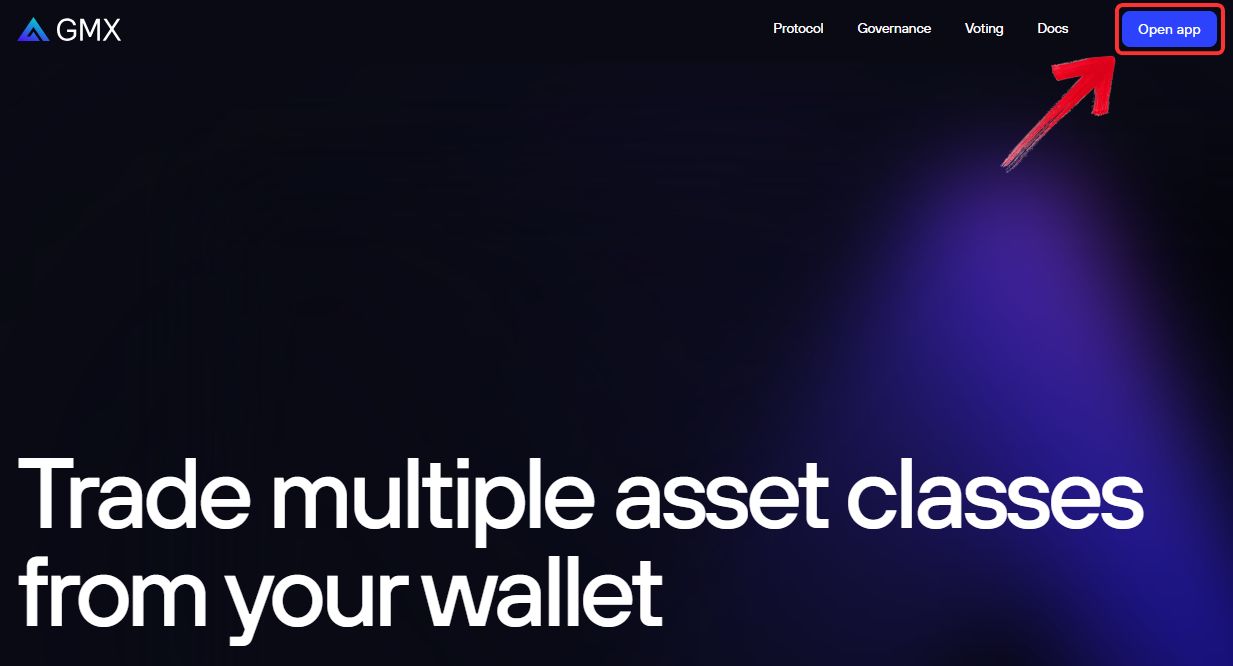
Step 1: First, head over to the official GMX website and click on “Open App” to access the trading platform.
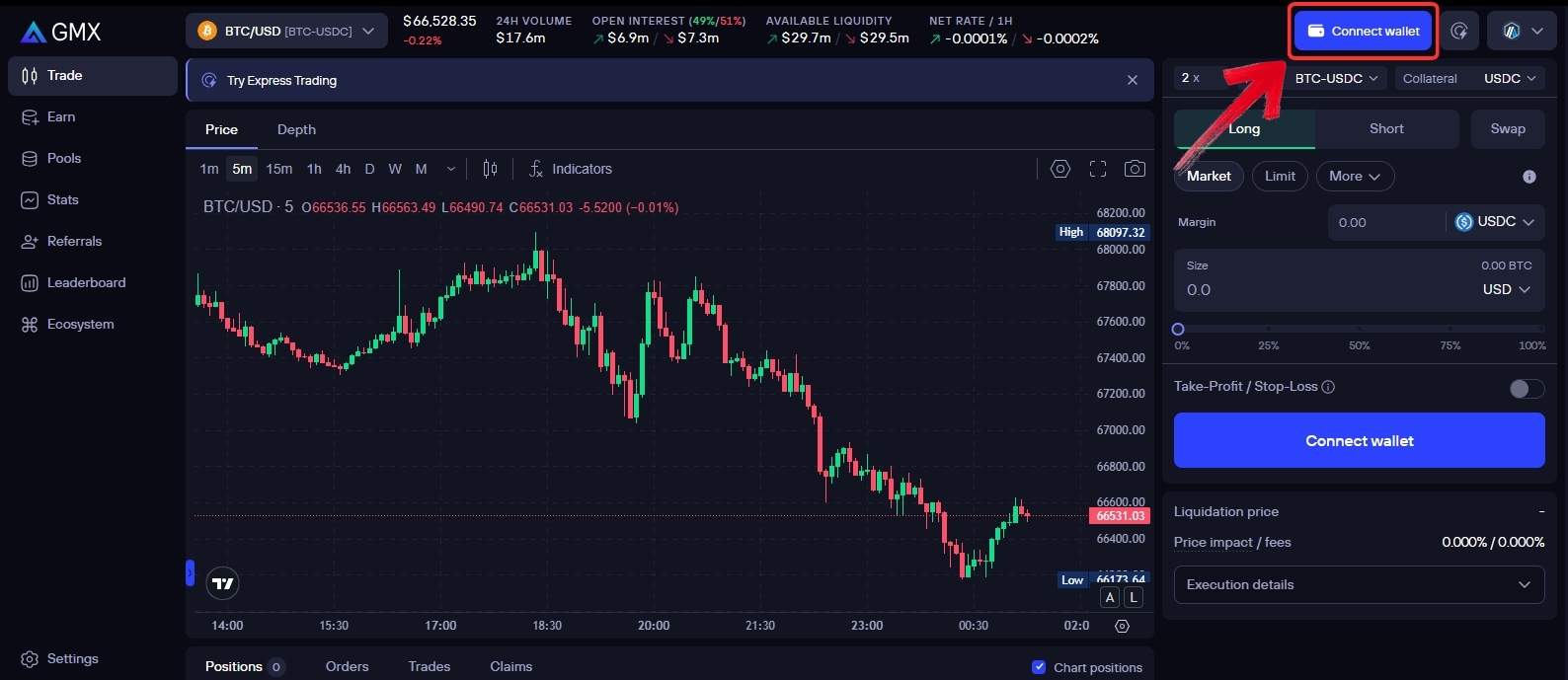
Step 2: Once you are on the platform, click on “Connect Wallet” to begin linking your wallet.
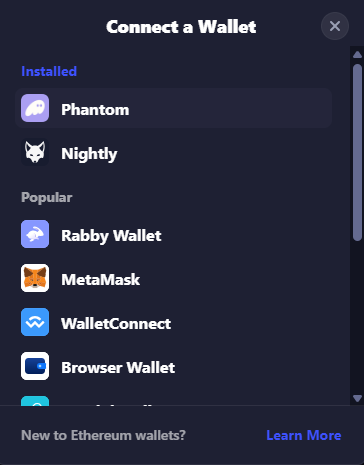
Step 3: GMX supports multiple networks, so you will need a compatible wallet to proceed. Select your preferred wallet from the available options.
Step 4: After selecting your wallet, a pop-up will appear asking for signature approval. Sign the message to complete the connection.
Once your wallet is connected, the sign-up process is complete. To start trading, you will need to fund your wallet with supported assets.
Supported Networks
GMX currently supports up to eight networks, divided into two categories: Wallet-only and Wallet & GMX Account.
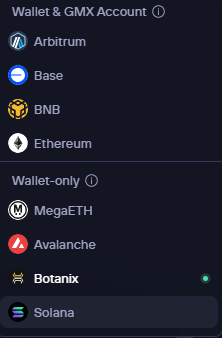
The GMX Account model allows users to trade using shared liquidity on the main hub, primarily on Arbitrum, while still being able to interact from supported chains like Ethereum, Base, and BNB Chain. Pricing is powered by Chainlink Data Streams for more accurate execution.
In Wallet-only mode, users trade directly on supported chains such as Avalanche, Botanix, and MegaETH, where network-specific fees apply.
GMX also has exposure to Solana through a separate platform called GMTrade. This operates on a different domain with its own infrastructure and allows on-chain trading with higher leverage, but it is managed independently and requires a separate wallet connection.
GMX Products and Services
GMX has moved beyond being a platform focused only on derivatives trading, now offering more features like vaults, copy trading, and other tools. Let’s take a look at what GMX offers its users.
GMX Trading Platform
The GMX trading platform is the main area where users access perpetuals and spot swaps. You can open long or short positions, swap tokens, adjust slippage, and manage trade size, leverage, and collateral from one interface. The layout includes TradingView charts, the order panel, and open position details, so it feels familiar if you have used a centralized exchange before.
Users can also use the leverage selector, size slider, and margin section to control exposure more precisely. For faster execution, one-click trading can be enabled in settings, while Express Trading may be available on supported chains. It is also important to check which GM or GLV pool your market uses, since that affects liquidity and fees.
GMTrade
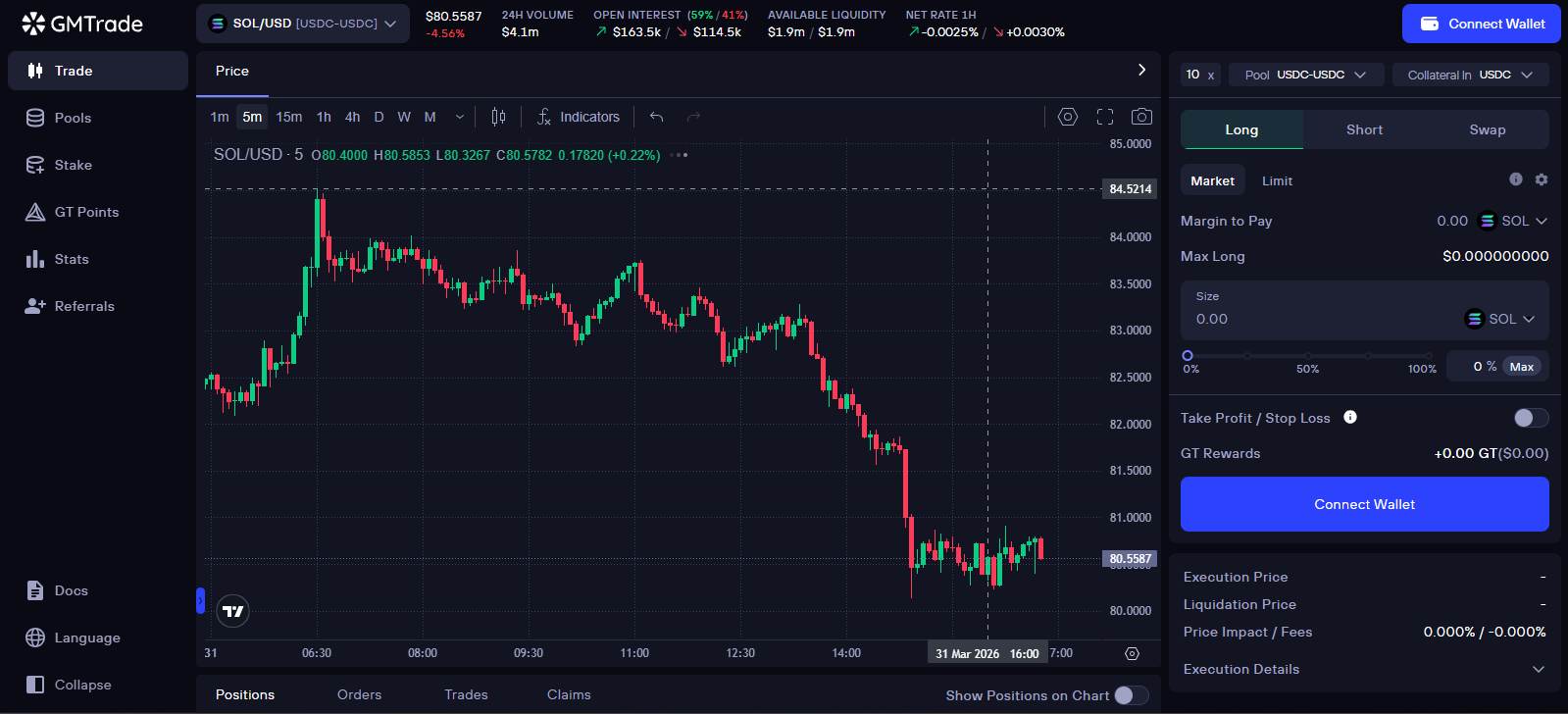
GMTrade is a separate platform from the main GMX app. It is built on Solana and gives users access to pool-based trading in a setup inspired by GMX. On this platform, users can trade Solana-based assets and access leverage of up to 500x. It is not part of the standard GMX interface, so it runs on its own domain, uses separate wallet connections, and is managed independently.
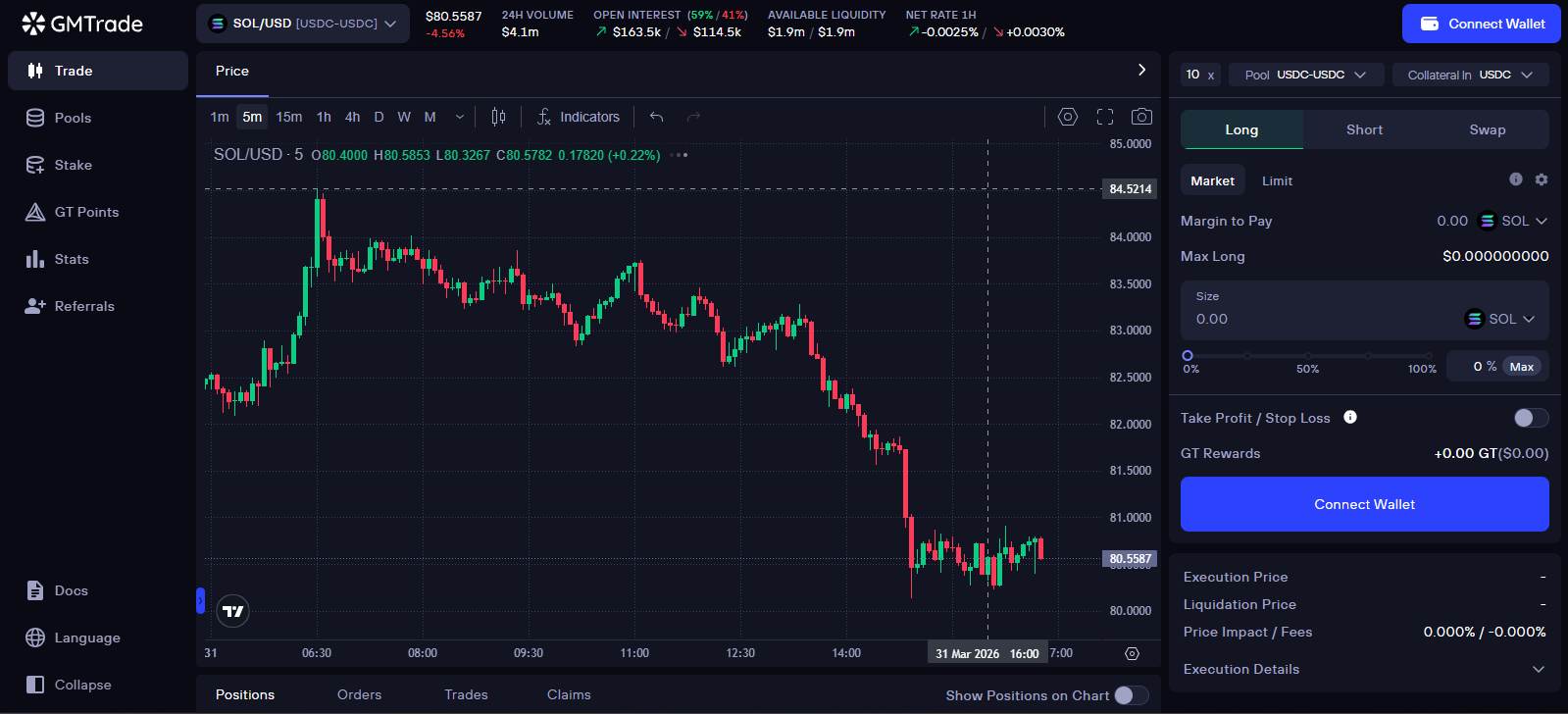
For users who mainly trade on Solana, it works as an alternative route to access a similar trading model.
Stats
The Stats section is where users can track protocol activity and market-level data. It usually shows metrics such as total trading volume, open interest, available liquidity, fees generated, and borrowing rates.
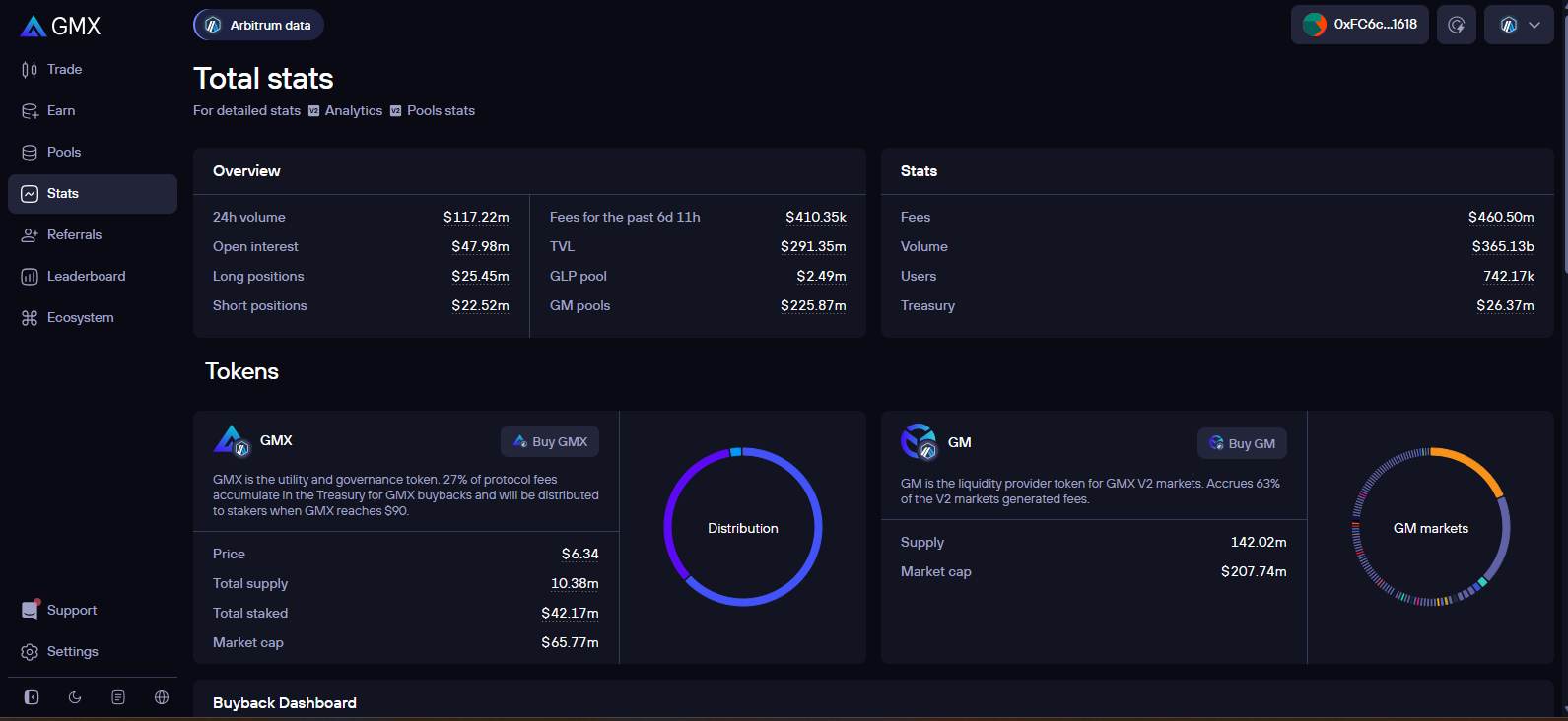
This section is useful for users who want a clearer view of how active the platform is before trading or providing liquidity. It can also help when comparing markets, checking demand, or understanding how much activity is flowing through GMX at a given time.
Pools
The Pools section is for users who want to provide liquidity rather than actively trade. GMX offers GM Pools and GLV Vaults here. GM Pools give more direct market-specific exposure, so users can choose a pool tied to a specific trading market. GLV Vaults are more hands-off and spread liquidity across multiple pools, which can reduce the need to manage allocations manually.
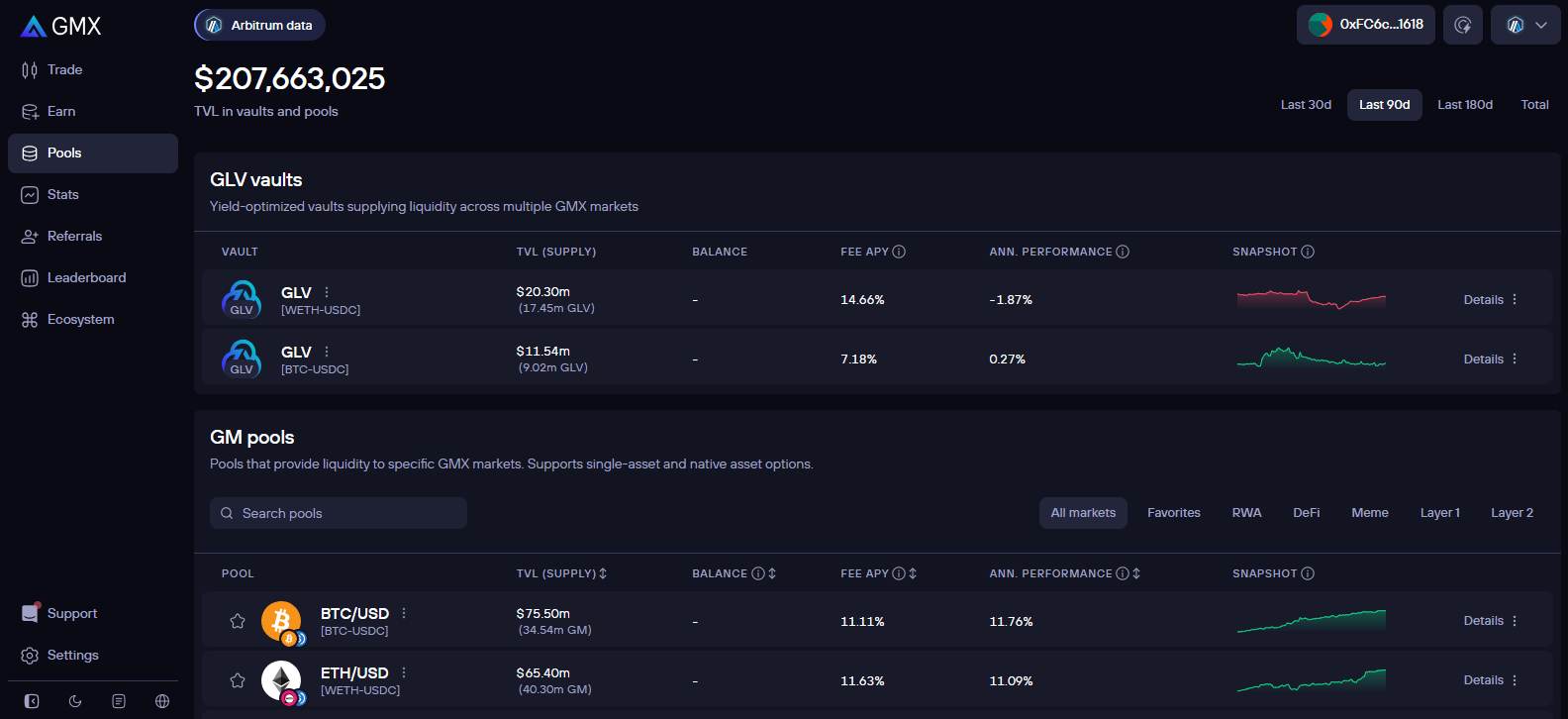
Users can deposit, withdraw, or shift liquidity between supported pools from this section. Before joining, it is worth checking pool size, utilization, fee generation, and long-short balance, since these affect how the pool behaves and what kind of exposure you are taking.
Earn
The Earn section brings together the passive side of GMX. This is where users can stake GMX tokens, deposit into pools, and monitor the rewards they are generating from protocol activity. It gives a combined view of earnings, estimated APRs, and positions tied to staking or liquidity provision.
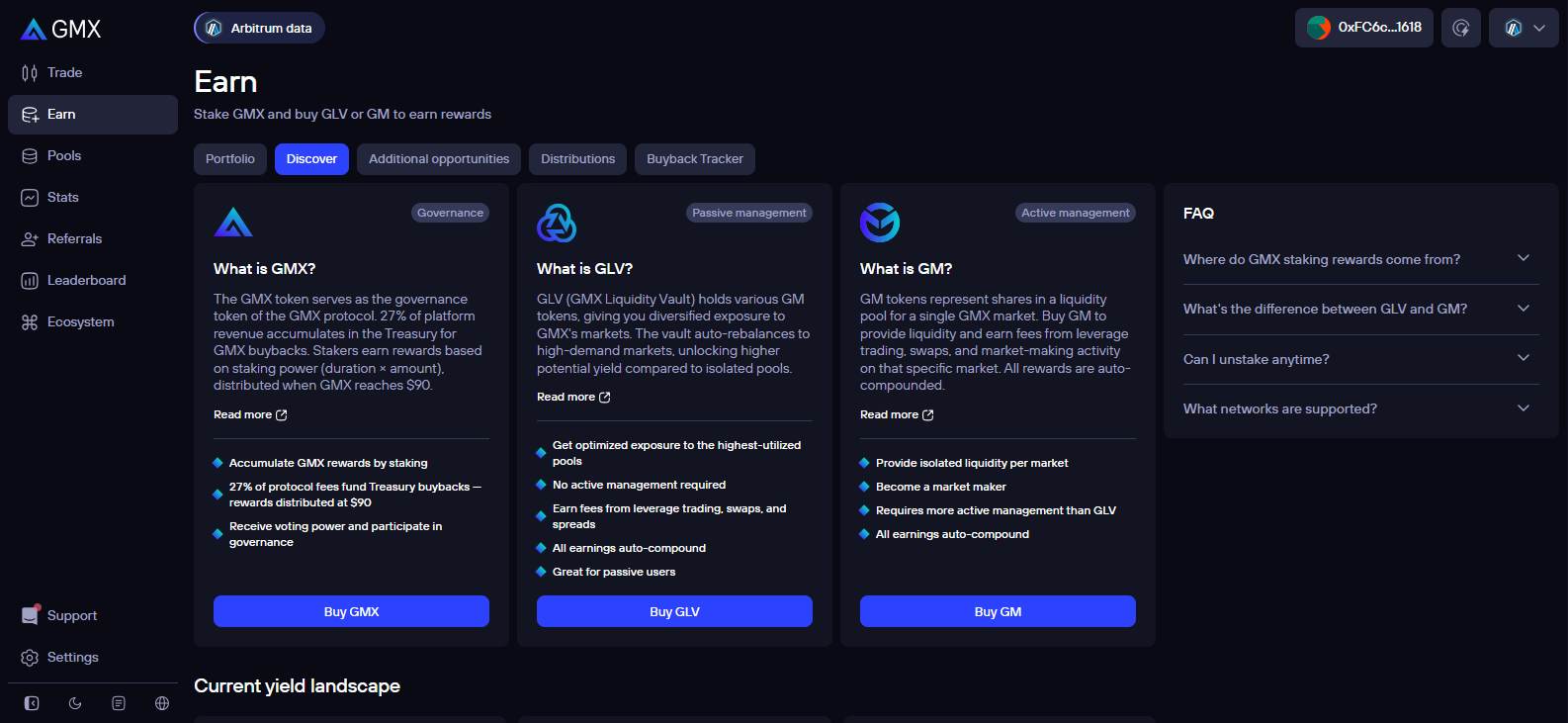
In practical terms, this section is meant for users who want exposure to GMX without constantly opening trades. It is less about execution and more about tracking yield, staking rewards, and liquidity-based returns across the platform.
GMX Token
GMX is the governance and staking token of the GMX protocol. It connects holders with decisions about the exchange and a revenue-funded token mechanism. The current rewards documentation allocates 27% of eligible leverage-trading, liquidation, borrowing and swap fees to buying back GMX. This is different from using a token balance to pay each trading fee at a discount.
The current reward-distribution status is particularly relevant: the documentation says rewards are accumulating in the treasury and distributions are suspended until GMX reaches $90. Staking should therefore not be described as producing an immediate, regular cash distribution under today’s rules. The buyback process and payment of rewards to stakers are separate steps.
GMX’s staking-power system accounts for both the amount staked and time committed. Loyalty tracking began in March 2026, and reducing a position below 80% of its recorded peak stake resets accumulated staking power under the published rules. A partial withdrawal can consequently affect more than the number of tokens remaining. Check the reward page when managing a position, since governance can change the programme.
GMX
연결 중- 시가총액
- $88.85M 순위 #320
- 24시간 거래량
- $4.31M 추적 중인 시장 전체
- 유통량
- 10.47M GMX 총공급량의 100.0%
GMX Trading Platform
GMX offers a trading interface that feels familiar to users coming from centralized exchanges, with a clean layout designed to replicate a typical CEX trading experience. The interface is not customizable, but it includes all the essential components needed for execution. At the center, users get access to charts powered by TradingView, allowing the use of indicators and technical analysis tools. Alongside this, the interface includes an order panel and trade history section.
However, there is no traditional order book, since trades are executed directly against GMX liquidity pools. Instead of choosing between bids and asks, users select the liquidity pool they want to trade against. Each pool has its own funding rates and parameters, which change dynamically based on market conditions and asset demand.
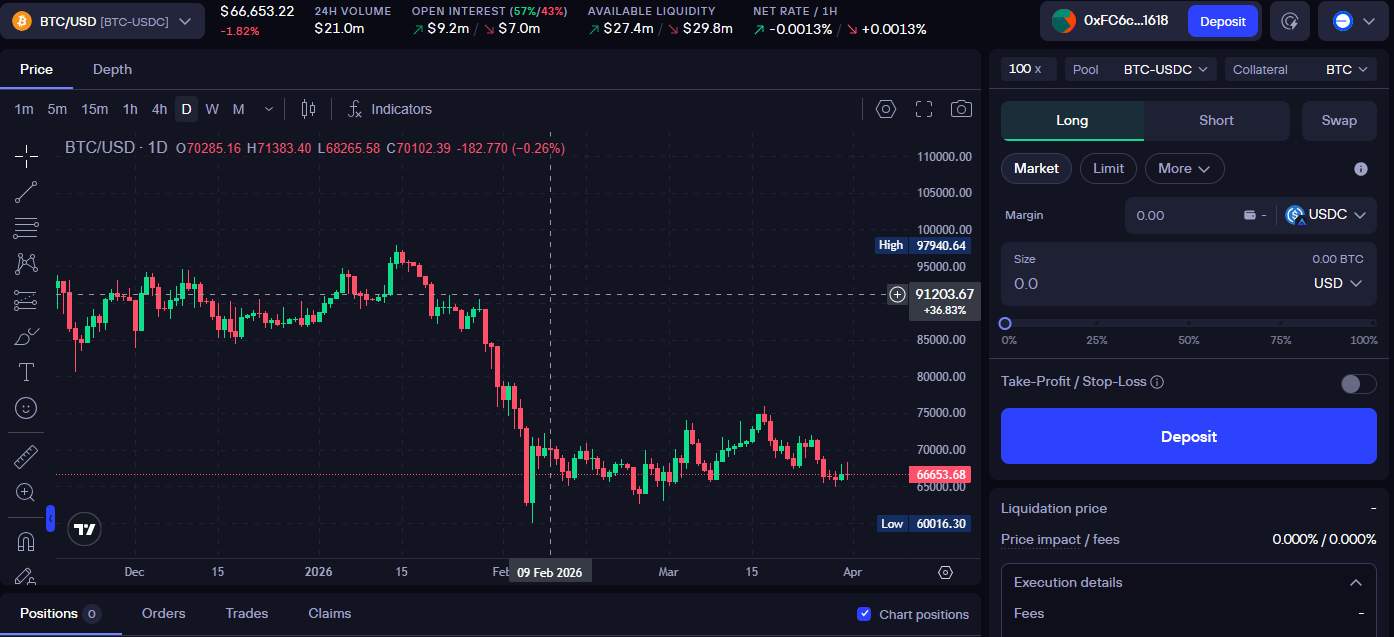
GMX supports both derivatives and spot trading. Users can access over 103+ perpetual contracts, while spot trading is available through the Swap feature. Leverage on GMX goes up to 100x. Additionally, a separate platform called GMTrade, built on Solana, offers higher leverage options, though it operates independently.
Order types are relatively limited, with support for Market and Limit orders, along with advanced options like Stop Market and TWAP. Trading experience also depends on the mode used. GMX accounts allow one-click execution, while wallet-only trading requires manual approvals and careful slippage management.
최대 레버리지는 100×배입니다.
GMX Trading Fees
Let’s take a closer look at the fees you can expect when trading on GMX.
Trading Fees
Trading fees on GMX are dynamic rather than fixed, meaning they adjust based on how your trade affects the balance of the liquidity pool. For derivatives, position fees range between 0.04% and 0.06% of the position size. If your trade helps balance long and short open interest, you pay the lower fee, while trades that increase imbalance are charged slightly higher.
For swaps, fees also vary depending on market conditions. Standard swaps typically range between 0.05% and 0.07%, while stablecoin swaps are significantly cheaper. However, atomic swaps carry a higher fee of around 3.75%, as they execute in a single transaction against the pool. Overall, fees on GMX are closely tied to liquidity conditions rather than being static.
Deposits and Withdrawals
Deposits and withdrawals on GMX follow a multi-layer fee structure rather than a fixed rate. Every transaction includes an execution fee, which covers the gas cost for keepers to process your request. The interface usually overestimates this cost, with unused amounts refunded automatically.
In addition, GMX applies deposit and withdrawal fee factors, which are percentage-based and vary depending on the market and pool conditions. For users interacting with multi-token pools, deposits or withdrawals can also incur price impact, as they affect pool balance. However, single-token pools do not have this cost.
| 거래 유형 | 메이커 수수료 | 테이커 수수료 | DEX 중앙값 (22개 추적 중) | 평가 |
|---|---|---|---|---|
| 선물 | 0.04% | 0.06% | 0.011% / 0.045% | 더 비싼 편 |
추적 중인 22개 탈중앙화 거래소(DEX) 전체의 수수료 유형별 중앙값입니다. GMX는 항상 같은 유형끼리만 비교합니다. "평균"은 중앙값에서 0.5bp 이내를 의미합니다.
GMX Security & Regulation
GMX is a self-custodial, decentralized platform, which means users are fully responsible for securing their wallets and approving transactions. Unlike centralized exchanges, there is no account recovery or internal protection layer, so risks such as phishing, malicious signatures, or wallet compromise fall on the user. It is important to verify contract interactions, use trusted interfaces, and ideally separate storage wallets from trading wallets when interacting with DeFi platforms.
From the protocol side, GMX reduces risk through continuous testing, smart contract monitoring, and an active bug bounty program that rewards vulnerability disclosures. Users are also guided to interact only with official contracts and review transaction details before signing, helping reduce common exploit vectors. On the auditing side, GMX has undergone multiple security reviews by firms such as Guardian Audits, ABDK, Certora, Dedaub, and Sherlock, with ongoing audits covering newer upgrades and protocol changes.
GMX Customer Support
GMX does not offer traditional customer support like centralized exchanges. There is no live chat or dedicated help center with structured tutorials. Instead, support is mainly handled through its Discord community, where users can ask questions and get help from moderators or other users.
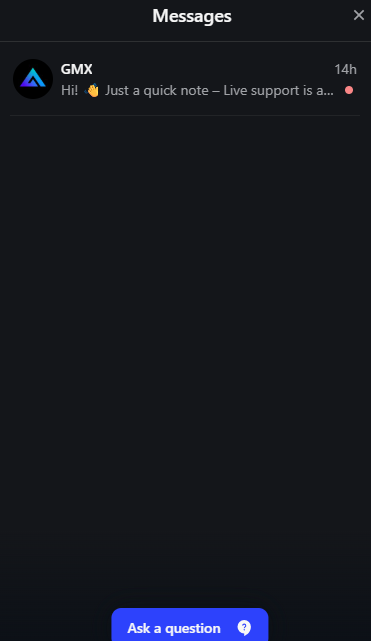
While this may feel limited, GMX has a relatively long operational history compared to many DeFi platforms, and most common issues are already discussed within its community channels and documentation.
GMX Deposit Methods
When trading on GMX, the network you choose directly affects how you fund your account, execute trades, and access features like leverage.
If you plan to use the GMX Account, you will need to deposit funds through supported networks such as Arbitrum, Ethereum, Base, and BNB Chain. The assets you can deposit depend on the selected network. For example, on Ethereum, users can deposit assets like ETH, USDT, LINK, and other supported tokens into their GMX account. These funds are then used for trading through shared liquidity on the platform.
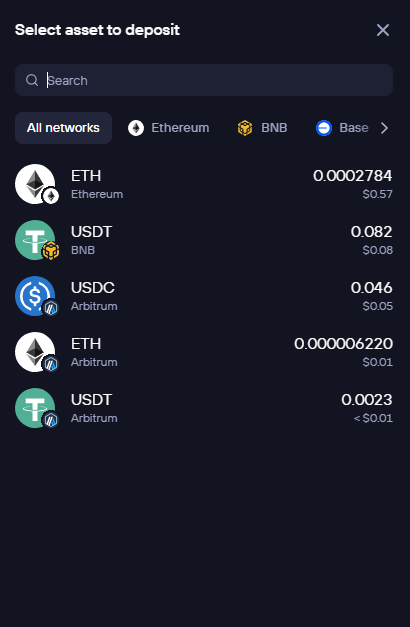
On the other hand, if you prefer not to deposit into a GMX Account, you can trade directly using your wallet through the wallet-only model. In this case, your funds remain in your wallet, and trades are executed on supported networks such as MegaETH, Arbitrum, Avalanche, Botanix, or Solana.



GMX Withdrawal Methods
Withdrawals follow the same structure. For GMX Accounts, funds can be withdrawn back to the originating network. For wallet-only trading, there is no separate withdrawal process, since assets remain in your wallet throughout.
GMX Alternatives
| 기능 | GMX | Hyperliquid | Lighter | edgeX |
|---|---|---|---|---|
| 설립일 | 2021 | 2021 | 2022 | 2024 |
| CryptoWinRate 점수 | 6.8/10 | 8.8/10 | 7.5/10 | 7.2/10 |
| 현물 메이커 수수료 | — | 0.04% | 0% | — |
| 현물 테이커 수수료 | — | 0.07% | 0% | — |
| 선물 메이커 수수료 | 0.04% | 0.015% | 0% | 0.012% |
| 선물 테이커 수수료 | 0.06% | 0.045% | 0% | 0.038% |
| 현물 자산(암호화폐) | — | 316 | 2 | — |
| 선물 계약(암호화폐) | 120 | 183 | 205 | 168 |
| 최대 레버리지 | 100× | 40× | 50× | 100× |
| KYC | KYC 불필요 | KYC 불필요 | KYC 불필요 | KYC 불필요 |
| 이용 가능 국가: 귀하의 국가 | — | — | — | — |
| 링크 |
Bottom Line
GMX is one of the oldest perp DEXes, offering a solid way to ditch CEXes without an order book. It uses liquidity pools for smoother liquidations even in high volatility. It provides perps, spot trading, and pools, covering most features of top perp DEX platforms. However, trading fees, wrapped assets, and modest LP yields might push you to keep looking for better alternatives. If your main goal is escaping CEX risk and trading anonymously with self-custody on Arbitrum’s low fees, GMX remains a reliable and straightforward choice.
FAQ
GMX is a self-custodial platform, so security depends on how you manage your wallet and transactions. The protocol itself is audited and runs a bug bounty program, but user-side risk still exists.
No, GMX does not require KYC. You can connect a compatible wallet and start trading without creating an account or submitting personal information.
GMX uses dynamic fees. Perpetual trading fees range between 0.04% and 0.06%, while swap fees are typically 0.05% to 0.07%, with atomic swaps going up to 3.75%.
Yes, GMX supports spot trading through its Swap feature, where users can exchange between supported assets directly from the interface.
GMX offers leverage of up to 100x on its main platform, depending on the asset and market conditions.
아니요. KYC는 선택 사항이며, 인증 전에도 한도 내에서 거래할 수 있습니다.
GMX은(는) 현물 거래를 지원하지 않습니다.; 선물 거래 수수료는 메이커 0.04% / 테이커 0.06%입니다. 수치는 거래소 데이터베이스에서 실시간으로 불러옵니다.