Paradex Review 2026: Trading Costs, Vaults, and Liquidity
Bu sayfada
Bu sayfada
- Değerlendirme ve puan
- Paradex Overview
- Paradex Pros & Cons
- Paradex Sign-up & KYC
- Paradex Products and Services
- Paradex Supported Cryptocurrencies
- Paradex Trading Platform
- Paradex Trading Fees
- Paradex Security & Regulation
- Paradex Customer Support
- Paradex Deposit Methods
- Paradex Withdrawal Methods
- Paradex Token (DIME)
- Paradex Alternatives
- Bottom Line
- FAQ
Değerlendirmemiz
Paradex is a derivatives-focused platform with a clear architecture built around perpetual contracts, ZK-based position privacy, and a self-custodial model that removes custodian risk while keeping execution on-chain. That said, spot trading is limited to a single pair, which makes the platform a poor fit for anyone wanting broad market access, and the socialized loss model means that in stress scenarios, traders can absorb losses that are not their own.
| Kuruluş | 2023 |
|---|---|
| Merkez | Amerika Birleşik Devletleri |
| Kurucu | Anand Gomes |
| KYC | KYC yok |
| İstatistikler | Paradex |
|---|---|
| Varlıklar | |
| Vadeli işlem sözleşmeleri (kripto) | 59 |
| Opsiyon varlıkları | 5 |
| Emtialar | 4 |
| Ücretler | |
| Spot komisyonları (maker/taker) | 0% / 0% |
| Vadeli işlem komisyonları (maker/taker) | 0% / 0% |
| İşlem | |
| 24 saatlik spot işlem hacmi | $0 |
| 24 saatlik vadeli işlem hacmi | $3,149,286 |
| Maksimum kaldıraç | 50× |
| CryptoWinRate puanı | 6.2/10 |
- Paradex focuses primarily on perpetual futures, with 59+ contracts and up to 50x leverage.
- Paradex charges 0% maker / 0% taker fees across spot and perpetual trading.
- Spot trading is limited to ETH/USDC, keeping the platform derivatives-focused.
- Trading data such as positions and PnL is hidden using ZK-based encryption.
- Paradex supports 17+ networks for deposits and withdrawals.
- Vault Traded Funds (VTFs) allow passive participation through managed strategies.
Paradex Overview
Fees compound, and public exposure creates risk in perpetual markets. Paradex, built as a Starknet appchain, was designed to reduce both by removing retail trading fees, encrypting positions, and introducing portfolio margin on-chain. With its primary focus on perpetual trading and limited spot exposure, Paradex is structured for advanced traders looking to move away from CEX platforms but still expecting a similar level of ease on a DEX. In this Paradex review, we focus on what Paradex actually delivers to traders, while also examining practical factors like slippage, funding mechanics, liquidity depth, and overall execution to see how it compares with other perpetual DEXs.
Paradex was founded in 2023 by Anand Gomes and built as a dedicated perpetual futures exchange running as an appchain on Starknet. From the start, the focus has been derivatives. It is not trying to compete as a broad spot marketplace. Instead, the structure is clearly centered around perpetual contracts. The platform reports 73K+ users and more than $27B+ in monthly trading volume, with most of that activity coming from perps, and its native DIME token is now used for fee payments and staking benefits.
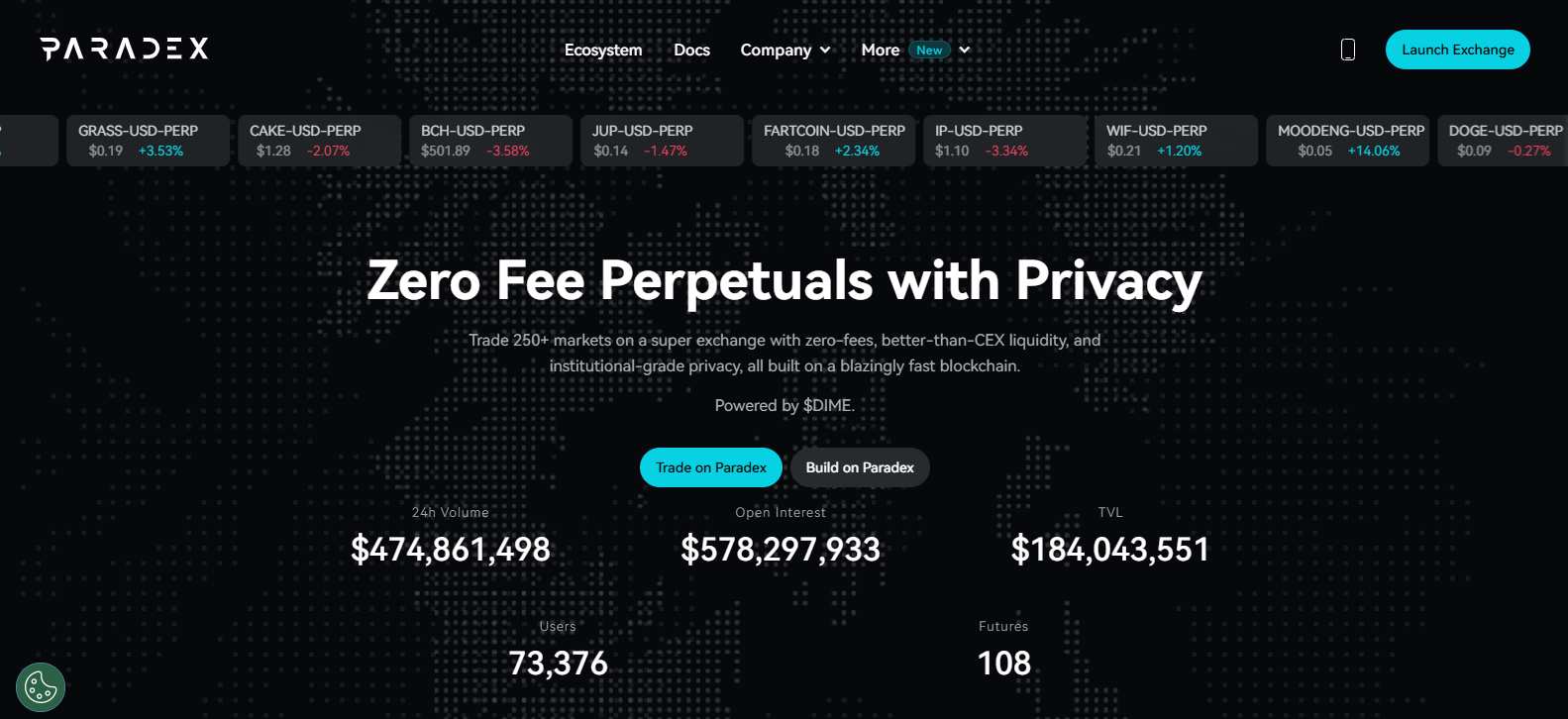
In terms of markets, Paradex currently lists 59+ perpetual contracts with leverage up to 50x. Retail traders do not pay maker or taker fees through the UI, which changes cost dynamics compared to many other venues. Spot exposure exists, but it is limited to ETH/USDC, so the design remains perp focused. Trading begins with USDC deposits.
On the infrastructure side, Paradex supports 17+ networks including Ethereum, other EVM compatible chains, and Starknet. Users can move funds through the native Paradex bridge, or use integrations such as Orbiter Finance, Hyperlane, and Rhino.fi.
Structurally, the exchange uses off-chain order matching for speed, while settlement happens on-chain via ZK-STARK proofs. Accounts are ZK encrypted, so positions, liquidation levels, and PnL are not publicly visible. Funding runs continuously rather than in fixed intervals, auto deleveraging is not used, and portfolio margin allows offsetting positions under one margin system. Core contracts and the bridge have undergone external audits, and the API and web infrastructure have been penetration tested, which together outline the current security framework behind the platform.
Paradex Pros & Cons
Beğendiğimiz yönler
- 0% maker and 0% taker fees on spot and perpetual trading
- ZK-based encryption hides positions and PnL
- Portfolio margin under a unified account structure
- 59+ perpetual contracts with up to 50x leverage
- 17+ supported networks for deposits and withdrawals
- Vault Traded Funds (VTFs) for passive strategies
- CEX-like performance and UX
Eksik yönleri
- Spot market limited to ETH/USDC
- One-way mode only, no hedge mode
- No sub-accounts for strategy separation
- Past operational incident in January 2026
- Blockchain rollback raised decentralization concerns
Paradex Sign-up & KYC
Paradex works like most modern dApps. There is no traditional account creation flow with documents or manual approval. You get started by connecting a Web3 wallet. It supports EVM wallets such as MetaMask and Rabby Wallet, along with Starknet wallets like Braavos. You can also choose email or social login if you prefer that route. Here are the steps to set up your Paradex account.
Step 1: Open the Paradex website and click on the “Launch Exchange” button.
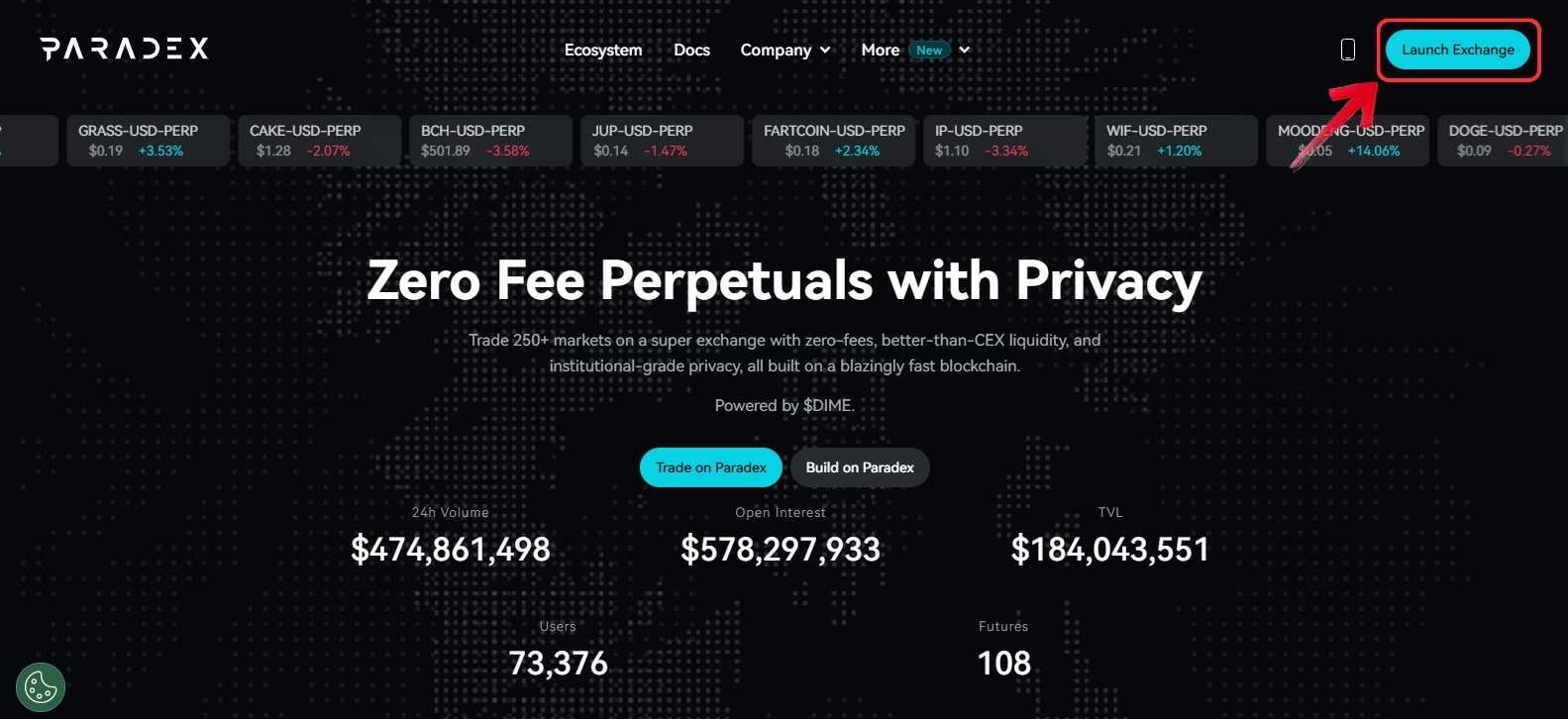
Step 2: Once inside the interface, click on “Login” in the top right corner.
Step 3: You will see connection options. Choose between an EVM wallet, a Starknet wallet, or email/social login, depending on what you are using.
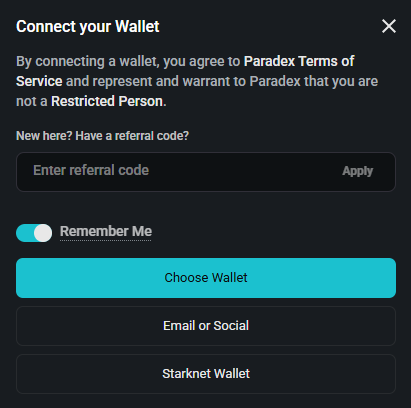
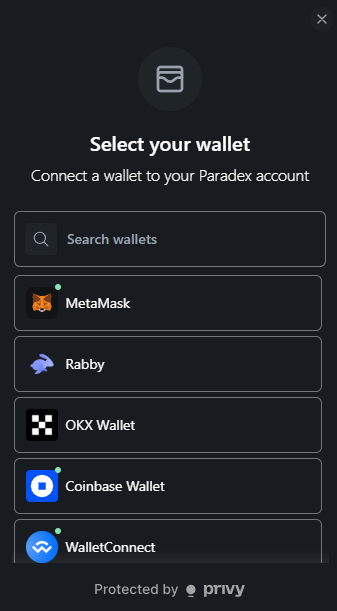
Step 4: A wallet selection window will appear. Select your preferred wallet from the available list.
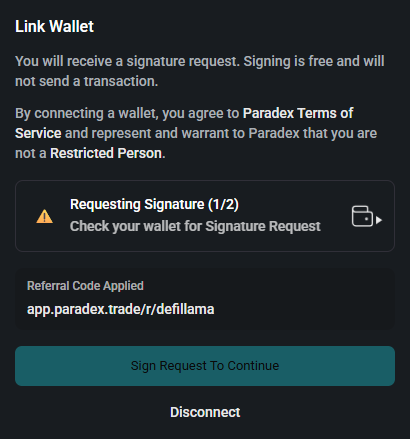
Step 5: Paradex will send a signature request to your wallet. Approve the signature. This does not move funds; it only verifies ownership of the wallet.
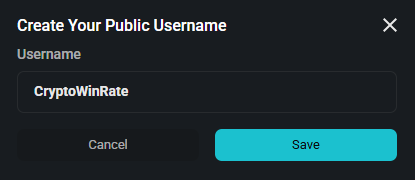
Step 6: After the wallet is connected, you will be asked to set a username. Once that is done, you can deposit USDC through the supported networks and begin trading.
Supported Networks
Paradex currently allows users to deposit and withdraw funds across 17+ supported networks. Most of these are EVM compatible chains such as Ethereum, Mantle, Arbitrum, Optimism, and Base.
In addition to EVM networks, Paradex also supports non-EVM chains including Solana and Starknet, giving users multiple routes to move USDC and access the platform.
Paradex Products and Services
Next, let’s take a look at the products and features offered by Paradex, and what users actually get beyond basic perpetual trading.
Paradex Trading Interface
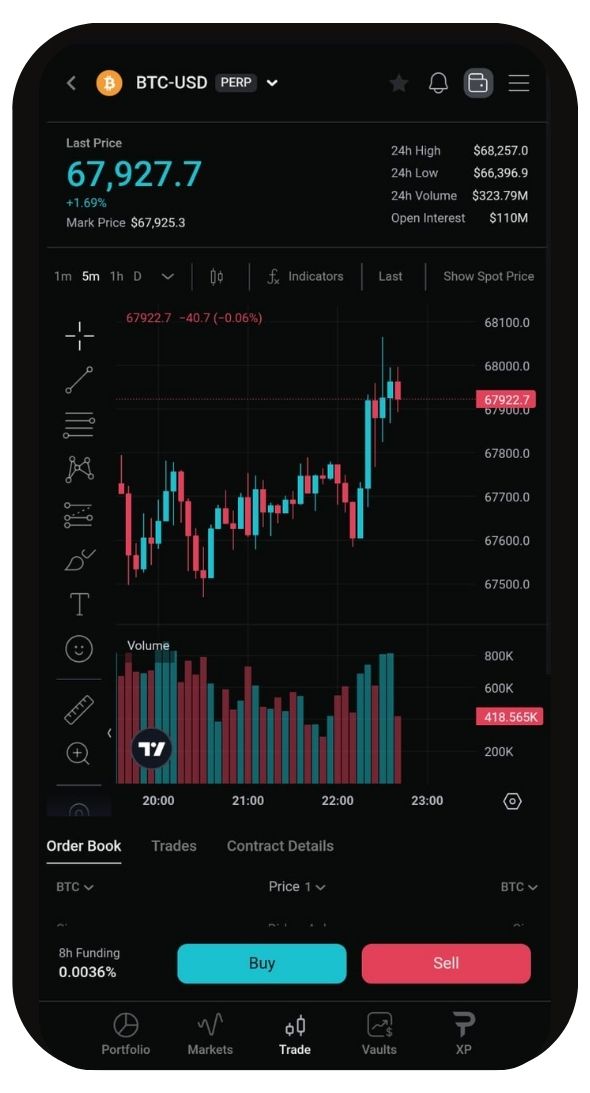
The trading interface on Paradex feels familiar if you have used centralized exchanges before. The layout is clean and straightforward, without too much clutter, although users do not get layout customization options. What you see is largely fixed.
Charts are powered by TradingView, so traders have access to a full set of indicators, drawing tools, and timeframes. That makes it easier to structure entries and exits without needing external charting platforms. For most users, the charting setup will feel standard and sufficient for strategy work.
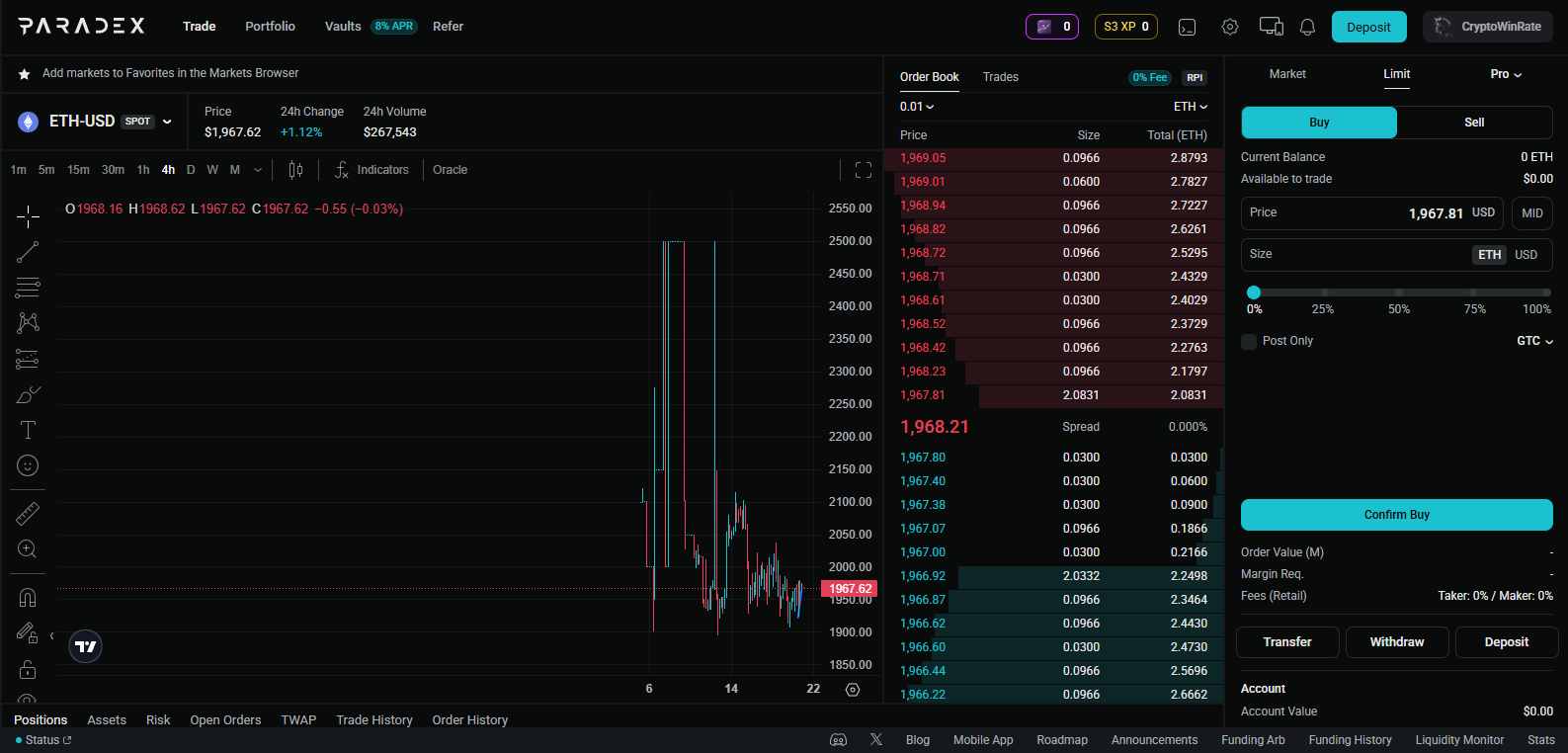
In terms of order types, the basics are covered. Users can place limit and market orders directly from the main panel. Under the Pro dropdown, additional order types are available, including TWAP, scaled orders, and stop limit or stop market orders. This gives more flexibility for traders who want to manage execution more precisely rather than entering a full position at once.
At the same time, it is worth noting that Paradex currently operates in one-way mode only. You cannot open simultaneous long and short positions on the same contract within a single account, and sub-accounts are not available for separating strategies. That means traders looking to run hedge positions internally may need to manage exposure differently.
As for liquidity, major perpetual pairs generally maintain tight bid-ask spreads. Order books appear deep on high-volume contracts.
Mobile App
Paradex offers a native mobile app available on both iOS and Android, giving users access to the same trading environment as the web platform. From the app, traders can open and manage perpetual positions, place advanced order types such as stop limit, scaled, and TWAP orders, and monitor their full portfolio in real time. Vault access is integrated directly within the app, allowing users to allocate funds without switching devices. The app also supports more than 20 languages. For wallet-based accounts, a compatible mobile wallet is required for non-custodial login.
Vaults
Paradex Vaults are smart contract-based pools where users deposit collateral, primarily USDC, and receive vault tokens representing their proportional share. The platform offers Protocol Vaults, such as the flagship liquidity-focused vaults that have historically shown minimum APR levels around 8%, along with User Vaults created and managed by independent operators. These are also referred to as Vault Traded Funds (VTFs), structured as tokenized multi-strategy portfolios.
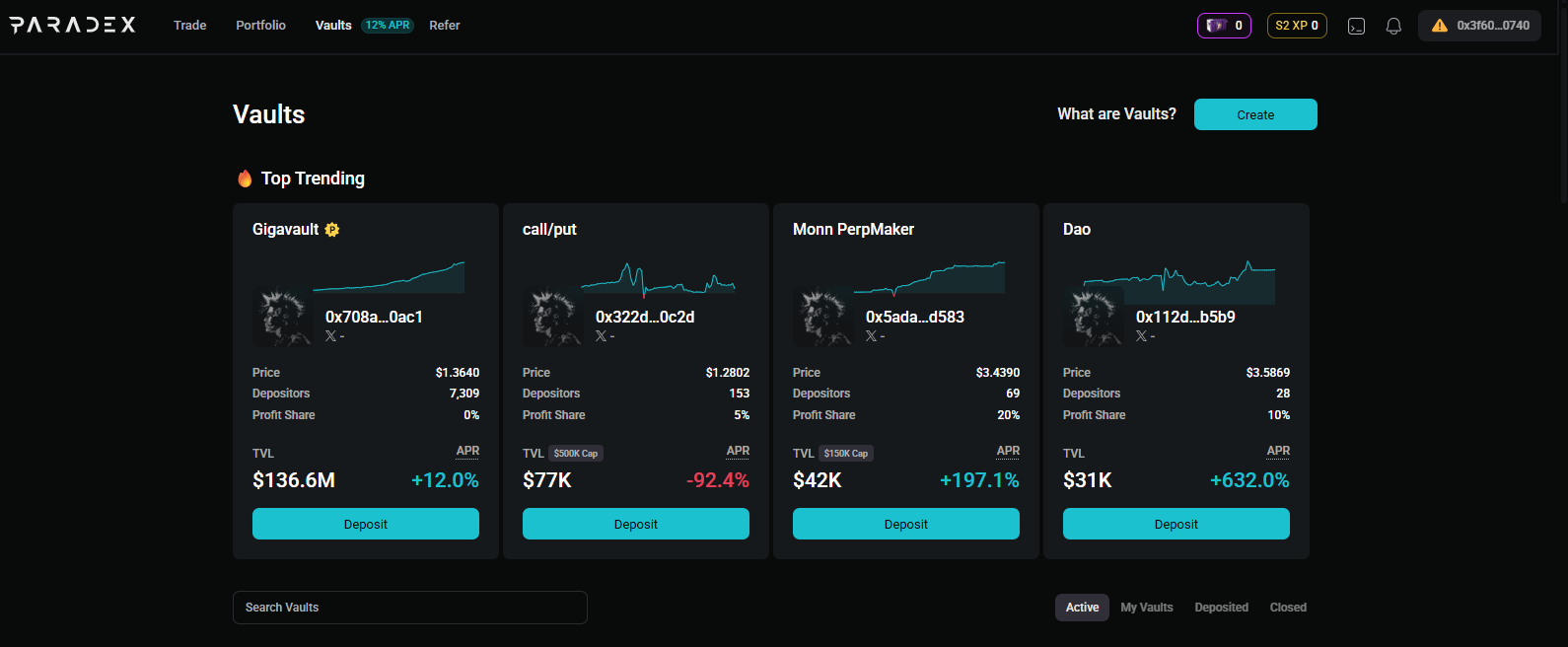
Strategies typically deploy capital across perpetual markets, and sometimes spot or options. Returns depend on trading performance and are distributed after any operator profit share. While vaults allow passive participation without manual trading, users should still consider risks such as drawdowns, strategy underperformance, and smart contract exposure.
Paradex Liquidity Monitor
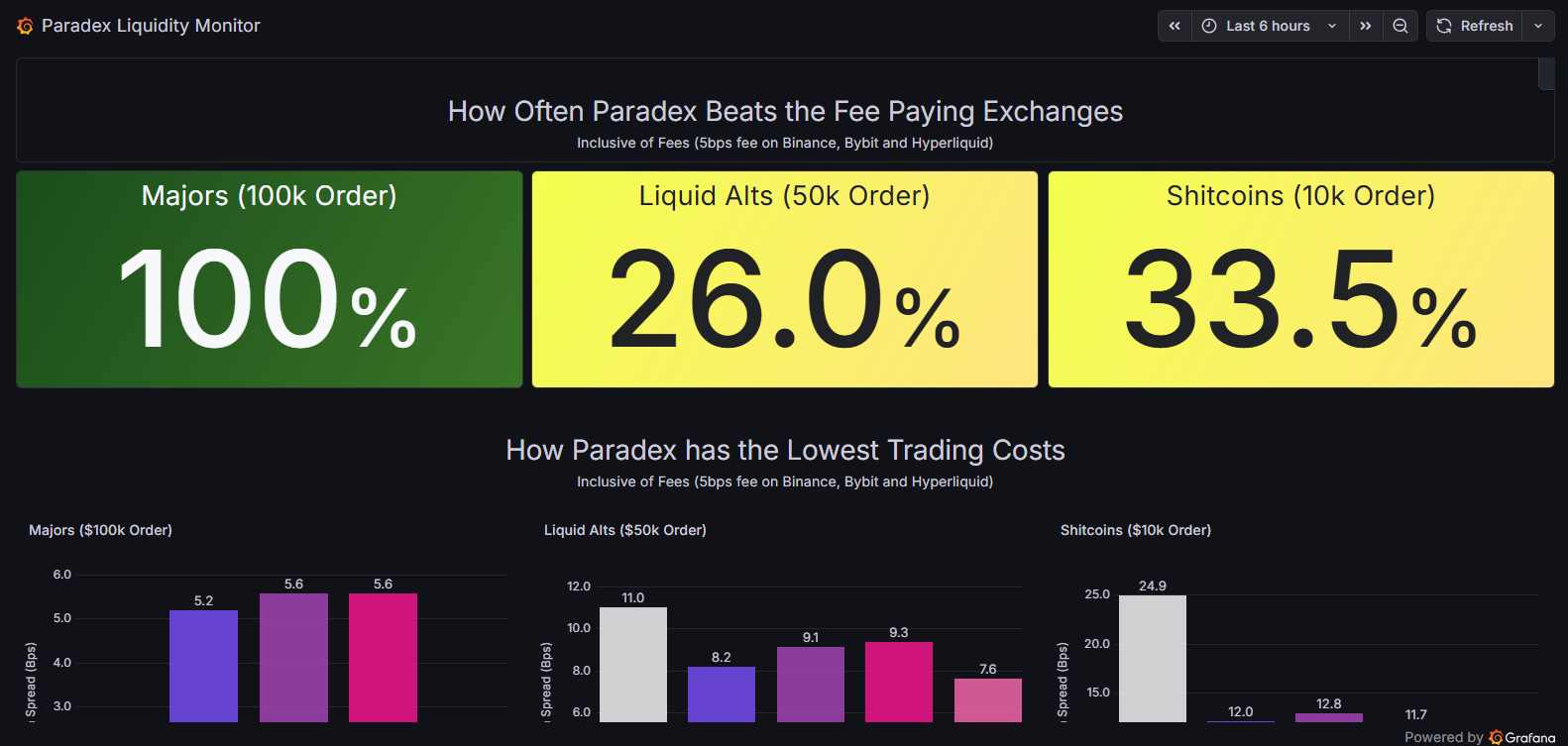
Paradex includes a Liquidity Monitor that gives you a clearer picture of how its order books compare in real time. Inside the platform, you can view order book depth, market depth charts, and slippage estimates before placing larger orders. The tool also tracks how often Paradex matches or beats fee-paying exchanges for different order sizes, including majors and smaller alt pairs. Since trading fees for retail users are zero, the comparison includes external exchange fees for context. For active traders, this helps evaluate execution quality rather than relying on spreads alone.
Paradex Portolfio
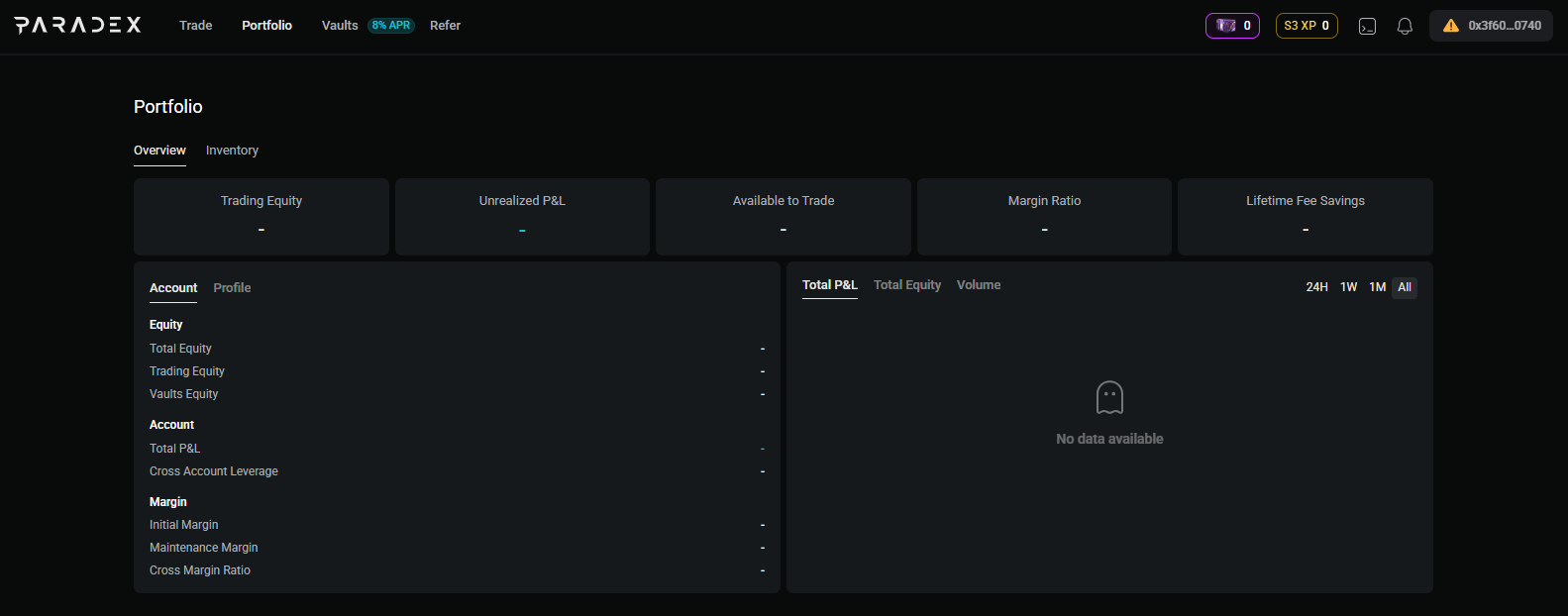
Paradex uses a unified account structure where spot, perpetual futures, options, and vault positions sit under one margin system. This enables portfolio margin, meaning risk is calculated across the entire account rather than per position. For example, offsetting positions such as long spot and short perps can significantly reduce required margin. Users can switch between isolated, cross, or portfolio margin modes. The dashboard provides visibility into positions, PnL, orders, and vault holdings within a single consolidated view.
Paradex Supported Cryptocurrencies
Paradex, 59 vadeli işlem piyasası listeliyor. Yerel token: DIME.
 ETH
ETH PAXG
PAXG BTC
BTC HYPE
HYPE SOL
SOL BNBUS500CL
 SUI
SUI ZEC
ZEC XRP
XRP ENA
ENA PUMP
PUMP XMRBZ
XMRBZ ONDO
ONDO JUP
JUP XPL
XPL LIT
LIT TRX
TRX GOOGL
GOOGL TAO
TAO JTONG
JTONG LINK
LINK CRCLUS100
 DOGE
DOGE AVAX
AVAX ADA
ADA NEAR
NEAR GRAM
GRAM VVV
VVV AAVE
AAVE CC
CC DRAM
DRAM ETHFIEWY
 INTC
INTC KAITOkPEPEkSHIB
 LDO
LDO LTC
LTC META
META MON
MON MORPHOMRVL
 MSFT
MSFT MSTR
MSTR MU
MU PENDLE
 PYTH
PYTH SNDK
SNDK SPCX
SPCX STRK
STRK TRUMP
TRUMP UNI
UNI WLFI
WLFINo cryptos match your search.
Options: 5 instruments listed by the exchange. We do not hold the instrument list for this class yet.
No TradFi assets match your search.
Paradex Trading Platform
Paradex offers both spot and derivatives, but the spot side is extremely limited. At the moment, users can only trade ETH on the spot market, and both maker and taker fees remain at 0%. So while spot exists, it is not the core focus of the platform.
The main activity happens in derivatives. Once funds are deposited, users can trade over 59+ perpetual contracts with leverage of up to 50x. Retail traders do not pay maker or taker fees here either. Trading is limited to crypto contracts for now, with no tokenized equities or traditional asset markets live, although those expansions appear in the longer-term roadmap.
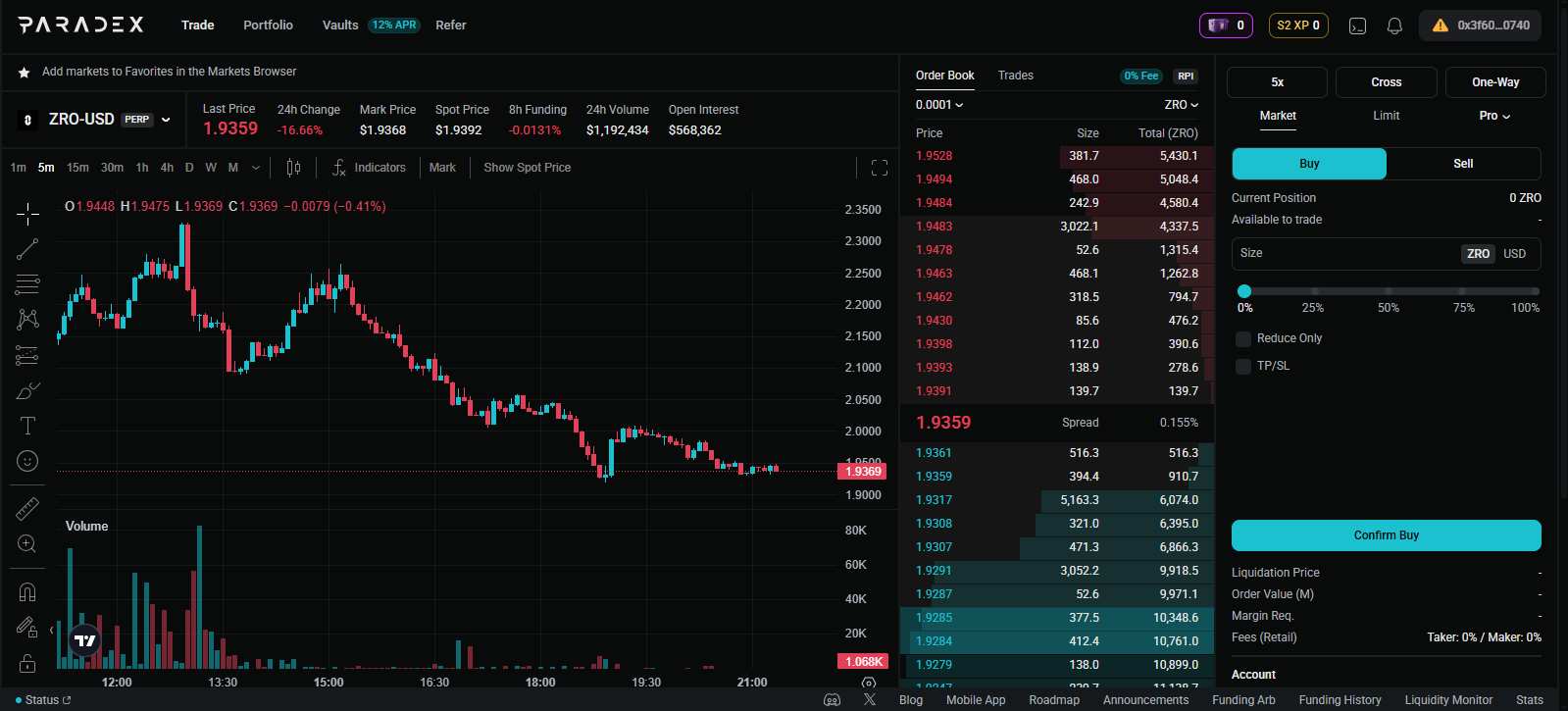
A structural difference appears in how account data is handled. Trade details such as open positions, entry and exit levels, liquidation prices, and unrealized PnL are not publicly visible. The platform uses ZK-based account encryption, which means other participants cannot monitor or track large positions directly on-chain.
On the technical side, Paradex runs on a Starknet appchain architecture with off-chain order matching and on-chain settlement. Execution is designed to remain fast even during higher activity. Funding does not operate on fixed 8-hour cycles like many perpetual platforms. Instead, it runs on a continuous mechanism, which smooths funding adjustments over time. The platform also does not use auto deleveraging. In the event of system losses, a socialized loss model applies instead of forcibly closing opposing trader positions.
Maksimum kaldıraç: 50×.
Paradex Trading Fees
Next, let’s take a closer look at the cost structure on Paradex, including trading fees as well as any charges associated with deposits and withdrawals when using the platform.
Trading Fees
Paradex separates traders into two profiles: Retail (UI users) and Pro (API traders). The fee structure and trading limits depend on which profile you fall under.
Retail traders using the interface trade perpetual futures with 0% maker and 0% taker fees. There are no trading fees charged under the retail profile. However, retail accounts are subject to a speed bump. Order submission carries a 500ms delay, and order cancellations have a 300ms delay. If a retail account exceeds the allowed activity thresholds, it automatically switches to the Pro profile and loses access to RPI liquidity.
Pro traders, typically those accessing through API, operate without speed bumps and with significantly higher rate limits. The fee structure for Pro traders on perpetual futures is 0.003% maker and 0.02% taker. When a Pro taker order matches against retail flow, a FastFills mechanism applies and reduces the taker fee by 75%, bringing it down to 0.005%.
Deposits and Withdrawal Fees
Deposit and withdrawal fees depend on the network and bridge provider used. While Paradex itself does not charge a separate platform fee for deposits, users still pay standard network gas fees and any applicable bridge charges. These bridge costs vary by provider and source chain, and in some cases can be noticeably higher depending on network congestion and current conditions.
| İşlem türü | Maker komisyonu | Taker komisyonu | Medyan: DEX (22 takip edilen öğe) | Değerlendirme |
|---|---|---|---|---|
| Spot | 0% | 0% | — | — |
| Vadeli İşlemler | 0% | 0% | 0.011% / 0.045% | Daha ucuz |
| Opsiyonlar | 0% | 0% | — | — |
Takip ettiğimiz 22 adet Merkeziyetsiz borsalar (DEX) arasında ücret türüne göre medyan. Paradex yalnızca kendi türündeki borsalarla karşılaştırılır. “Ortalama”, medyanın yarım baz puanlık aralığında olmak anlamına gelir. Paradex spot işlemler için 0.00% spot komisyon oranı yayımlar ve spot işlemlerini bunun yerine alış-satış farkı üzerinden fiyatlandırır. Bu nedenle spot satırında bir değerlendirme yer almaz: maliyet gerçektir, yalnızca bu sütunda gösterilmez.
Paradex Security & Regulation
When it comes to security, the first thing you should understand is that Paradex is self-custodial, just like most perpetual DEXs. Your funds are not sitting with a central company. You connect through your own wallet, and you remain in control of your assets. That removes custodian risk, but it also means security is largely in your hands. If your wallet is compromised, there is no centralized recovery process. So private key management and wallet hygiene matter.
On the protocol side, Paradex does add a privacy layer. Your open positions, entry and exit levels, liquidation prices, and unrealized PnL are not publicly visible. Unlike many on-chain perpetual models where anyone can monitor large positions, this data is protected through ZK-based encryption. That changes how exposed your trading activity is.
In terms of audits, core contracts including Paraclear, Vault, Factory, Registry, and Oracle were reviewed in May 2025 by Cairo Security Clan. The L1 Bridge has earlier audits from Zellic and Trail of Bits. The API and web infrastructure also went through penetration testing in March 2025 via HackerOne. Full reports are publicly available.
It is also important to mention that in January 2026, a database migration issue briefly caused Bitcoin prices to display incorrectly, triggering liquidations. The team rolled back the state and refunded around $650,000 to affected users.
Paradex Customer Support
If you are expecting traditional live chat or ticket-based support inside the platform, that is not currently available. Paradex does not offer direct in-app chat support. Instead, users can reach out through the official Paradex Discord server, where community members and team representatives are active.
This setup works for general questions, technical clarifications, and platform updates, but response times can vary depending on activity levels. There is no dedicated 24/7 private support desk, so users relying on immediate assistance during volatile market conditions should keep that in mind.
Paradex Deposit Methods
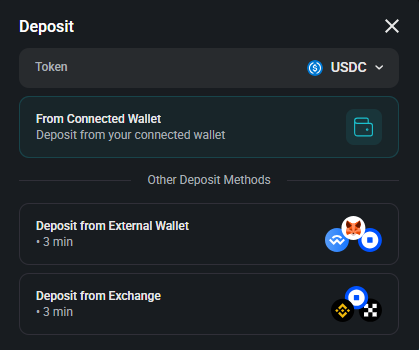
For deposits and withdrawals, Paradex supports 17+ networks. Although trading itself runs on Starknet since it operates as an appchain, users are not limited to funding directly from Starknet. USDC can be deposited from multiple supported networks, with bridging handled inside the interface. This includes the native Paradex bridge, which currently supports Ethereum, along with integrations such as Hyperlane, Orbiter Finance, and Rhino.fi. As a result, users do not need to manually bridge assets elsewhere before transferring them to Paradex.
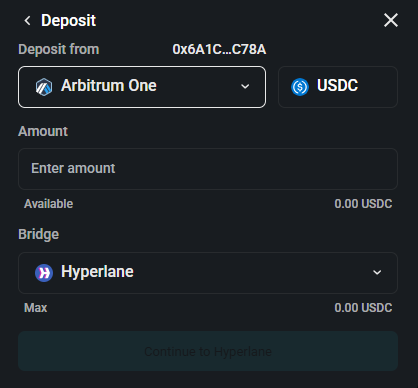
Deposits can also be made directly from external wallet addresses or centralized exchanges. The process is straightforward: select the preferred network inside Paradex, copy the generated deposit address, and transfer USDC from the chosen source. Once confirmed on-chain and bridged internally, the balance becomes available for trading within the app.
Paradex Withdrawal Methods
Paradex Token (DIME)
DIME is the native token of Paradex. Its main current trading benefits are fee payment and staking discounts. Paying eligible fees from a spot DIME balance gives a 40% reduction, with the charge converted at the DIME/USDC mark price when the transaction occurs. This spends tokens from the available balance, rather than simply checking whether the user holds DIME.
Staking provides a separate tiered discount on spot and perpetual taker fees, reaching 30% at the highest published tier. The DIME utility guide explicitly allows it to combine with the fee-payment saving. Its example combines a 15% staking discount with the 40% payment discount for a total 55% reduction on the applicable volume-based taker fee.
Unstaking requires a request, a 24-hour cooldown and a final confirmation to receive the tokens. Paradex also directs available net protocol revenue towards DIME buybacks and ecosystem development. Its documentation separates those current mechanisms from the token’s intended future use as gas for DimeVM. Neither a stake nor a spot balance should therefore be assumed to activate every proposed ecosystem feature.
Paradex
Bağlanıyor- Piyasa değeri
- $42,37M Sıra #544
- 24 saatlik işlem hacmi
- $356,57K İzlenen piyasalarda
- Dolaşımdaki arz
- 668,84M DIME Toplam arzın 66,9% oranı
Paradex Alternatives
| Özellik | Paradex | Hyperliquid | Lighter | edgeX |
|---|---|---|---|---|
| Kuruluş | 2023 | 2021 | 2022 | 2024 |
| CryptoWinRate puanı | 6.2/10 | 8.8/10 | 7.5/10 | 7.2/10 |
| Spot maker komisyonu | 0% | 0.04% | 0% | — |
| Spot taker komisyonu | 0% | 0.07% | 0% | — |
| Vadeli maker komisyonu | 0% | 0.015% | 0% | 0.012% |
| Vadeli taker komisyonu | 0% | 0.045% | 0% | 0.038% |
| Spot varlıklar (kripto) | — | 316 | 2 | — |
| Vadeli işlem sözleşmeleri (kripto) | 59 | 183 | 205 | 170 |
| Maksimum kaldıraç | 50× | 40× | 50× | 100× |
| KYC | KYC yok | KYC yok | KYC yok | KYC yok |
| Kullanılabilir: Ülkeniz | — | — | — | — |
| Bağlantılar |
Tüm Paradex alternatiflerini karşılaştırın
Bottom Line
If you are looking for a perpetual DEX with zero trading fees, Paradex is a practical option and competes closely with Lighter on cost alone. It also offers features like ZK-encrypted account privacy and Vault Traded Funds for passive strategies, which add another layer beyond basic perp trading. However, operational risk should not be ignored. The January 2026 pricing incident shows that platform-level errors can still happen. If long-term track record and stability matter more to you, it may be worth comparing other established perpetual DEXs before deciding.
Paradex borsasını ziyaret edin
FAQ
No, Paradex does not require KYC for trading or withdrawals. Users connect through a Web3 wallet.
Paradex currently focuses on perpetual futures with 59+ contracts. Spot trading is limited to ETH/USDC.
Paradex offers up to 50x leverage on perpetual contracts.
Yes. Users retain control of their funds through connected wallets. The platform does not hold user assets.
Positions, entry and exit prices, liquidation levels, and PnL are hidden using ZK-based encryption, meaning they are not publicly visible on-chain.
Paradex supports 17+ networks including Ethereum, Arbitrum, Base, Mantle, Solana, and Starknet.
Hayır, KYC isteğe bağlıdır. Doğrulama yapmadan belirli limitler dahilinde işlem yapabilirsiniz.
Spot işlem ücretleri: maker 0% / taker 0%; vadeli işlemlerde maker 0% / taker 0%. Rakamlar borsa veritabanımızdan canlı olarak yüklenir.