What Is Crypto Bridging and How Do Crypto Bridges Work?

На этой странице
- Crypto bridging transfers assets between different blockchain networks.
- Bridge costs depend on networks, liquidity, assets, and the selected route.
- Always verify the bridge, destination token, and final amount before confirming.
What is Bridging in Crypto?
Bridging, in the context of cryptocurrency, refers to the process of connecting two different blockchain networks to enable interoperability and the transfer of assets or data between them.
Blockchain networks typically operate independently, each with its own set of rules, protocols, and native tokens or assets. Bridging facilitates communication and interaction between these networks, allowing users to move assets or data from one blockchain to another. Bridging can happen within one blockchain ecosystem (intra-chain) or between separate blockchains (inter-chain).
How Do Crypto Bridges Work?
Crypto bridges do not physically move the same tokens from one blockchain to another. Instead, they use different methods to remove, secure, or receive your assets on the source network and provide an equivalent amount on the destination network. A bridge may use one or combine several of the following methods.
1. Lock-and-Mint
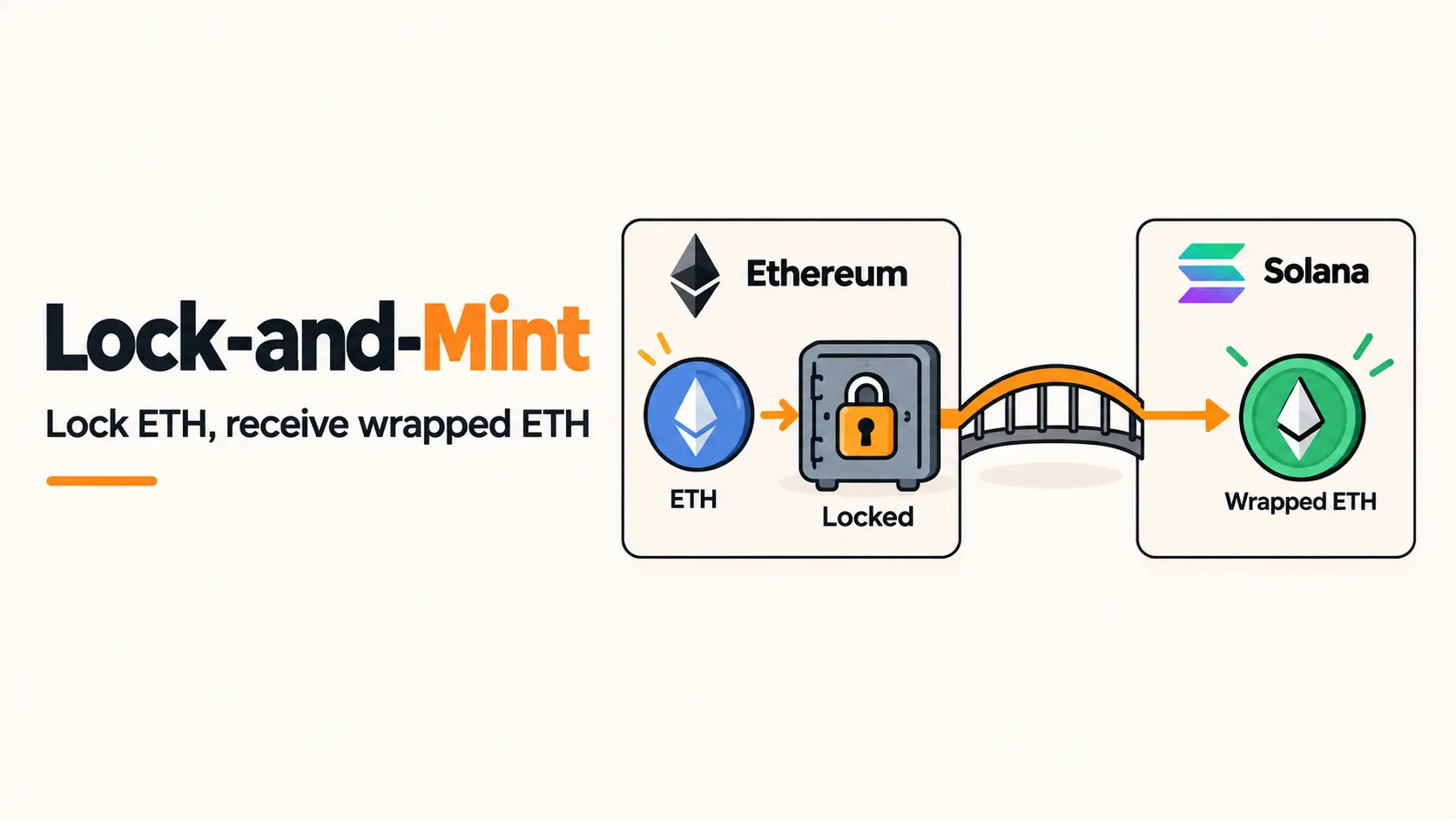
Suppose you have ETH on Ethereum and want to use its equivalent on Solana. A lock-and-mint bridge deposits your ETH into a smart contract on Ethereum, where it remains locked. The bridge then creates an equivalent amount of wrapped ETH on Solana and sends it to your wallet.
Your original ETH remains on Ethereum, while the wrapped ETH represents its value on Solana. If you bridge it back, the wrapped tokens are burned and the original ETH is released.
2. Burn-and-Mint
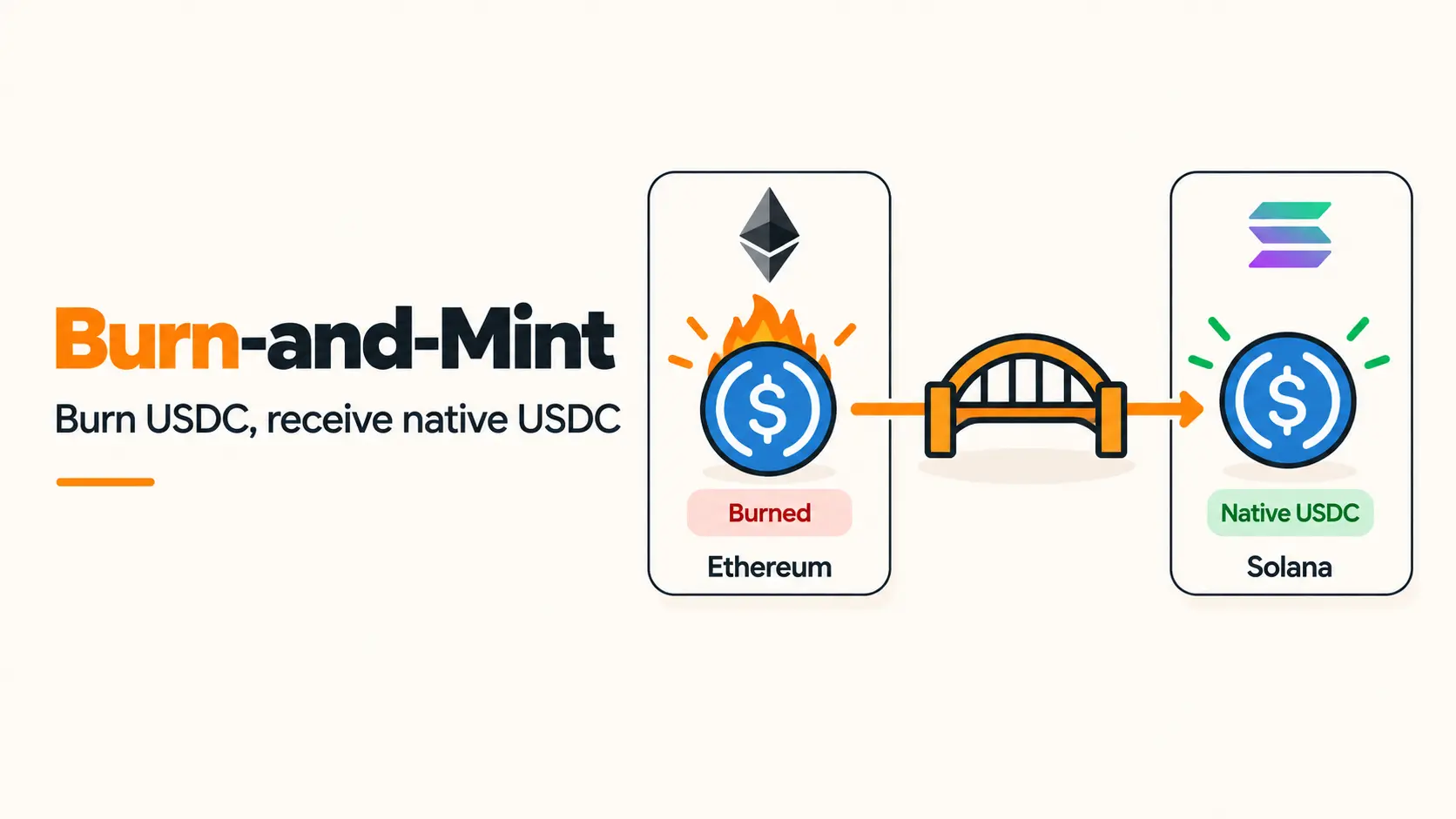
Burn-and-mint is commonly used when an asset is officially issued on several blockchains. For example, if you transfer USDC from Ethereum to Solana through Circle CCTP, the USDC on Ethereum is burned, meaning it is removed from circulation. The same amount of native USDC is then minted on Solana.
Unlike lock-and-mint, this method does not leave you with a wrapped version. You receive native USDC issued for the destination network.
3. Liquidity Pools
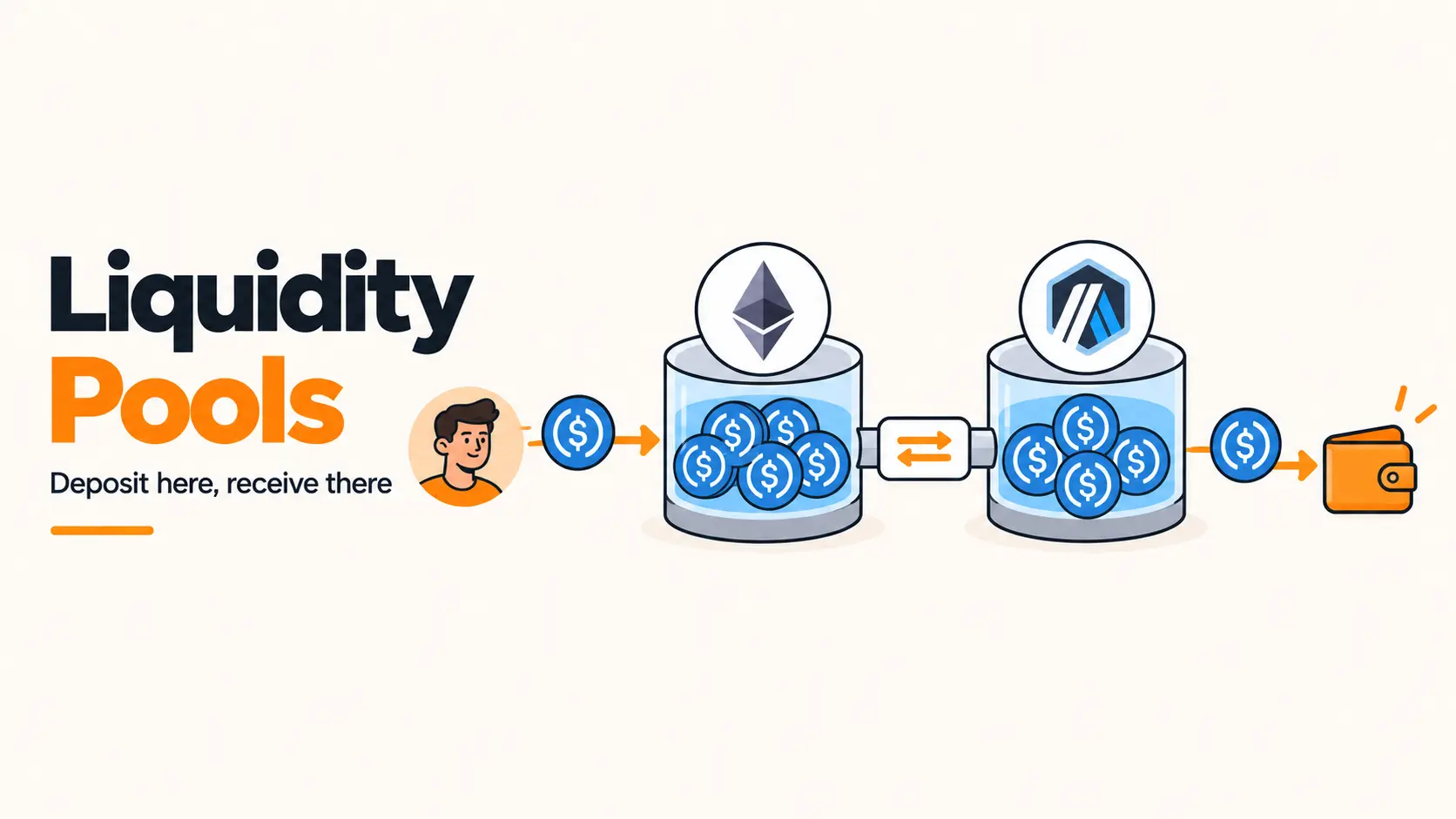
A liquidity-pool bridge already holds tokens on each network it supports. Suppose you want to bridge USDC from Ethereum to Arbitrum. Your USDC is deposited into the bridge’s Ethereum pool, while an equivalent amount is released from its existing USDC pool on Arbitrum.
The bridge does not need to create a new wrapped token for every transfer. However, the transaction depends on the bridge having enough liquidity on the destination network.
4. Intent-Based
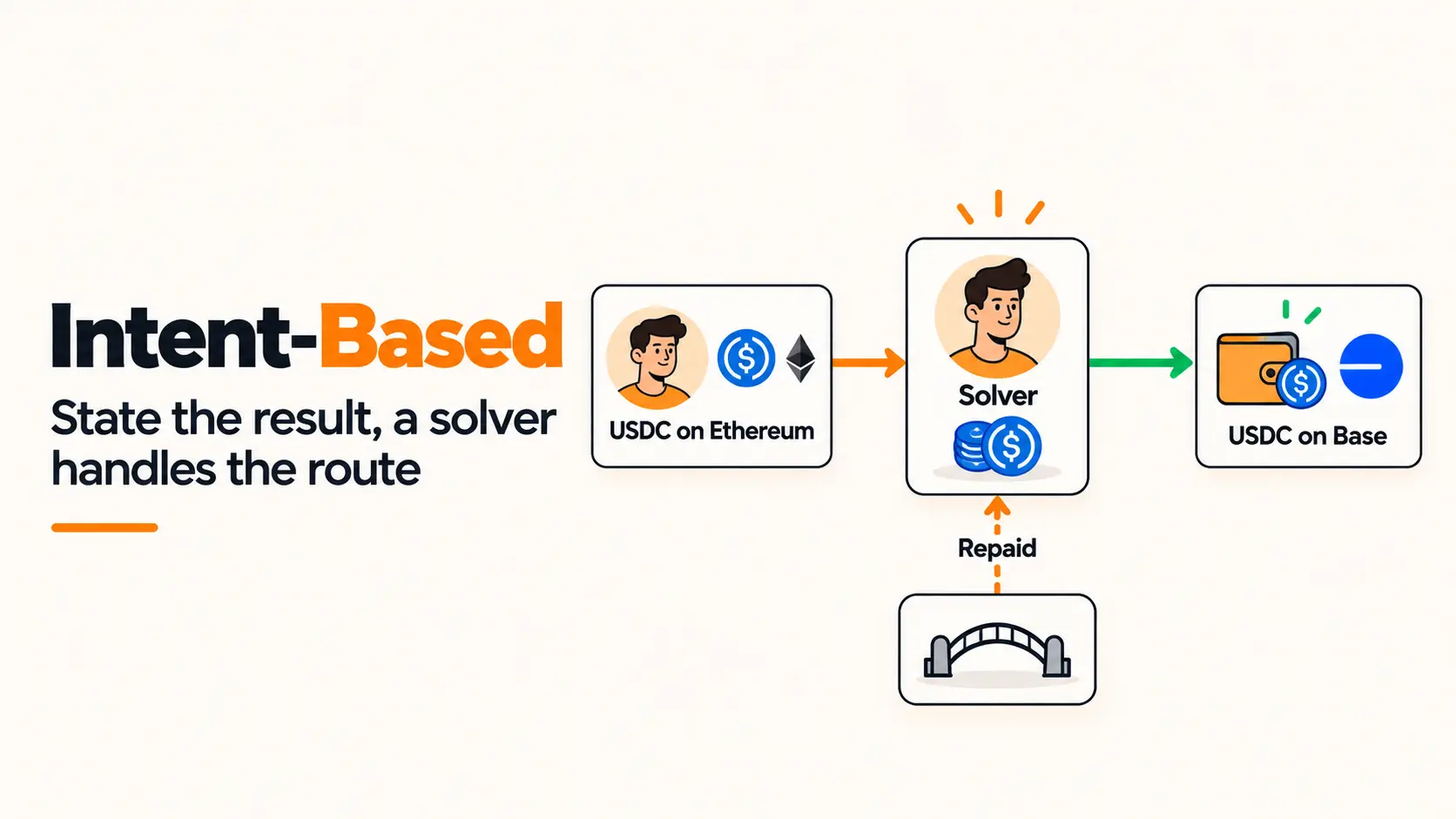
An intent-based bridge focuses on the result you want rather than requiring you to select every step of the route. For example, you may request to send USDC from Ethereum and receive USDC on Base.
A third party known as a solver or relayer uses its own funds to deliver the requested tokens to your wallet on Base. It later claims your deposited funds through the bridge’s settlement system. Across, for example, uses relayers that provide their own capital on the destination network before receiving reimbursement later.
Intra and Inter (cross) Chain Bridging
Intra-chain bridging refers to mechanisms or protocols that enable the transfer of assets or data within a single blockchain ecosystem but across different applications, layers, or segments of that blockchain. An example of this would be transferring tokens between the Ethereum mainnet and a Layer 2 scaling solution such as Arbitrum.
Inter-chain bridging, on the other hand, refers to the mechanisms or protocols that enable the transfer of assets, data, or information between different blockchain networks. An example is transferring tokens between the Bitcoin and Ethereum blockchains.
How to Bridge Crypto
Suppose you want to bridge to Solana from Ethereum, moving ETH. First, you need a crypto bridge that supports Ethereum as the source network, Solana as the destination network, and ETH as the asset.
You will also need ETH to pay the gas fee on Ethereum. This means you should not enter your entire ETH balance for bridging. For example, if you have 1 ETH, you may need to bridge slightly less and leave some ETH in your wallet so the Ethereum network can process the transaction. The bridge will show the estimated gas fee before you confirm.
Once your assets arrive on Solana, you will need SOL to pay for any swaps or transfers you make there. ETH pays for transactions on Ethereum, while SOL pays for transactions on Solana.
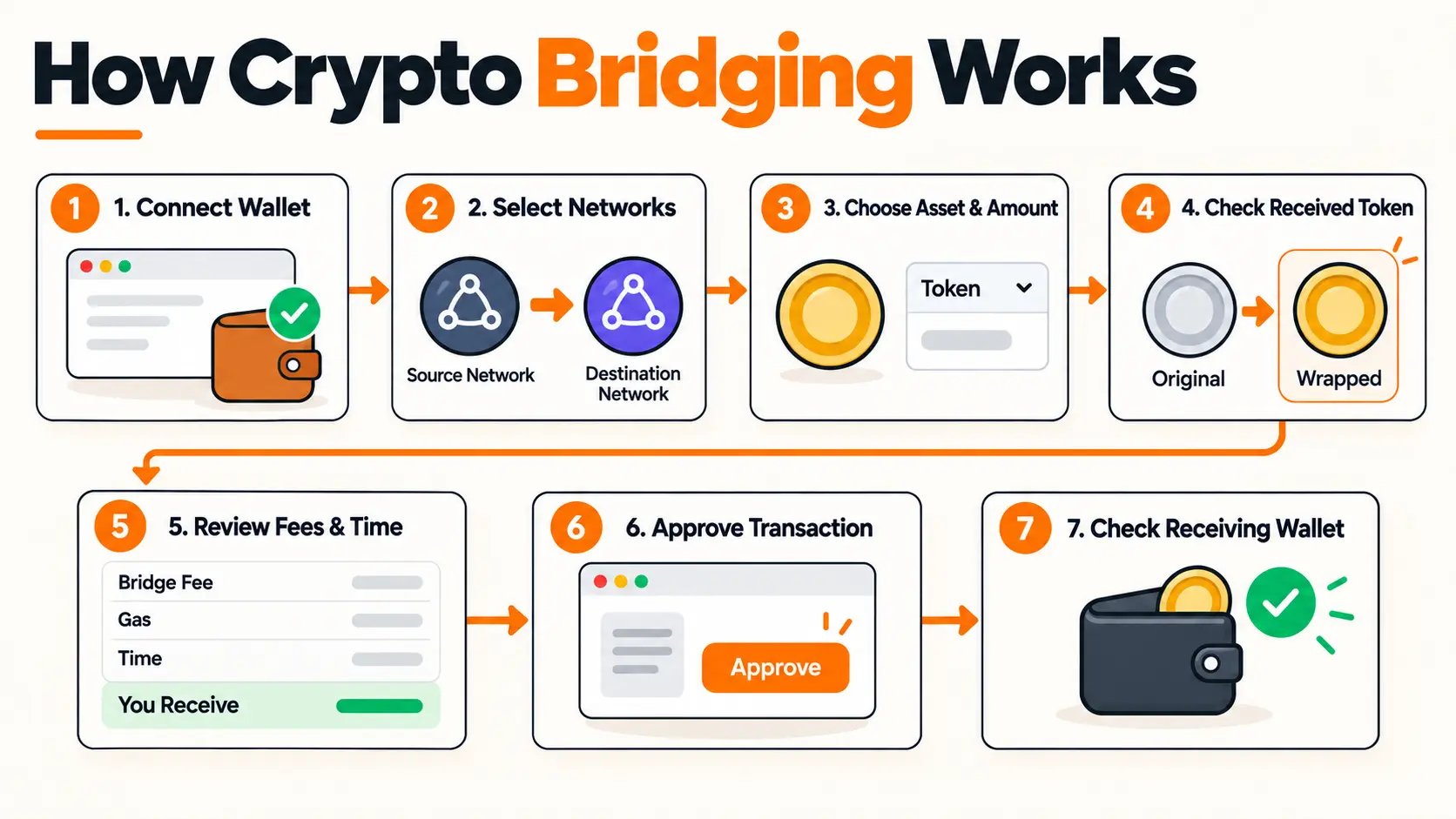
Here is how a typical bridging process works:
Step 1: Open the bridge’s official website and connect your crypto wallet.
Step 2: Select Ethereum as the source network and Solana as the destination network.
Step 3: Choose ETH as the asset and enter the amount you want to bridge.
Step 4: Check which token you will receive on Solana. Depending on the route, it may be a wrapped version of ETH rather than native ETH.
Step 5: Review the bridge fee, Ethereum gas fee, estimated arrival time, and final amount you will receive.
Step 6: Approve and confirm the transaction in your wallet.
Step 7: Wait for the bridge to confirm the transfer, then check your receiving wallet on Solana.
Crypto Bridge Types
Crypto bridges can be grouped by who operates them and how transfers are verified. A bridge may fit into more than one category.
- Native Bridges: Built or officially supported by a blockchain’s development team.
- Third-Party Bridges: Independent protocols supporting transfers across multiple blockchains.
- Trusted Bridges: Rely on a company, custodian, or validator group to approve transfers.
- Trustless Bridges: Use smart contracts and cryptographic verification instead of a central custodian.
How to Choose a Crypto Bridge
Start with the official website of the network you want to use. For example, if you are bridging to Polygon, check whether Polygon provides a native bridge or recommends any third-party bridges. A native or officially supported bridge is usually the most straightforward option for first-time users.
If the network does not provide clear instructions, check its official documentation and community channels. You can ask other users on Discord, but never trust bridge links sent through direct messages. Scammers often impersonate support members and share phishing websites.
For newer networks without a native bridge, consider an established third-party bridge such as Orbiter Finance or use a bridge aggregator to compare available routes. Before connecting your wallet, confirm that the bridge supports both networks and the exact asset you want to transfer. Also check the token you will receive, total fees, recent reviews, and any previous security incidents.
Always confirm the website address through official sources and send a small test transaction before bridging a larger amount.
What Are Bridge Aggregators?
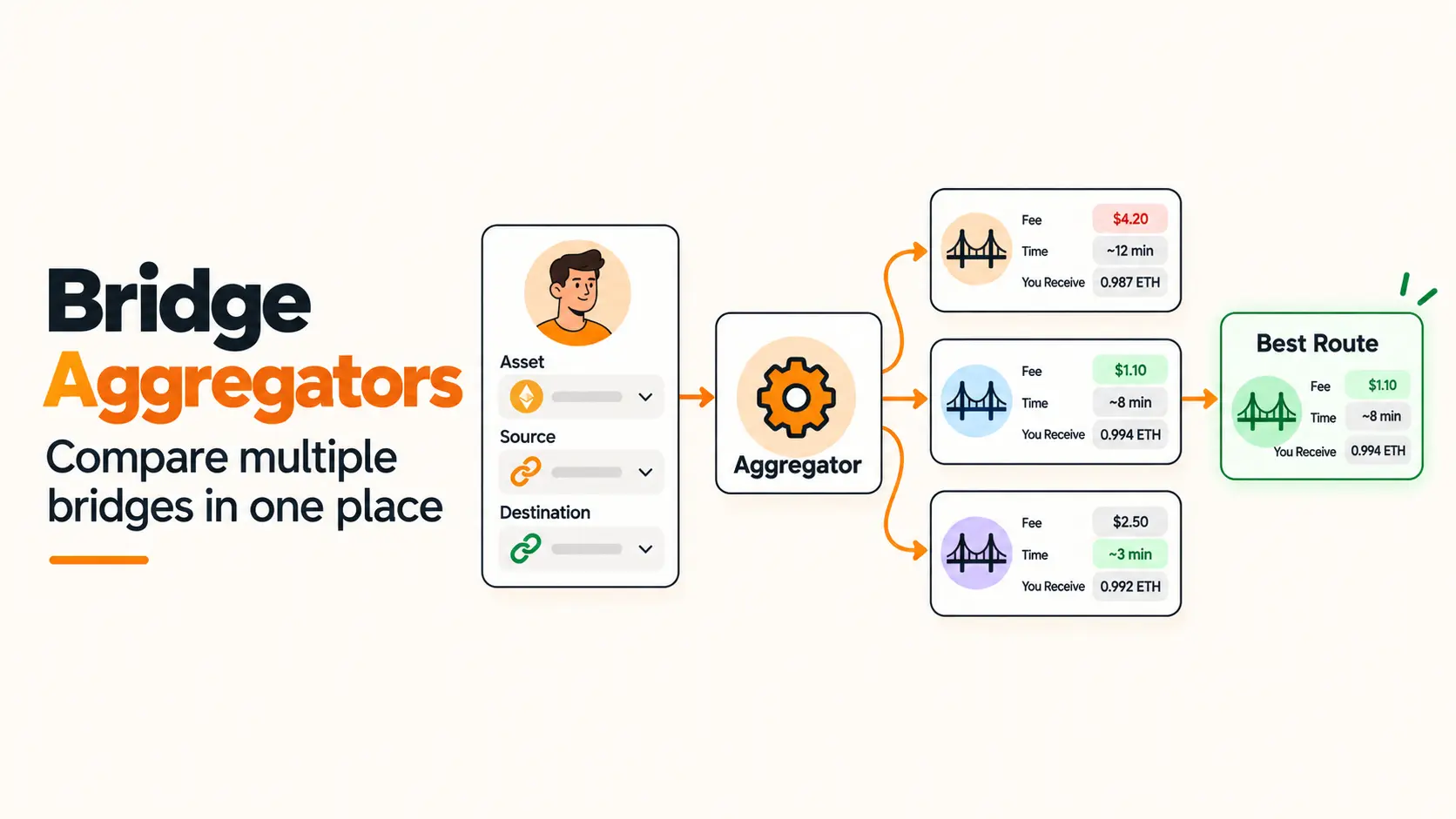
Bridge aggregators are essentially middlemen between you and multiple crypto bridges. Instead of checking each bridge separately, you select the asset, source network, and destination network, and the aggregator searches the available routes for you.
It then compares factors such as fees, transfer time, and the amount you will receive. Examples include LI.FI, Jumper, Squid, and Rango. However, the aggregator usually does not process the transfer itself. Your transaction is routed through one or more underlying bridges.
This makes aggregators more convenient, but they can sometimes cost more because an additional service or integrator fee may be added. However, an aggregator may also find a cheaper route than the one you would have selected manually.
Bridging vs. Swapping
Swapping exchanges one crypto asset for another on the same blockchain, such as ETH for USDC on Ethereum. Bridging moves an asset or its value from one blockchain to another, such as Ethereum to Solana. Swaps are usually faster and cheaper because they do not require cross-chain verification or liquidity.
Crypto Bridging Fees
The total cost depends on the networks, bridge, asset, and selected route.
- Gas fee: Paid to process the transaction on the original network.
- Bridge fee: Charged by the bridge for processing the transfer.
- Liquidity fee: Applied when destination liquidity is used.
- Swap fee: Charged if the asset is exchanged during bridging.
- Aggregator fee: May apply when using a bridge aggregator.
Is Crypto Bridging Safe?
Crypto bridging can be safe, but no bridge is completely risk-free. Security depends on the bridge’s smart contracts, verification method, operators, and past security record. Before transferring funds, confirm the website through official network documentation, check recent audits and incidents, and verify the receiving token. Never use links sent through unsolicited messages. For a new bridge or route, begin with a small test transaction. Using a separate wallet can also reduce exposure if something goes wrong during the bridging process.
Bottom Line
If your assets are on a network such as Ethereum but the exchange, token, or dApp you want to use is on Solana, a crypto bridge connects the two networks. Depending on the bridge, your original tokens may be locked, burned, deposited into a liquidity pool, or matched by a solver. What arrives may be a native or wrapped version of the asset. The complete transaction can include network gas, bridge charges, and other route-specific fees. In simple terms, crypto bridging gives you a way to use your funds outside the blockchain where they currently exist. Bridging can take a few seconds to several hours. The timing depends on the networks, bridge model, congestion, liquidity, and route selected. Check the transaction status using the bridge’s tracker or a blockchain explorer. If the source transaction succeeded but funds did not arrive, contact the bridge through its official support channel. No. The bridge must support the token, source network, and destination network. Some routes may swap your token into another asset during the transfer. Bridge fees can increase due to source-network gas, destination costs, limited liquidity, swaps, or aggregator charges. The cost can change even when bridging the same amount. A confirmed blockchain transaction usually cannot be cancelled. Some pending wallet transactions may be replaced or cancelled, but this does not apply once the bridge has started processing them.
FAQs