What Are xStocks? A Guide to Tokenized Stocks

На этой странице
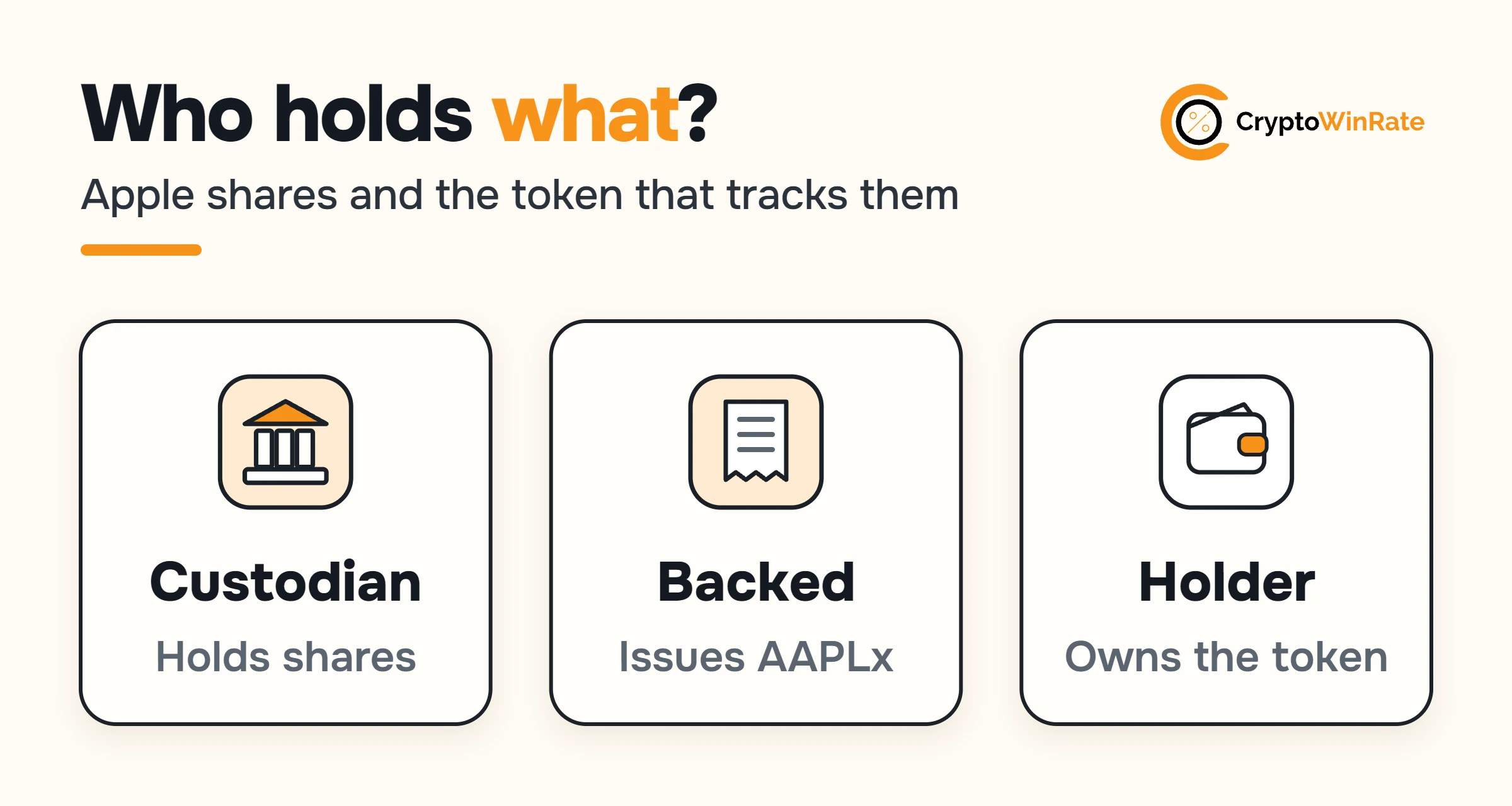
Apple has two tickers you might come across on a trading app. AAPL is a share of Apple. AAPLx is a token issued by another company that tracks Apple’s share price. Both can rise after a strong iPhone earnings report. Only one makes you an Apple shareholder.
xStocks are blockchain tokens that track individual stocks or exchange-traded funds (ETFs). You can buy a fraction, hold it on an exchange, or move it to a compatible wallet where withdrawals are supported. The certificate sets your rights and how dividends are handled. The exchange you use sets the trading hours. Apple xStock product terms
How do xStocks work?
Backed Assets (JE) Limited, a Jersey company, issues xStocks as tracker certificates. For a stock such as Apple, the issuer arranges for actual shares to be bought and held by a custodian. Backed describes the tokens as fully backed. For an ETF token such as SPYx, the backing is shares of the SPDR S&P 500 ETF Trust. You can follow the S&P 500 with one token without buying each company in the index. Issuer FAQ · Prospectus and final terms
Backing matters if the issuer runs into trouble. A security agent can take control of the collateral and distribute proceeds under the prospectus. Recovering money can take time, and the proceeds can fall short. Apple owes its shareholders the rights attached to their shares. Buying AAPLx gives you rights under Backed’s certificate and no vote at Apple’s annual meeting. Kraken risk disclosure
xStocks vs. real stocks
Here’s what changes if you buy a token tracking a U.S. company instead of its common stock through a brokerage.
| Feature | Spot xStock | Common stock at a broker |
|---|---|---|
| What you own | A certificate linked to the share price. | An ownership interest in the company, usually held through your broker. |
| Voting | No vote in the underlying company. | Voting shares generally let you vote by proxy. |
| Dividends | Eligible holders receive the economic benefit through a balance or value adjustment. | A declared cash dividend is generally credited to eligible holders. Many brokers offer optional reinvestment. |
| Trading hours | Depends on the token and venue. Some trade on weekends. | The regular U.S. session runs 9:30 a.m. to 4 p.m. Eastern on trading days. Extended hours depend on the broker. |
| Moving a position | Withdraw to a wallet if the exchange supports that token and network. | Eligible shares can move between brokerage accounts. |
| If an intermediary fails | Recovery depends on the certificate, collateral and custody arrangements. | Eligible assets at a U.S. SIPC-member broker may have protection if the broker fails and assets are missing. Market losses are excluded. |
Investor.gov on stock ownership · NYSE market hours · SIPC coverage
Who gets the dividend?
If the underlying company or ETF declares a dividend, the custodian receives it and the issuer reinvests the amount left after applicable withholding taxes. According to xStocks, you generally need to hold the token before the relevant record date to benefit. The product terms govern eligibility, and processing times vary by platform. Buying a token on the day the company sends cash to shareholders can already be too late. Issuer’s dividend eligibility guide
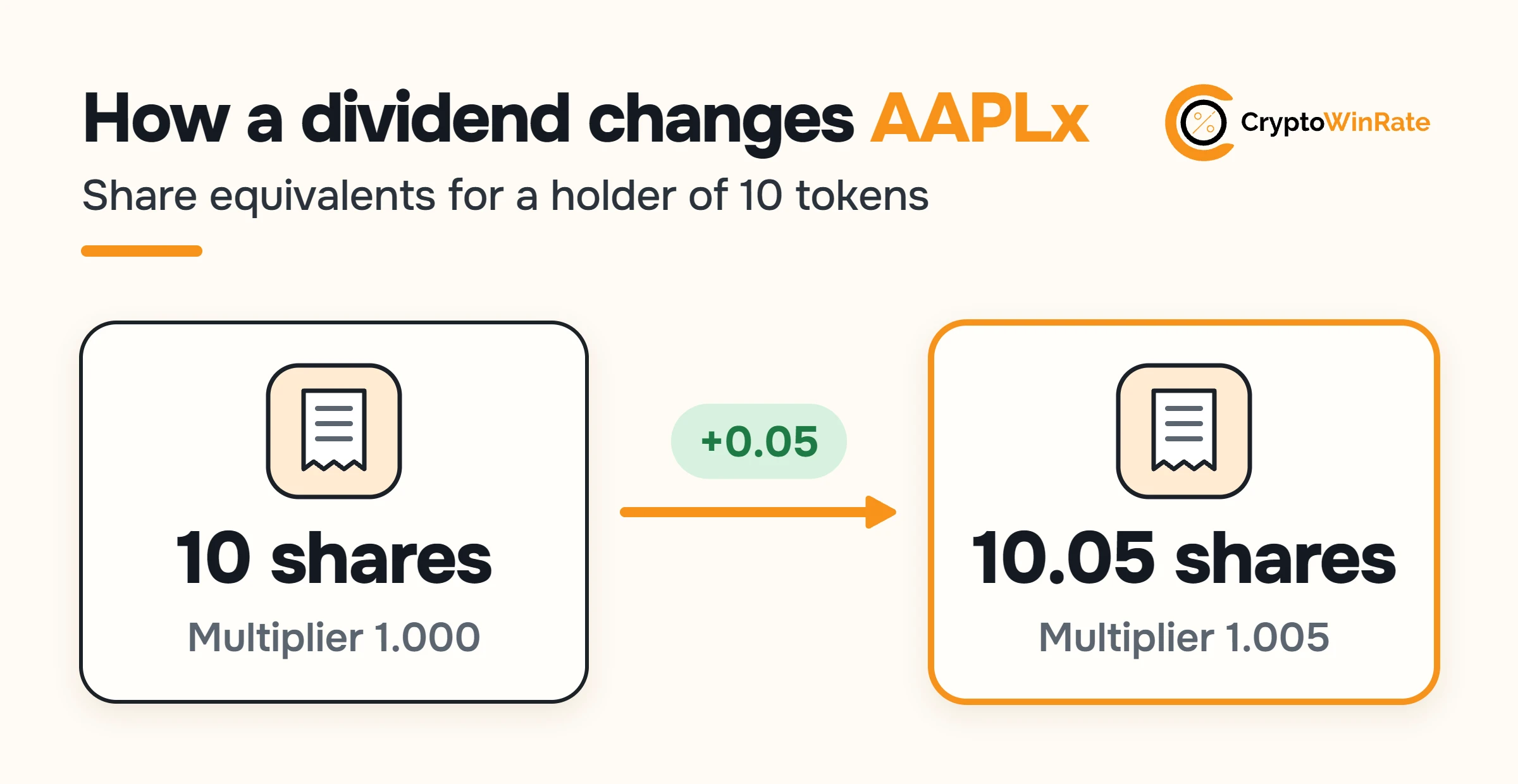
The adjustment is called a rebase. Suppose you hold 10 tokens and the multiplier rises from 1.000 to 1.005 after reinvestment. Your position now tracks 10.05 shares. Kraken may show a larger adjusted balance. Bybit explains that it can keep the token count at 10 and reflect the change in what each token represents. Either way, there’s no cash dividend to withdraw. How the multiplier works · Bybit’s balance treatment
Are xStocks legal where you live?
The issuer says xStocks are unavailable in the United States or to U.S. persons. In the European Economic Area (EEA), Kraken offers them to eligible clients through a Cyprus investment firm regulated under MiFID II. EEA clients must pass a questionnaire and can use fiat currency to buy, sell and convert. Kraken Pro order-book trading is unavailable to them. Kraken also excludes the UK, Canada and Australia. Issuer’s regional disclosures · Kraken eligibility by region
Bybit’s global platform lists the EEA among its excluded regions for xStocks. An eligible customer in Germany, for example, could qualify on Kraken while being unable to place the same order on Bybit. Check the rules for your country and the exchange entity that holds your account. The ability to view a market price tells you very little about eligibility. Bybit’s country restrictions
Where to trade xStocks
Kraken. Eligible clients can buy fractions starting at $1. On Kraken Pro, selected U.S. tokens, including AAPLx and NVDAx, trade through the weekend. Other U.S. listings trade 24 hours on weekdays. Tokens tracking UK and EU shares follow their home exchange’s hours on Kraken. Kraken trading hours and minimums
Bybit. Look under Spot for a pair such as AAPLX/USDT. Eligible verified users can trade these pairs around the clock. Bybit also offers stock perpetuals and contracts for difference (CFDs). Those are separate contracts. A spot purchase gives you the token, while opening a CFD gives you a position whose profit or loss depends on the stock price. Bybit product comparison
Gate, KuCoin and MEXC. Gate and KuCoin list Apple’s AAPLX/USDT spot pair. MEXC’s spot listings include NVDAX for Nvidia. Gate also lists perpetual futures in its xStocks section, so check the market type before entering an order. Gate spot market · KuCoin spot market · MEXC listings
XT.com, Bitrue and LBank also list Apple xStock against USDT. The same ticker can have different bids and offers across venues. Compare the price available for the size of your trade, especially when the underlying stock exchange is closed. XT Apple spot market · Bitrue markets · LBank’s Apple listing
A trading fee is only one part of the cost. Look at the quoted price against the stock price during regular hours, then check the withdrawal fee if you plan to move the tokens. For AAPLx specifically, Backed lists no current management fee but reserves the right to introduce one of up to 0.25% a year. AAPLx fee terms
Pros and cons of xStocks
Pros
- Small positions. Buying a fraction lets you choose a dollar amount even when a single share costs more than you want to spend.
- Wallet transfers. On a supported network, you can hold the token alongside your other assets and move it without transferring a brokerage account.
- Weekend access on selected markets. If news breaks on Saturday, some venues let you adjust your position before the stock exchange reopens.
Cons
- Weekend pricing can be expensive. Fewer orders and no fresh exchange price can widen the gap between the best bid and offer. A limit order lets you set the most you’ll pay, but may never fill.
- Another company stands between you and the asset. Even if Apple remains healthy, a problem at the issuer or custodian could affect what you recover.
- Less control over income and voting. You can’t collect a declared dividend as spending money or vote on a board election. A self-custody wallet also makes you responsible for your keys.
Frequently asked questions
Can I exchange AAPLx for Apple shares?
Buying AAPLx on an exchange doesn’t put Apple shares in your brokerage account. Selling the token on the market is the usual exit. Direct redemption is a separate process for eligible clients who complete the issuer’s checks and meet its minimums. Bybit doesn’t process issuer redemptions. Issuer redemption rules
Does 1:1 backing mean I’ll get the stock’s closing price?
No. Backing describes the assets held in custody. Your sale price depends on the orders available when you sell. On a Sunday, for example, the last official Friday close can be out of date after weekend news. Kraken on price tracking
What happens in a stock split?
In a two-for-one split, each old share becomes two and the price per share roughly halves, all else equal. The issuer adjusts the multiplier to reflect the split. Seeing twice the share-equivalent balance doesn’t mean your investment doubled in value. Issuer’s stock split guide